Complete Guide to Vastu for Plots: Selection, Direction & Design Tips for Maximum Prosperity
Learn Vastu plot selection: facing directions, shapes, entrance placement & more. Free plot analyzer + 20-point checklist. Get started with AI analysis

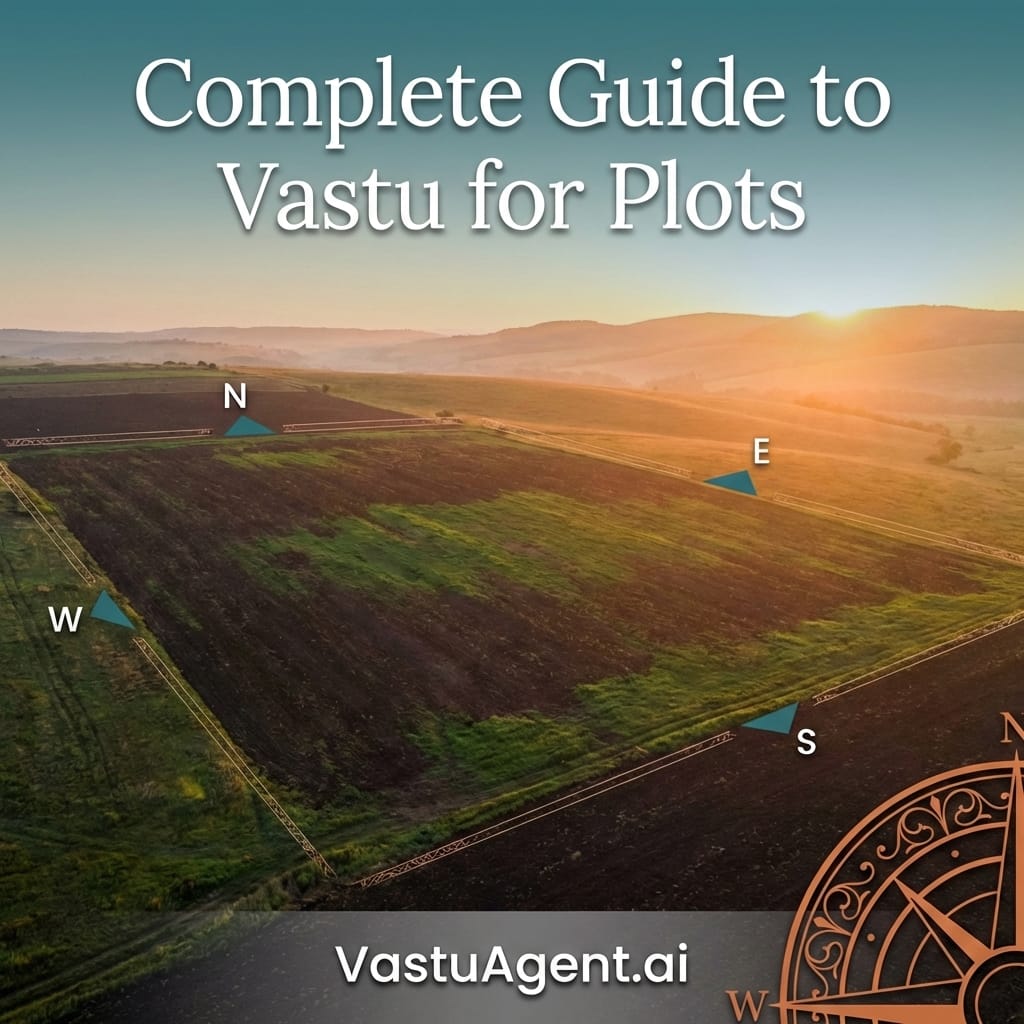
The land beneath your feet determines everything that follows. Before the first brick is laid, before architects draft blueprints, before contractors break ground—the plot itself sets the trajectory for health, wealth, and harmony.
According to ancient Vastu Shastra texts like the Brihat Samhita and Mayamata, selecting the right plot is the single most critical decision in building a home. A perfectly designed house on a poorly chosen plot struggles against natural energies. A modest home on an auspicious plot thrives with minimal effort.
Here's the challenge: most plot selection guides bury you in contradictory rules, leaving you more confused than when you started. What direction should the plot face? Does shape really matter? And what about that T-junction everyone warns against?
This guide cuts through the noise. You'll learn precisely how to evaluate any plot using the same framework Vastu experts have refined over 5,000 years—now enhanced with AI-powered analysis tools that make assessment instant and accurate.
Whether you're purchasing raw land, inheriting property, or evaluating your existing plot, these principles apply. Let's decode the science behind plot selection.
Video Overview
Video overview for Guide to Vastu for Plots
Understanding Vastu Plot Directions: North, South, East & West Explained
Direction forms the foundation of all Vastu analysis. The magnetic axis of the Earth creates predictable energy flows that interact with your plot's orientation. Understanding these flows transforms plot selection from guesswork into science.

North-Facing Plots: The Wealth Magnet
North-facing plots receive the Pranic energy flowing from the magnetic north pole. This energy—associated with Kubera, the deity of wealth—makes northern plots particularly favorable for financial prosperity.
Ideal for: Business owners, entrepreneurs, professionals seeking career growth.
Energy characteristics: The northern zone (Uttara) governs material gains. When your plot faces north, the main entrance naturally aligns with wealth-attracting energies.
Practical benefits: Northern plots receive balanced sunlight throughout the day without harsh afternoon exposure, keeping homes naturally cooler.
East-Facing Plots: Health & Recognition
Eastern plots harness the powerful UV-rich morning sun—the source of Vitamin D, mood regulation, and natural sanitization. Ancient texts call east-facing plots "Suryamukhi" (facing the Sun).
Ideal for: Families with children, health-conscious residents, those seeking professional recognition.
Energy characteristics: East is governed by Indra, the king of deities. This direction brings fame, social standing, and vitality to residents.
Practical benefits: Morning sunlight enters living spaces naturally, reducing electricity costs and creating psychologically uplifting environments.
South-Facing Plots: Stability & Strategy
South-facing plots often carry undeserved negative reputation. When properly designed, they provide exceptional stability and protection for specific purposes.
Ideal for: Certain business categories (especially women-focused enterprises), leaders requiring strong decision-making energy.
Energy characteristics: Ruled by Yama, the deity of dharma and justice. Southern energy governs discipline, responsibility, and structure.
Key consideration: South-facing plots require careful internal layout to ensure heavy structures occupy the southern zones while keeping northern areas light and open.
West-Facing Plots: Prosperity Through Action
Western plots receive the setting sun's infrared-heavy rays. While often considered secondary to north and east, west-facing plots excel for specific applications.
Ideal for: Traders, salespeople, those in hospitality or food industries.
Energy characteristics: West is governed by Varuna, deity of water and cosmic order. This direction supports steady income through consistent effort.
Design requirement: Western plots need thicker, taller boundary walls on the west side to block harsh afternoon heat while retaining morning energy.
Compound Directions: NE, SE, SW, NW
The corner directions carry amplified characteristics of their adjacent cardinals:
| Direction | Governing Deity | Element | Best Plot Usage |
|---|---|---|---|
| Northeast (Ishaan) | Shiva | Water | Spiritual practices, learning centers |
| Southeast (Agni) | Fire deity | Fire | Commercial, manufacturing |
| Southwest (Nairutya) | Earth | Earth | Stability-focused residences |
| Northwest (Vayu) | Wind deity | Air | Guest houses, transit properties |
The Northeast deserves special attention. Every Vastu text emphasizes that plots extended toward the northeast bring "immense prosperity, spiritual growth, and health." Conversely, a plot with a cut or missing northeast corner—described as a "headless body" in classical texts—should be avoided entirely.
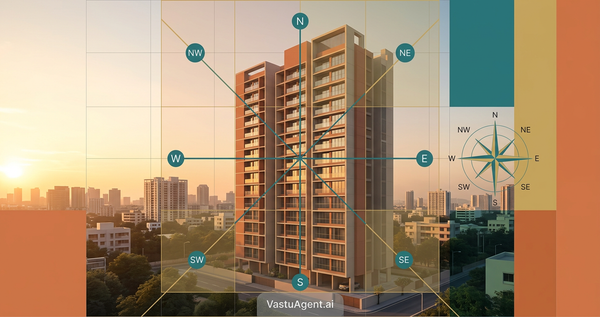
🧭 Not sure which direction your plot faces? VastuAgent.ai's Vastu Chakra tool determines precise plot orientation using satellite data and compass calibration—no manual measurement needed.
→ Try Vastu Chakra: vastuagent.ai/vastu-chakra
Vastu Plot Shape Analysis: Which Shapes Build Prosperity
Geometry determines how energy distributes across your plot. The Vastu Purusha Mandala—the cosmic energy grid underlying all Vastu—is fundamentally square. Your plot's shape determines how well it resonates with this universal template.
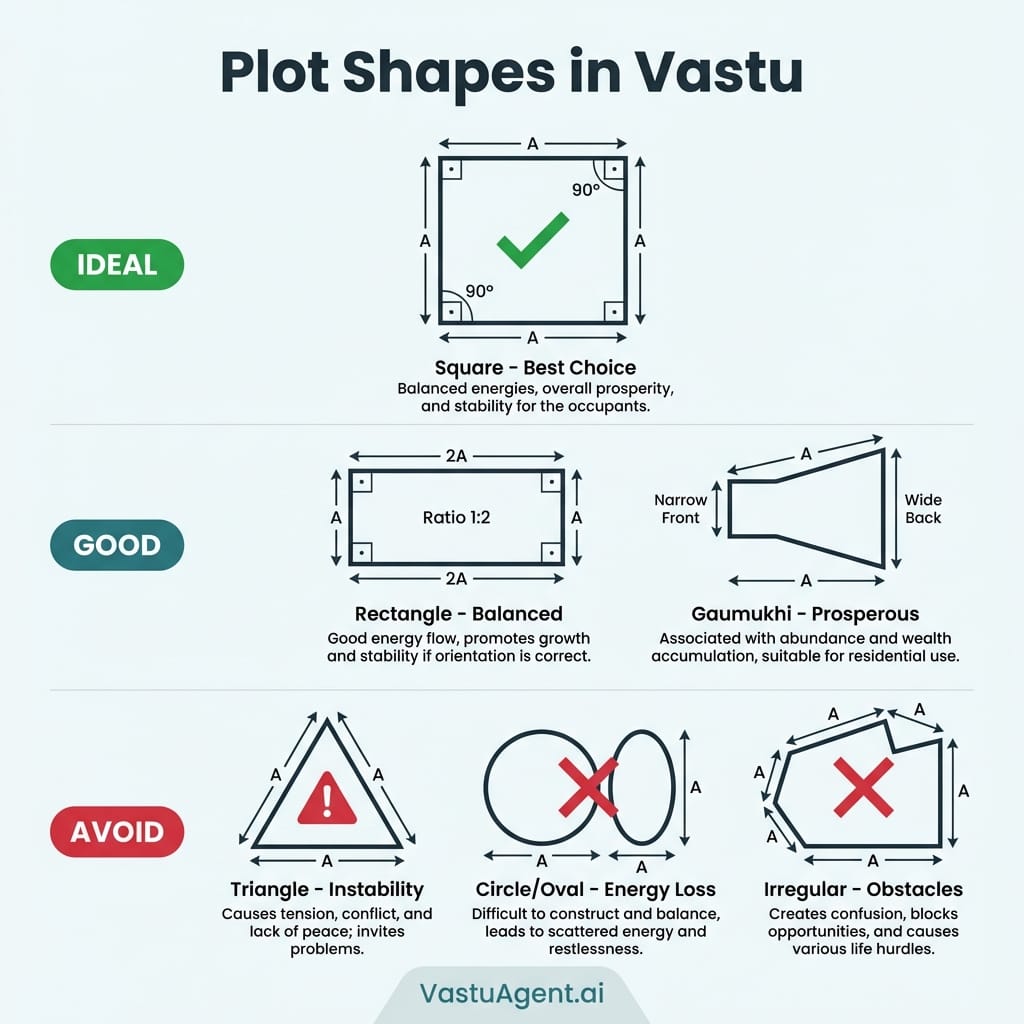
Square Plots: The Gold Standard
A plot where all four sides are equal and angles measure exactly 90° represents the "perfect" Vastu configuration. The Brihat Samhita states that square plots ensure "all-round prosperity, health, and happiness."
Why squares work: Energy lines within a square maintain equal field strength in all directions. The plot functions like a perfectly tuned receiver, capturing cosmic energy without distortion. Think of it as an antenna optimized for the frequency of the Vastu Purusha Mandala.
Practical verification: Measure all four corners with a builder's square. Even small deviations (2-3 degrees) can be corrected during boundary wall construction.
Rectangular Plots: The Practical Choice
Rectangular plots with length-to-width ratios of 1:2 or less rank second only to squares. They bring financial growth and are far more commonly available in urban markets.
Orientation matters: The longer axis should ideally run North-South. This orientation maximizes morning sun exposure while minimizing harsh western afternoon light.
Energy consideration: In rectangles, energy lines must stretch to meet the corners. As the ratio increases beyond 1:2, field strength decreases. Plots narrower than 1:2.5 require careful remedy application.
Gaumukhi (Cow-Faced) Plots
Plots narrow at the front and wide at the rear carry the auspicious "Gaumukhi" designation—named for the sacred cow's shape. These plots excel for residences under specific conditions.
Auspicious only when: The road faces the South or West side. If the road faces North or East, this shape loses its beneficial properties.
Best for: Families seeking wealth accumulation over time. The widening rear symbolically represents expanding prosperity.
Shapes to Absolutely Avoid
Classical Vastu texts unanimously condemn certain geometries:
Triangular plots: Associated with fire hazards, legal disputes, and family discord. The Vishwakarma Prakash specifically warns of "harassment from authorities" and financial instability.
Circular/oval plots: Create restlessness and instability. Unless your building design is also circular (rare in residential construction), these plots produce disharmony between land and structure.
Cart-shaped or drum-shaped plots: The Mayamata classifies these as "Mridangakaar"—bringing severe suffering and wealth loss.
Irregular plots with multiple angles: Each additional corner beyond four creates energy leakage points. Octagonal plots carry mixed interpretations across texts, but plots with random, asymmetric angles universally predict instability.
📐 Uncertain about your plot's geometry? Upload your plot survey document to VastuAgent.ai's Floor Plan Optimizer. The AI identifies shape irregularities and recommends corrections.
→ Analyze Your Plot: vastuagent.ai/floor-plan-optimizer
Soil Quality & Land Slope in Vastu: The Bhumi Pariksha
Before purchasing any plot, traditional Vastu prescribes Bhumi Pariksha—comprehensive land testing that examines soil composition and topography.
The Pit Test: Ancient Soil Assessment
Dig a pit measuring 2 × 2 × 2 feet. Remove all soil, then refill the pit with the same earth.
Prosperous indication: Excess soil remains after refilling—the land holds energy well.
Warning sign: Insufficient soil to fill the pit—the land drains energy and invites loss.
Additional observations: Soil that smells sweet and appears white benefits intellectual pursuits. Reddish soil with iron undertones suits leadership-oriented residents. Yellow soil with pleasant fragrance supports commercial success.
Avoid immediately: Land containing ash, bones, hair, charcoal deposits, or active termite mounds. These indicate previous negative use or ongoing energy depletion.
Slope Directions: Where Energy Flows
Land topography determines how solar and magnetic energies interact with your plot. The general principle: facilitate energy inflow from beneficial directions while blocking or anchoring energy in others.
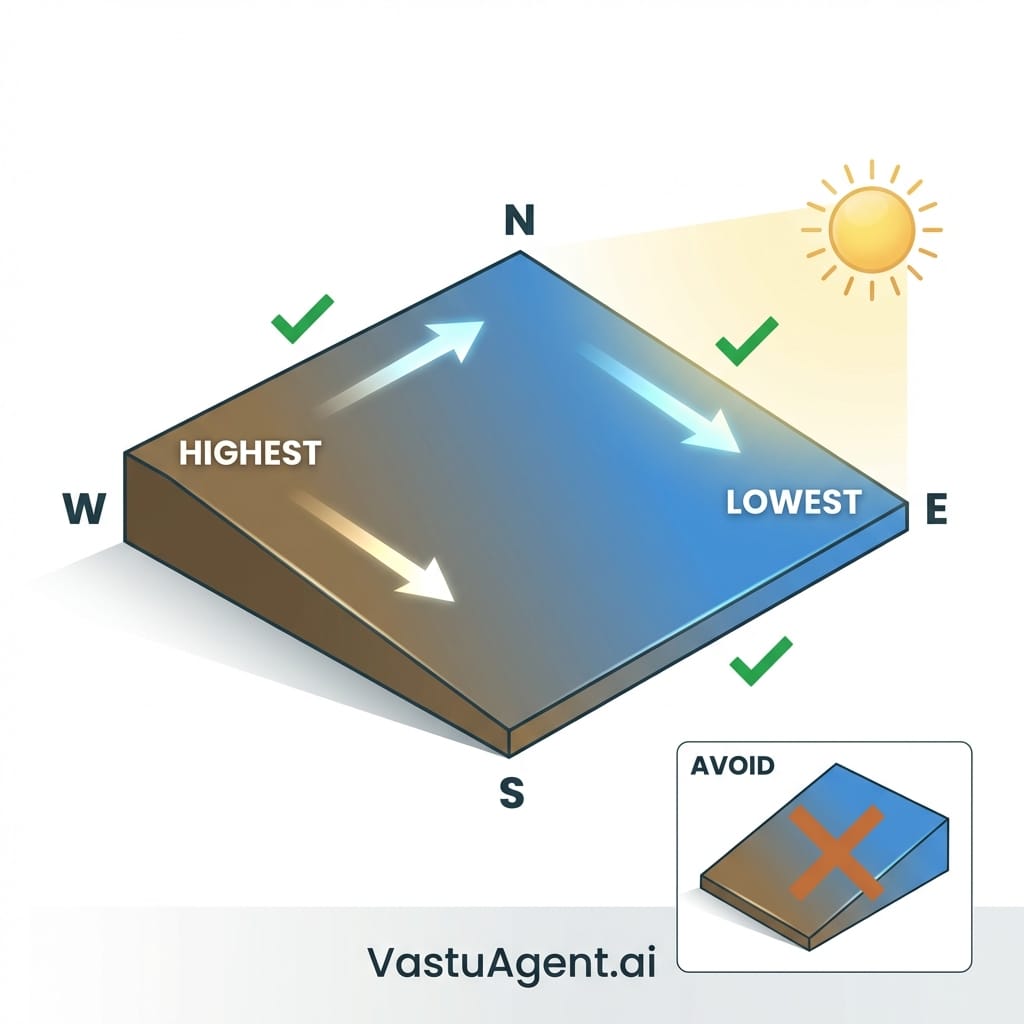
Ideal slopes:
| Slope Direction | Effect | Rating |
|---|---|---|
| Downward toward North | Wealth accumulation | ✅ Excellent |
| Downward toward East | Health, recognition | ✅ Excellent |
| Downward toward Northeast | Spiritual growth, prosperity | ✅✅ Best |
| Elevated South/West/Southwest | Energy retention, stability | ✅ Excellent |
Gajprishtha (Elephant's Back): Land elevated in South, West, Southwest, and Northwest represents the most auspicious topography. The Mayamata associates this configuration with "longevity and increasing wealth."
Kurmaprishtha (Tortoise's Back): Land elevated in the center and sloping down on all sides brings "enthusiasm, comfort, and prosperity."
Dangerous Slope Patterns
Daitya Prishtha (Demon's Back): Land sloping downward toward South or West causes the "loss of wealth, cattle, and children." This configuration drains positive energy and should be rejected regardless of other favorable features.
Central depression: A plot depressed in its center—the Brahmasthan zone—is described as "worst of all" in every major Vastu text. Such plots lead to total destruction and bankruptcy.
If you're evaluating a sloping plot, use this quick test: place a ball in the center. Where does it roll? Northeast movement signals prosperity. Southwest movement demands caution.
🏠 Need accurate slope analysis? VastuAgent.ai's comprehensive Vastu report includes topographical assessment based on your uploaded site images and survey data.
→ Get Your Free Report: vastuagent.ai/free-report
Plot Entrance & the 32 Pada System
The main entrance location determines how energy enters your property. Vastu divides the plot perimeter into 32 equal segments called padas, each governed by a specific deity with distinct characteristics.
Understanding the Pada Grid
Imagine dividing each side of your plot into 8 equal parts. This creates 32 entrance positions around the perimeter:
- North side: Padas 1-8 (Shikhi to Mukhya)
- East side: Padas 9-16 (Bhallat to Vitatha)
- South side: Padas 17-24 (Gruhakshat to Gandharva)
- West side: Padas 25-32 (Yama to Roga)
Best Entrance Positions by Direction
North-facing plots: Position your entrance in padas 4, 5, or 6 (Mukhya, Bhallat, or Soma zones). These bring wealth, recognition, and family prosperity.
East-facing plots: Pada 12 (Jayant) or pada 13 (Indra) create the most auspicious entrances—bringing fame and divine protection.
South-facing plots: If unavoidable, padas 20 or 21 (Vitatha or Gruhakshat) offer the least negative impact. Southern entrances require additional remedies.
West-facing plots: Padas 28 or 29 (Sugriva or Pushpadanta) support financial gains through trade.
Entrances to Avoid Absolutely
Certain padas carry severe negative predictions across all classical texts:
| Pada | Location | Effect |
|---|---|---|
| 17 (Yama) | South, 1st segment | Death-related issues |
| 25 (Nairitya) | Southwest corner | Destruction, bankruptcy |
| 32 (Roga) | West, last segment | Chronic illness |
| 1 (Shikhi) | North, first segment | Fire hazards |
The exact center of any side should also be avoided—energy enters too rapidly, creating instability.
Measuring Your Entrance Pada
To identify your current or planned entrance pada:
- Measure your plot's perimeter length
- Divide the relevant side into 8 equal segments
- Mark which segment contains your main gate
- Cross-reference with the deity chart
This calculation requires precision—a few feet can shift you from an auspicious pada to a problematic one.
🕉️ Want to identify your exact entrance pada? VastuAgent.ai's Vastu Purusha tool overlays the complete 32-pada grid onto your plot plan, highlighting your entrance position instantly.
→ Explore Vastu Purusha: vastuagent.ai/vastu-purusha
The Brahmasthan: Why Your Plot's Center Matters
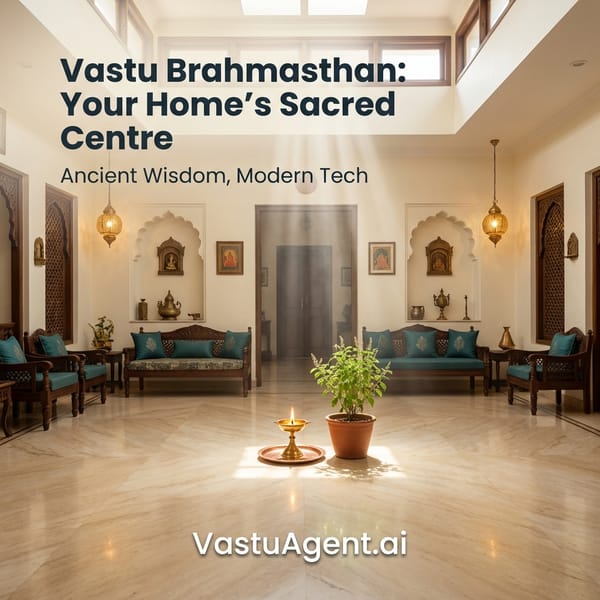
The Brahmasthan represents the energetic navel of your plot—the central zone where all cosmic forces converge. In the Vastu Purusha Mandala, this area occupies the central 9 cells of the 81-cell grid.
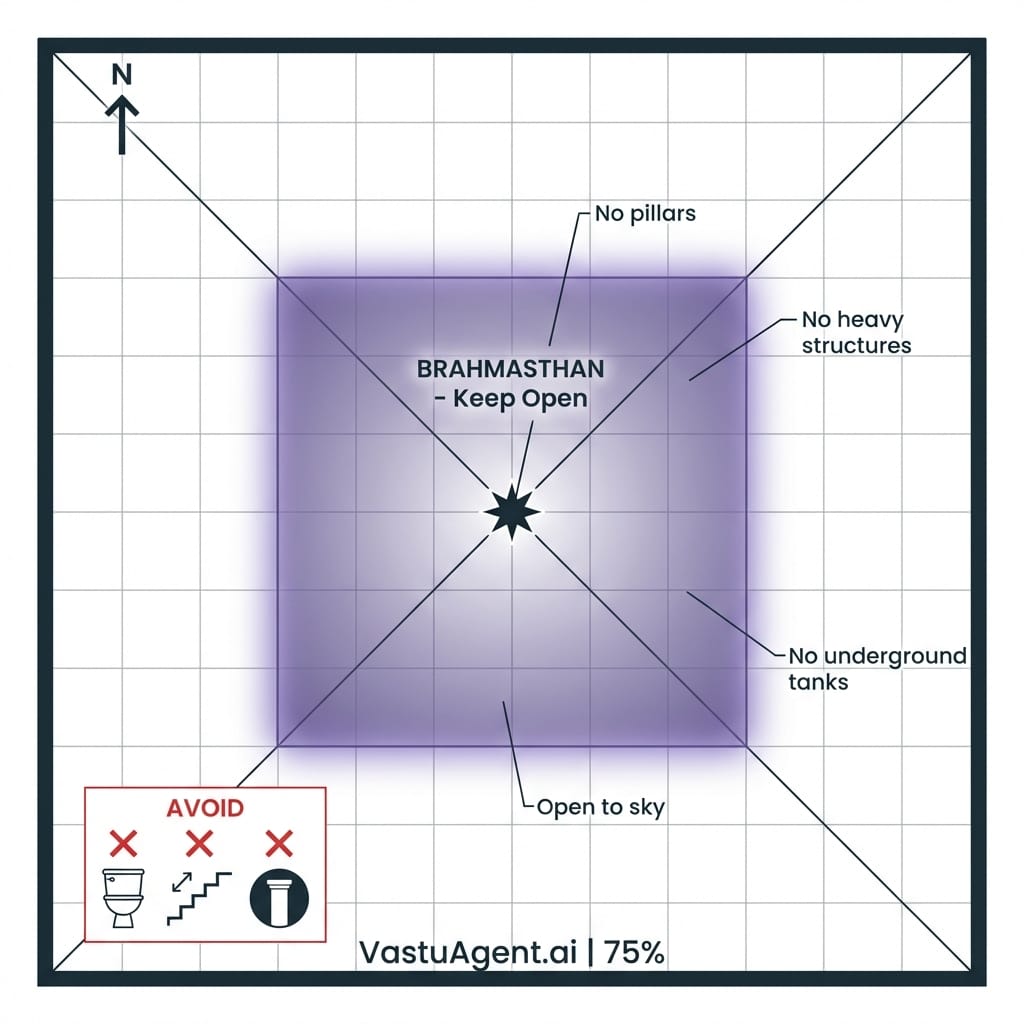
Locating the Brahmasthan
For any plot:
- Draw diagonal lines connecting opposite corners
- The intersection point marks the Brahmasthan center
- Extend this point into a zone covering roughly 9% of the total plot area
On a square 60' × 60' plot, the Brahmasthan measures approximately 20' × 20' centered in the plot.
What Belongs in the Brahmasthan
The Brahmasthan should remain:
- Open to the sky (no roof covering)
- Light and unobstructed (no heavy structures)
- Free of pillars (even single columns disrupt energy)
- Without underground water tanks or septic systems
Ideally, this zone functions as a courtyard, lawn, or open-air meditation space. Traditional Indian homes featured central courtyards precisely for this purpose.
Brahmasthan Violations and Their Effects
A blocked or burdened Brahmasthan creates various problems:
Heavy construction: Weakens the family patriarch's authority and health.
Staircase placement: Creates constant instability and frequent relocations.
Toilet/bathroom: Leads to chronic illness and financial drainage.
Underground water tank: Causes severe mental health issues and family discord.
Depression or pit: The most severe violation—associated with "total destruction" in classical texts.
Remedies for Existing Violations
If you've already built on the Brahmasthan:
- Install a crystal pyramid at the exact center point
- Place a brass kalash (pot) filled with water and topped with mango leaves
- Keep the area well-lit—continuous lighting compensates for overhead obstruction
- Paint the ceiling white to symbolically create sky openness
These remedies reduce negative effects but cannot fully replicate an open Brahmasthan.
✨ Wondering if your Brahmasthan is compromised? Upload your floor plan to VastuAgent.ai. The AI instantly identifies center-point violations and recommends specific remedies.
→ Check Your Brahmasthan: vastuagent.ai/floor-plan-optimizer
External Elements: Roads, Neighbors & Environment
Your plot exists within a larger context. Surrounding roads, neighboring structures, and environmental features significantly influence energy flow.
Road Positions and Veedi Shoola
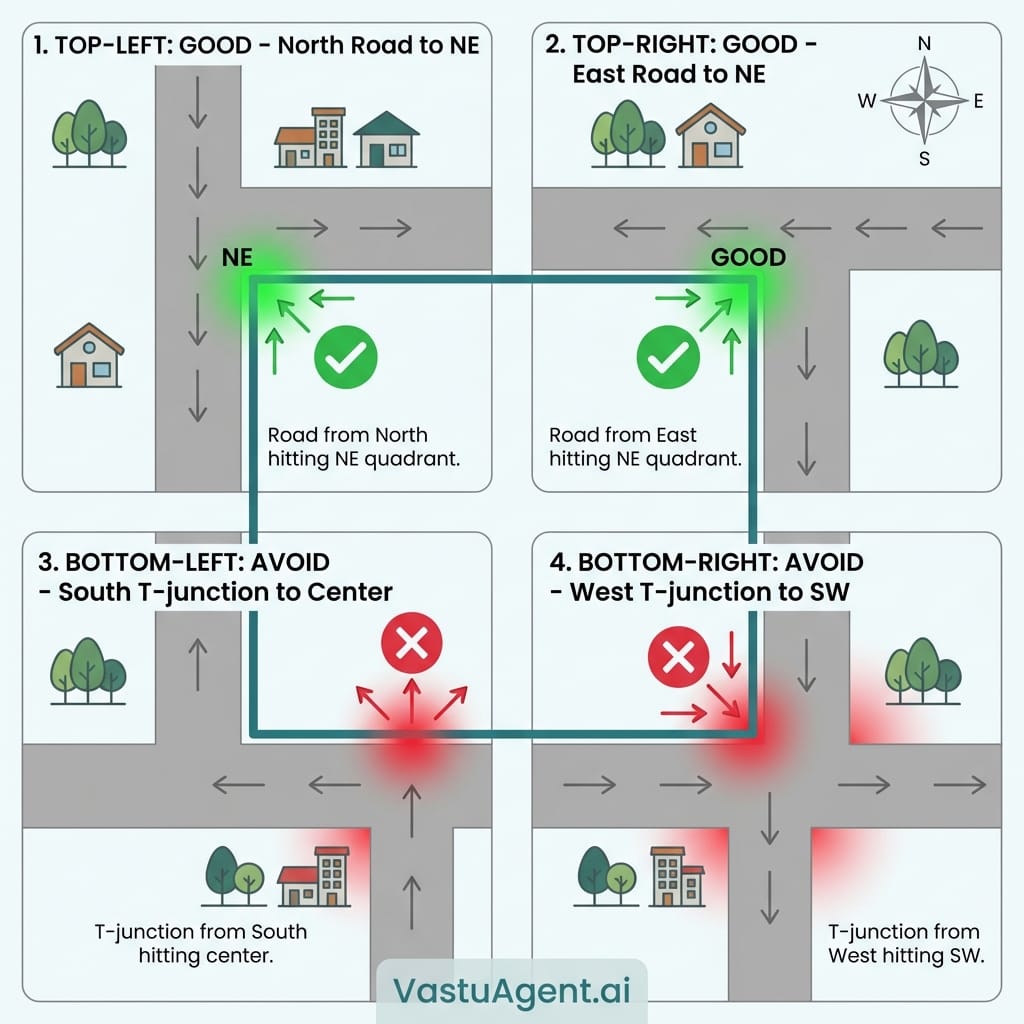
Veedi Shoola occurs when a road directly "hits" your plot—the road terminates at your property or a T-junction points toward your entrance.
Auspicious road thrust:
- Road hitting from North or East toward the Northeast quadrant brings wealth and opportunity
- Road from East toward the eastern half of your plot supports recognition
Dangerous road thrust:
- Road pointing at the center of any side creates instability
- T-junction hitting Southwest, South center, or West center causes accidents, financial loss, and legal troubles
- Road pointing at the main entrance (especially from South or West) brings constant challenges
Four-Sided Road Plots
Plots surrounded by roads on all four sides represent the most auspicious configuration when the plot size exceeds the roads' width. Such plots receive balanced energy from all directions.
Important: The plot must be elevated relative to the surrounding roads. A four-sided plot sitting lower than its roads accumulates stagnant energy.
Neighboring Structures
Survey adjacent properties before purchasing:
Favorable neighbors:
- Temples to the North or East (amplifies positive energy)
- Open land or parks to the North and East
- Lower buildings to the North and East than South and West
Unfavorable neighbors:
- Taller buildings directly North or East (blocks beneficial energy)
- Funeral homes, graveyards, or hospitals in direct line of sight
- Industrial facilities producing noise, smoke, or vibration
Environmental Factors
Water bodies: Lakes, rivers, or ponds to the North or Northeast enhance prosperity. Water to the South or Southwest drains energy.
Large trees: Beneficial in South and West zones (provides shade and stability). Avoid large trees in the Northeast—they block energy inflow.
Power lines: Overhead high-tension wires crossing the plot create electromagnetic disturbance. Underground utilities are preferred.
📊 Need comprehensive external analysis? VastuAgent.ai's detailed report evaluates road positions, surroundings, and environmental factors using satellite imagery.
→ Get Complete Analysis: vastuagent.ai/free-report
Common Plot Defects & Practical Solutions
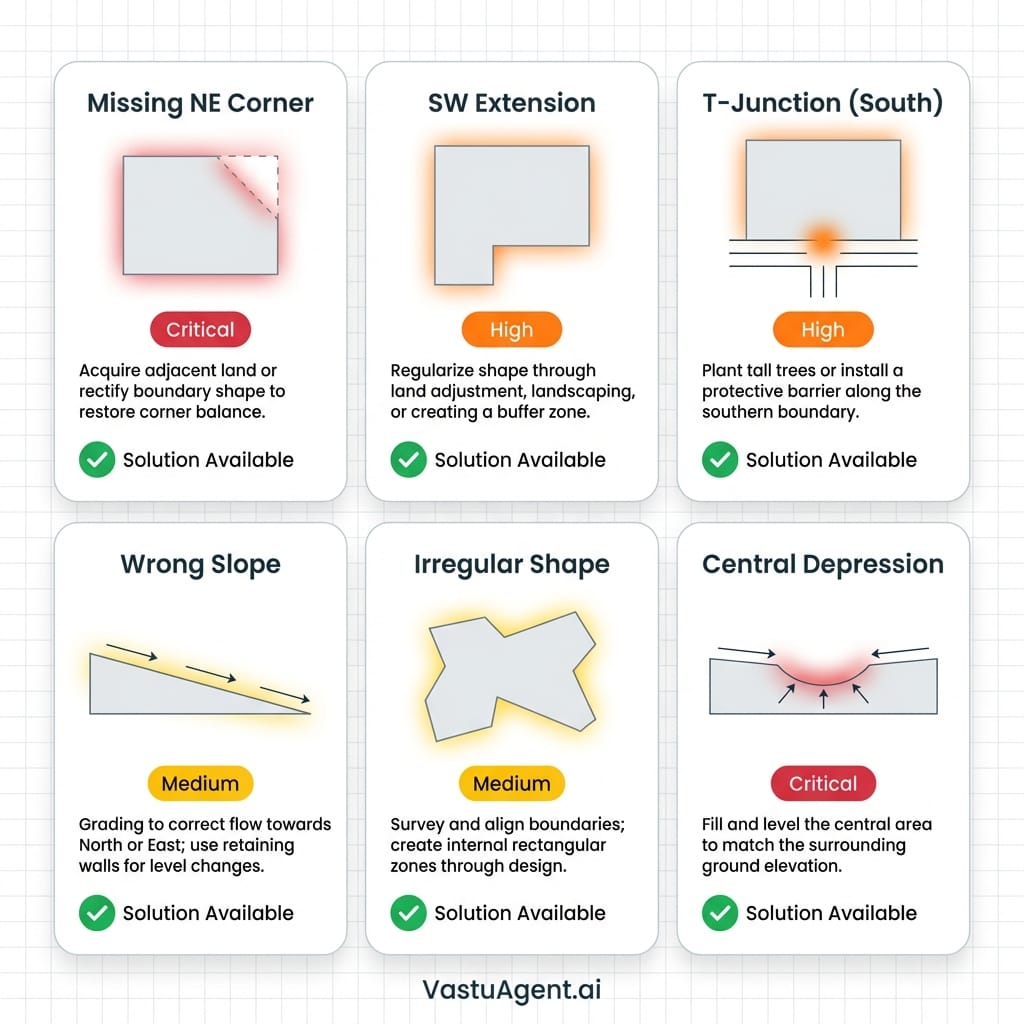
Perfect plots rarely exist in today's real estate market. Understanding common defects—and their remedies—helps you make informed decisions about imperfect options.
Missing Corners
Northeast cut: The most severe defect. A plot missing its northeast corner lacks the water element zone entirely. Residents experience blocked finances, health issues, and spiritual disconnection.
Remedy: Extend the boundary wall to create a symbolic northeast. Plant a Tulsi plant at the reconstructed corner. Install underground water storage in the nearest possible northeast location.
Southwest cut: Missing southwest destabilizes family authority. The household lacks grounding.
Remedy: Build a heavy structure (storage room, water tank) at the nearest southwest point. Raise the southwest ground level if possible.
Extended Corners
Northeast extension: The only beneficial extension. This plot shape brings exceptional prosperity.
Southwest extension: Creates serious problems—accidents, illness, authority challenges.
Remedy: Symbolically "cut" the extension by not using the extended portion for living spaces. Convert to garden or storage. Paint boundary walls in yellow or earth tones.
T-Junction Plots
T-junction plots face a road that terminates at the property—creating concentrated energy thrust.
If thrust comes from North or East toward Northeast: Actually beneficial for wealth.
If thrust comes from South, West, or toward center: Requires significant intervention.
Remedies:
- Install a convex mirror facing the road to deflect energy
- Build a thick boundary wall with rounded top (softens energy impact)
- Plant thorny hedges (like bougainvillea) along the affected boundary
- Place a brass trident (trishul) at the entry point
Sloping Toward Wrong Direction
Plots sloping toward South or West drain positive energy.
Remedies:
- Raise the South and West boundaries with taller walls or earth berms
- Create artificial elevation in the Southwest corner
- Install heavy outdoor furniture in the southwestern zone
- Dig a small water feature in the Northeast to counterbalance
Irregular Shapes
Plots with 5+ sides or random angles require correction before construction.
Approach: Identify the largest rectangular or square area within the plot. Use this area for the main structure. Remaining irregular sections become gardens, parking, or auxiliary buildings.
⚠️ Concerned about your plot's defects? VastuAgent.ai identifies every defect and generates prioritized remedy recommendations specific to your plot configuration.
→ Get Your Defect Report: vastuagent.ai/floor-plan-optimizer
The 20-Point Plot Selection Checklist
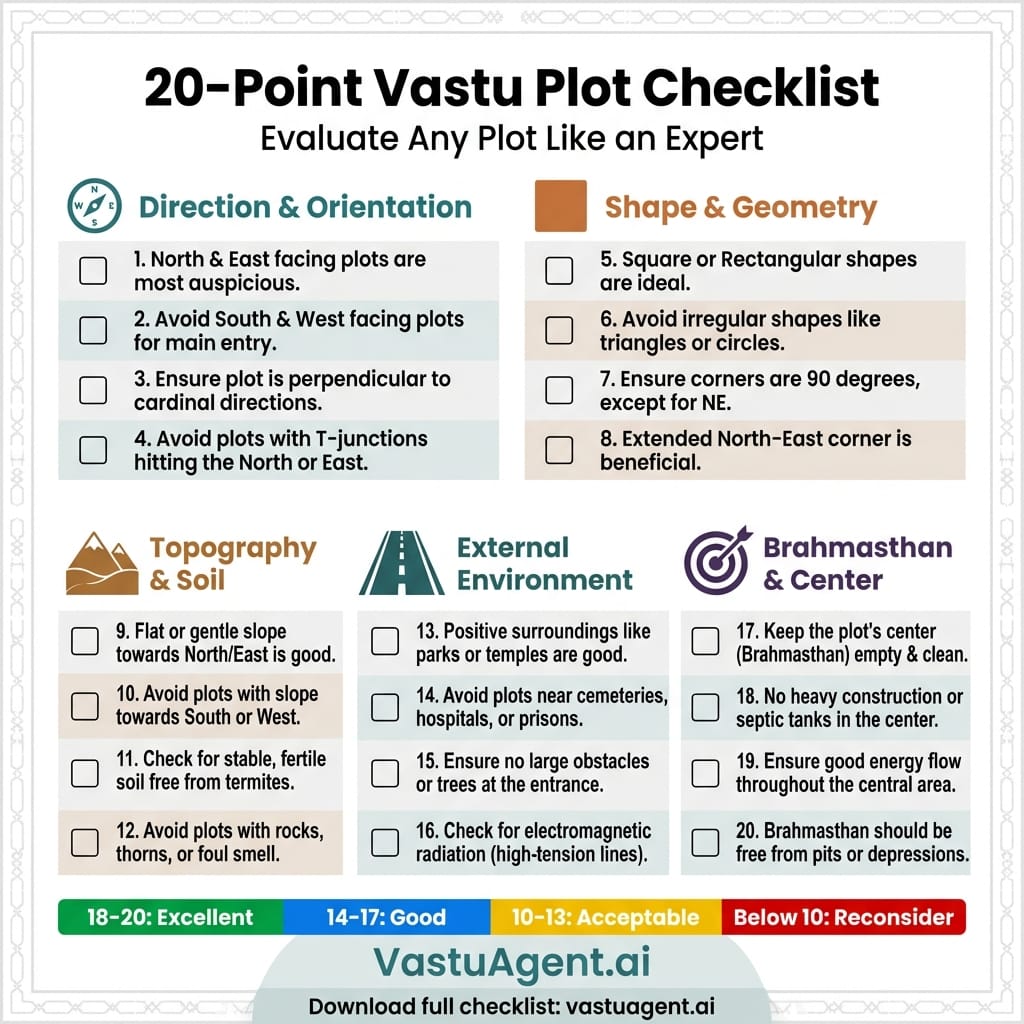
Use this systematic evaluation framework when assessing any plot:
Direction & Orientation (5 Points)
- ✅ Plot faces North, East, or Northeast (preferred)
- ✅ Magnetic axis alignment within 22.5° of cardinal directions
- ✅ No obstructions blocking morning sunlight
- ✅ Entrance pada falls in auspicious zone for the direction
- ✅ Road position supports (not opposes) the facing direction
Shape & Geometry (5 Points)
- ✅ Square or rectangular with ratio 1:2 or better
- ✅ All corners at 90° (or correctable during construction)
- ✅ No missing corners (especially Northeast)
- ✅ No problematic extensions (especially Southwest)
- ✅ Clear boundaries—no disputed edges or encroachments
Topography & Soil (4 Points)
- ✅ Slope toward North, East, or Northeast
- ✅ Southwest is the highest point
- ✅ Soil passes the pit test (excess soil after refill)
- ✅ No contamination, bones, ash, or termite activity
External Environment (4 Points)
- ✅ No T-junction hitting center, South, or West
- ✅ No taller obstructions to North or East
- ✅ No negative neighbors (crematoriums, hospitals, factories)
- ✅ Water bodies (if any) to North or East
Brahmasthan & Center (2 Points)
- ✅ Center zone is accessible (not landlocked by irregular shape)
- ✅ No existing underground obstructions at center
Scoring:
- 18-20 points: Excellent plot—proceed confidently
- 14-17 points: Good plot—minor remedies needed
- 10-13 points: Acceptable—significant remedies required
- Below 10: Reconsider purchase unless price compensates heavily
✏️ Want to design a Vastu-compliant layout for your plot? VastuAgent.ai's Floor Plan Generator creates optimal room arrangements based on your specific plot shape and direction.
→ Generate Your Design: vastuagent.ai/floor-plan-generator
Vastu Considerations for New Home Construction
If you're building from scratch, plot selection represents your single greatest opportunity to ensure lifelong Vastu compliance.

Work With Your Builder Early
Present Vastu requirements before architectural drawings begin. Retrofitting Vastu principles into completed plans is expensive and often impossible.
Key discussions:
- Entrance position based on pada calculations
- Room placement by zone (kitchen in Southeast, master bedroom in Southwest)
- Brahmasthan keeping open (no staircase or pillars in center)
- Boundary wall heights (taller in South and West)
Construction Sequence
Traditional Vastu prescribes specific construction order:
- Begin excavation in the Northeast—this zone should be dug deepest and first
- Lay foundation in the Southwest—heavy construction starts here
- Complete the Southwest quadrant before Northeast construction
- Keep Northeast construction light and complete it last
This sequence ensures the finished structure is "heavy" in the Southwest and "light" in the Northeast—optimal energy distribution.
ROI of Vastu Compliance
Beyond spiritual benefits, Vastu-compliant properties command market premiums:
- 5-10% higher resale values in Indian markets
- Faster sales cycles—73% of Indian buyers prefer Vastu-compliant homes
- Reduced renovation costs—proper initial design eliminates future corrections
- Better natural ventilation and lighting—lower energy bills
The marginal cost of building Vastu-compliant from the start is far lower than remediation after construction.
Frequently Asked Questions
Q: What is the best plot facing direction in Vastu?
North and East-facing plots are traditionally considered most auspicious. North attracts wealth energy (governed by Kubera), while East brings health and recognition through morning sunlight. However, any direction can be made positive with proper internal design—what matters most is correct entrance positioning and room layout.
Q: Can a triangular plot be corrected for Vastu compliance?
Triangular plots present severe challenges. The most practical remedy is identifying the largest rectangular area within the triangle and restricting all construction to that zone. The remaining triangular portions become gardens or parking. Complete correction is impossible without significant land modification.
Q: How do I find the exact Brahmasthan on an irregularly shaped plot?
Draw the smallest rectangle that contains your plot. The Brahmasthan is the center of this rectangle, not necessarily the center of your actual plot boundaries. For complex shapes, VastuAgent.ai's tools calculate precise Brahmasthan location accounting for irregular geometries.
Q: Is a T-junction plot always bad?
Not always. If the road thrust comes from the North or East and hits the Northeast quadrant of your plot, it actually enhances prosperity. T-junctions become problematic when thrust comes from South or West, or hits the center of any boundary. Remedy effectiveness depends on thrust direction and intensity.
Q: Should I reject a plot with Southwest extension?
Southwest extension is serious but not necessarily disqualifying if the price is right and you implement remedies. Avoid building living spaces in the extended portion. Convert it to garden or heavy storage. Paint walls in earth tones. The key is preventing family members from occupying that zone regularly.
Q: What's the ideal plot size for a residence?
Vastu doesn't prescribe specific sizes but emphasizes proportions. Rectangular plots should maintain 1:2 ratio or better. The Aaya calculation (plot dimensions multiplied and divided by specific factors) determines compatibility with the owner's birth details—VastuAgent.ai's calculator automates this complex formula.
Q: Can I buy land adjacent to my existing plot?
Purchase adjacent land only if it lies to your North, East, or Northeast. Land to the South, West, or Southwest of your existing property brings misfortune according to classical texts—even if offered free. Expansion should always occur in auspicious directions.
Q: How important is soil testing (Bhumi Pariksha)?
Extremely important for new construction. The pit test reveals soil energy retention. Additionally, look for natural vegetation—healthy, diverse plant life indicates positive earth energy. Barren land or land where plants struggle suggests energy depletion.
Q: What if my plot entrance falls in a bad pada?
If you've already purchased, consider creating a secondary entrance in a better pada and using it as your primary access. The original entrance can remain for deliveries or emergency access. Remedy the problematic entrance with thresholds, symbols, and plant barriers.
Q: Does plot Vastu apply to apartments?
Partially. The building's plot orientation affects all units. Within your apartment, focus on what you control: internal room positions, furniture placement, and directional alignment of beds and desks. VastuAgent.ai's apartment analysis adapts plot principles to multi-unit contexts.
Q: Can corner plots be auspicious?
Yes, corner plots offer unique advantages—two open sides allow better light and ventilation. The key is ensuring the open sides face North and East (or Northeast). A corner plot open to South and West requires significant remedies. Two-road access also provides flexibility in entrance placement.
Q: How do I measure my plot's facing direction accurately?
Stand at your main entrance facing outward. Use a compass (or VastuAgent.ai's digital compass) to determine the direction you face. That direction is your plot's "facing." If you face North, you have a North-facing plot. Measure in the morning to avoid magnetic interference from electronics.
Transform Your Plot with VastuAgent.ai
You now understand the principles that have guided Indian construction for millennia. The land you choose shapes everything that follows—prosperity, health, relationships, and peace of mind.
The difference between ancient Vastu practice and modern application is speed and precision. What traditionally required expert consultants and days of manual calculation now takes seconds with AI-powered analysis.
Ready to apply what you've learned? VastuAgent.ai offers free tools that make Vastu assessment instant and accessible:
| Tool | What It Does | Best For |
|---|---|---|
| Vastu Chakra | Interactive compass with 16-zone mapping | Finding directions, understanding zones |
| Vastu Purusha | 81-cell Mandala explorer with deity positions | Deep Vastu study, pada analysis |
| Floor Plan Optimizer | AI-powered defect detection | Existing plot/home analysis |
| Floor Plan Generator | Create Vastu-compliant designs | New construction planning |
| Free Report | 25+ page comprehensive analysis | Complete plot assessment |
Your plot holds untapped potential. The right analysis reveals exactly how to unlock it.
→ Start Your Free Plot Analysis: vastuagent.ai/free-report
Join 10,000+ property owners who've already transformed their spaces with VastuAgent.ai