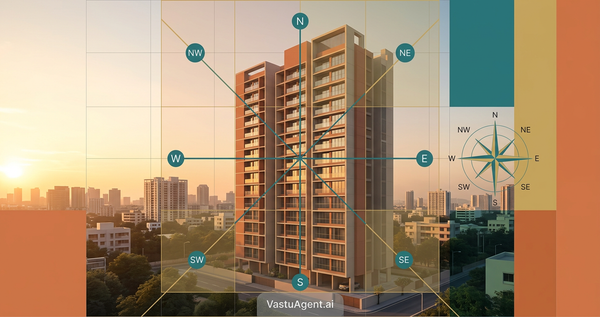
House Facing Vastu Guide: North, South, East & West Direction Complete Analysis [2026]
Complete house facing Vastu guide for all directions. Learn ideal door positions, room placement & remedies for North, South, East & West facing homes. Free AI analysis tool inside.

![House Facing Vastu Guide: North, South, East & West Direction Complete Analysis [2026]](/content/images/size/w1200/2026/01/Vastu-house-guide.jpeg)
Table of Contents
- What is House Facing Direction? How to Determine It
- Does House Facing Really Matter in Vastu?
- Which House Facing is Best as Per Vastu?
- North Facing House Vastu: Complete Guide
- South Facing House Vastu: Complete Guide
- East Facing House Vastu: Complete Guide
- West Facing House Vastu: Complete Guide
- House Facing by Zodiac Sign & Profession
- Corner Facing Houses: NE, NW, SE, SW
- Main Door Placement for Each Direction
- Common Myths About House Facing Debunked
- House Facing Remedies for Inauspicious Directions
- FAQs About House Facing Vastu
Choosing a home is one of the most significant decisions you'll ever make. Beyond the number of bedrooms and the quality of the neighborhood, ancient Indian wisdom suggests that the direction your home faces can profoundly influence your health, wealth, relationships, and overall life trajectory. This principle lies at the heart of Vastu Shastra, the 5,000-year-old Indian science of architecture and spatial harmony.
Whether you're buying a new property, building your dream home, or simply curious about why your current residence feels a certain way, understanding house facing Vastu can provide remarkable insights. In this comprehensive guide, we'll demystify every aspect of directional Vastu—from determining your home's exact facing to optimizing each room's placement based on that direction.
1. What is House Facing Direction? How to Determine It
The "facing" of your house is perhaps the most fundamental concept in Vastu Shastra, yet it's frequently misunderstood.
This distinction matters immensely. Many homeowners mistakenly believe their house faces the road or that it's determined by the plot orientation. In reality, the main entrance serves as the "mouth" of the home through which energy (prana) flows in and out. The direction this mouth faces determines how cosmic and terrestrial energies interact with your living space.
How to Accurately Determine Your House Facing
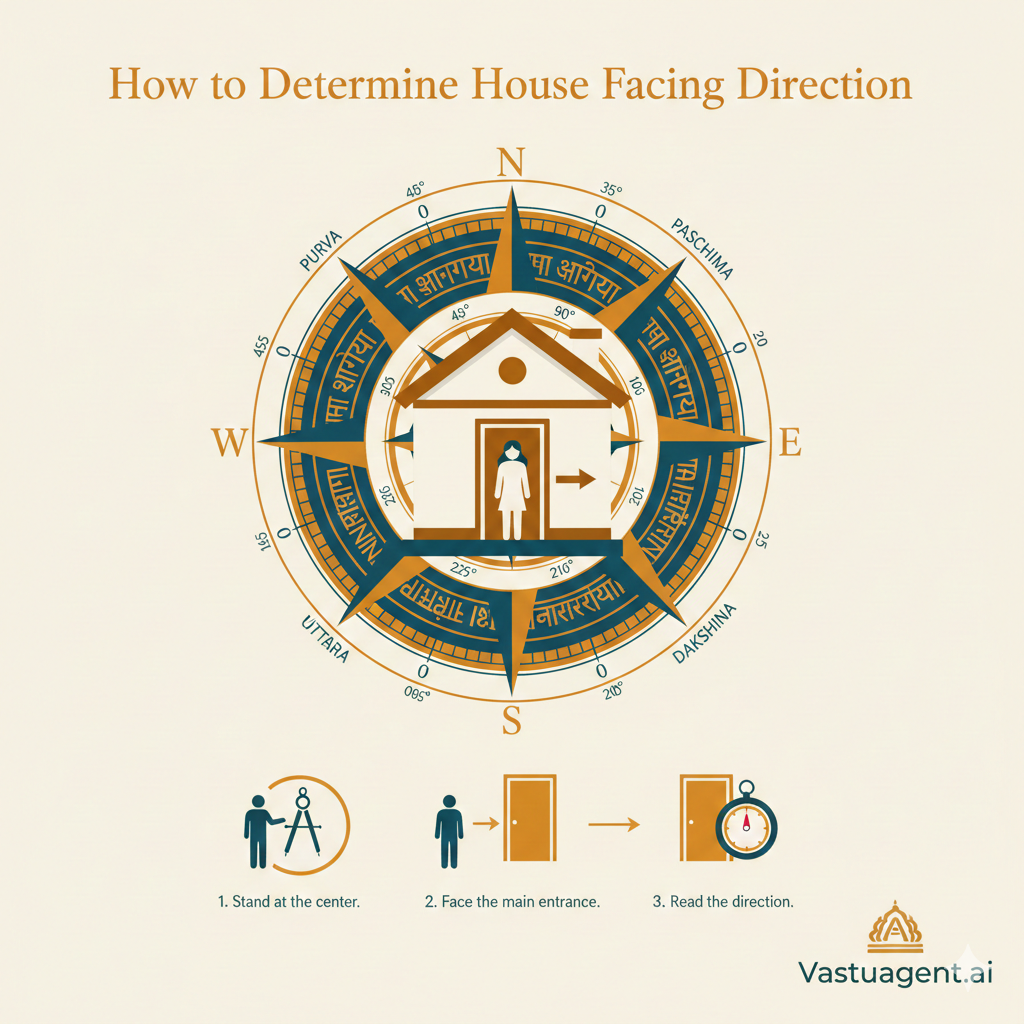
Stand at your main door threshold, facing outward as if you're about to leave your home. Hold a magnetic compass at chest level—or use a reliable compass app on your smartphone—and note the reading. The direction the needle points toward is your house facing direction.
| Compass Reading | House Facing Direction |
|---|---|
| 337.5° - 22.5° | North Facing |
| 22.5° - 67.5° | Northeast Facing |
| 67.5° - 112.5° | East Facing |
| 112.5° - 157.5° | Southeast Facing |
| 157.5° - 202.5° | South Facing |
| 202.5° - 247.5° | Southwest Facing |
| 247.5° - 292.5° | West Facing |
| 292.5° - 337.5° | Northwest Facing |
For the most accurate reading, take measurements at three different times of day and average them, as electronic devices and metal objects can temporarily affect compass readings.
True North vs. Magnetic North
While your compass shows magnetic north, Vastu structures ideally orient toward True North (Geographic North). The difference between magnetic and true north varies by location—a phenomenon called magnetic declination. In most of India, this difference is minimal (1-3 degrees), but in other regions, you may need to adjust your readings accordingly.
🔮 Want to instantly visualize your home's directional zones? The FREE Vastu Mandal Chakra Tool at VastuAgent.ai overlays all 16 directions onto your floor plan in seconds. Try it now →
🧭 Step-by-Step Instructions for Measuring Entrance Direction
1. The Essential Tool: A Compass
You will need a magnetic compass or a reliable mobile compass application.
- Best Practice: A physical magnetic compass is often preferred for its accuracy and reduced interference from electronics.
- Mobile App: If using a phone, make sure the compass app is calibrated, and the phone is held flat.
2. The Correct Position
Stand at the Main Door, Facing Outward:
- Stand right in the middle of your main entrance doorway, as if you are about to step out of the house.
- Your back should be to the house interior, and you should be facing the direction of the street or open space outside.
3. Taking the Reading
Hold the Compass Flat and Steady:
- Hold the compass flat and level (parallel to the ground) in front of you, pointing straight out.
- Keep the compass away from metallic objects (like a metal door frame, large electronic items, or even keys in your pocket) as they can interfere with the magnetic reading.
- Allow the needle to settle completely.
4. Noting the Direction and Degrees
Determine Your House Facing Direction:
- Read the direction (e.g., North, Northeast, East) and the degree reading (e.g., 30 degree, 90 degree, 180 degree) that is directly in front of you. This is the facing direction of your house.
- Example: If you face North when exiting, the reading will be around 0 degree/360 degree. If you face East, the reading will be around 90 degree.
5. Verification (For Accuracy)
- Take a few more readings by stepping back a couple of feet inside the house and again right outside the door (still facing away from the house).
- If the readings are close, take the average. Significant differences suggest local magnetic interference (e.g., a steel beam in the wall), and you may need to take a reading from the centre of the plot/building instead, or consult a professional.
🎯 Vastu's Further Level of Exactness (The 32 Padas)
For a truly exact Vastu analysis, the general direction is not enough. The Vastu Purusha Mandala divides the full 360 degree circle into 32 specific segments or padas, each covering 11.25 degree , and each associated with a different deity and energy.
To find your exact Vastu entrance:
- Find the Centre Point: Locate the precise centre point of your home or apartment floor plan (this may involve drawing diagonal lines from the corners).
- Use the Centre for Mapping: From the centre point, you would map the $360^\circ$ perimeter, dividing each cardinal direction (N, E, S, W) into 8 padas, totaling 32.
- Identify the Pada: By drawing a line from the centre through the exact location of your main door, you determine which of the 32 padas your entrance falls into.
For example, an entrance on the North side might fall into the N4 (Bhallat) or N5 (Soma) padas, which are considered highly auspicious, but you would want to avoid the N1 (Roga) and N2 (Naga) padas.
2. Should Brahmsthan (centre point) be measured from centre or from inside the house entrance door?
3. Does House Facing Really Matter in Vastu?
The short answer is yes, but perhaps not in the way popular culture suggests. House facing is one significant factor among many in Vastu, contributing approximately 20-30% to the overall Vastu compliance of a property. The internal layout, room placements, and elemental balance often matter even more.
Method 1: Measuring from the Doorway (For General Direction)
This is the method I detailed in the initial steps and is used for quickly identifying the overall house facing direction.
| Purpose | When to Use It | How to Do It |
| To define the general direction of the building for basic consultation (e.g., "Is this a North-facing or West-facing home?"). | When you need a quick, reliable reading of the general alignment of the structure relative to the magnetic north. | Stand in the center of the main doorway, facing out, and read the compass. |
| Result | You get a general reading like "East Facing" or "South-West Facing." |
Method 2: Measuring from the Centre (For Precise Vastu Mapping)
This is the method mentioned in my bullet point 2 and is necessary for the advanced, exact Vastu analysis.
| Purpose | When to Use It | How to Do It |
| To determine the exact pada (segment) your entrance falls into (the 32-pada system). | When you are performing a full Vastu check and need to know the specific energy field (pada) the entrance door sits on. | Place the compass in the absolute center (Brahmasthan) of the building and draw a line from the centre through the physical location of the door to read the corresponding degree on the perimeter grid. |
| Result | You get a precise reading like "Entrance in the E3 (Indra) Pada" or "Entrance in the W6 (Vitatha) Pada." |
The Key Takeaway
- For your initial goal (getting the exact instructions on how to measure the direction), start with Method 1 (Doorway). It gives you the direction the house is aligned to.
- Method 2 (Centre Point) is the next step a Vastu expert takes. It requires a proper scale floor plan to be accurate and is used to pinpoint the auspiciousness of the exact position of the door on the perimeter.
In short, the centre-point measurement is for precise positioning on the Vastu grid, while the doorway measurement is for the general alignment of the structure.
🧭 The Two Vastu Measurement Methods
1. Method for General House Facing Direction
This method tells you which direction the entire property is aligned to (e.g., North-Facing, East-Facing).
| Aspect | Instruction | Purpose |
| Position | Stand in the center of the main doorway, facing OUTWARD (as if you are leaving the house). | This establishes the direction from which cosmic energy enters the home. |
| Tool | Use a compass (physical or mobile, kept away from metal). | You need a precise degree reading. |
| Reading | Note the compass degree directly in front of you (where you are facing). | If the reading is $90^\circ$ (or close to it), your house is East-facing. If it is $0^\circ$/$360^\circ$ (or close), it is North-facing. |
2. Method for Exact Entrance Pada (Segment)
This method is for the technical part of Vastu, which determines the specific energy field (called a pada) your door falls into. The Vastu Purusha Mandala divides the entire perimeter into 32 padas, and the general direction (like "North") contains eight padas, some good, some bad.
| Aspect | Instruction | Purpose |
| Position | Place the compass or map the directions from the absolute centre of the house (Brahmasthan). | All Vastu zones and energy fields are mapped outwards from this central point of the property. |
| Process | Draw lines outward from the centre point to the exact physical location of your door. | This shows precisely which of the 32 padas the door occupies. For example, a "North-facing" house is only truly auspicious if the door falls into the N3 (Mukhya) or N4 (Bhallat) padas, not N1 or N2. |
The Conclusion for Your Confusion
The reason for the two methods is:
- You use the Doorway Method to find the general Vastu direction of the house. (e.g., "My house is East-facing at $85^\circ$").
- You then use the Centre Method (on a scaled floor plan) to apply the Vastu map, ensuring the door's exact position is in an auspicious $11.25^\circ$ segment (pada).
If you are simply checking a house and asking, "Which way does it face?" use Method 1 (Doorway). If you are doing a detailed Vastu correction or planning a new home, you must use Method 2 (Centre Point) on the floor plan.
The Science Behind Directional Energy
Vastu Shastra isn't merely superstition. It's rooted in keen observations about how buildings interact with natural forces. Your home's orientation determines three critical factors:
Solar Exposure (Pranic Energy): The sun's path from east to west creates distinct energy patterns throughout the day. A home's orientation determines which rooms receive morning light (considered most beneficial) versus afternoon sun (which can be intense and challenging in warmer climates).
Geomagnetic Flux (Jaivic Energy): Earth's magnetic field runs from the North Pole to the South Pole. This constant magnetic flow influences everything from bird migration to human biorhythms. Vastu principles about sleeping directions and entrance placements often correlate with these magnetic considerations.
Ventilation and Thermal Comfort: Different orientations capture or block prevailing winds differently. In tropical climates like much of India, homes that maximize cross-ventilation while minimizing direct western sun exposure naturally prove more comfortable.
The Relative Importance Perspective
Consider this: a north-facing home with the entrance in an inauspicious pada (zone), bedrooms in the northeast, and the kitchen in the north will perform far worse than a supposedly "challenging" south-facing home with perfect internal layout and correct door placement.
This perspective is liberating. It means you needn't reject properties based on facing alone. Any direction can be made auspicious through proper internal design and, when necessary, appropriate remedies.
🔮 Curious how the ancient Vastu Purusha grid applies to your specific floor plan? Our FREE Vastu Purusha Tool shows exactly which zones host which energies. Discover your home's hidden energy map →
3. Which House Facing is Best as Per Vastu?
If you've been told that only north or east-facing homes are "good," you've encountered an oversimplification that doesn't reflect authentic Vastu wisdom. Classical texts including the Brihat Samhita and Mayamata describe auspicious possibilities for all eight directions—each simply requires different optimization strategies.
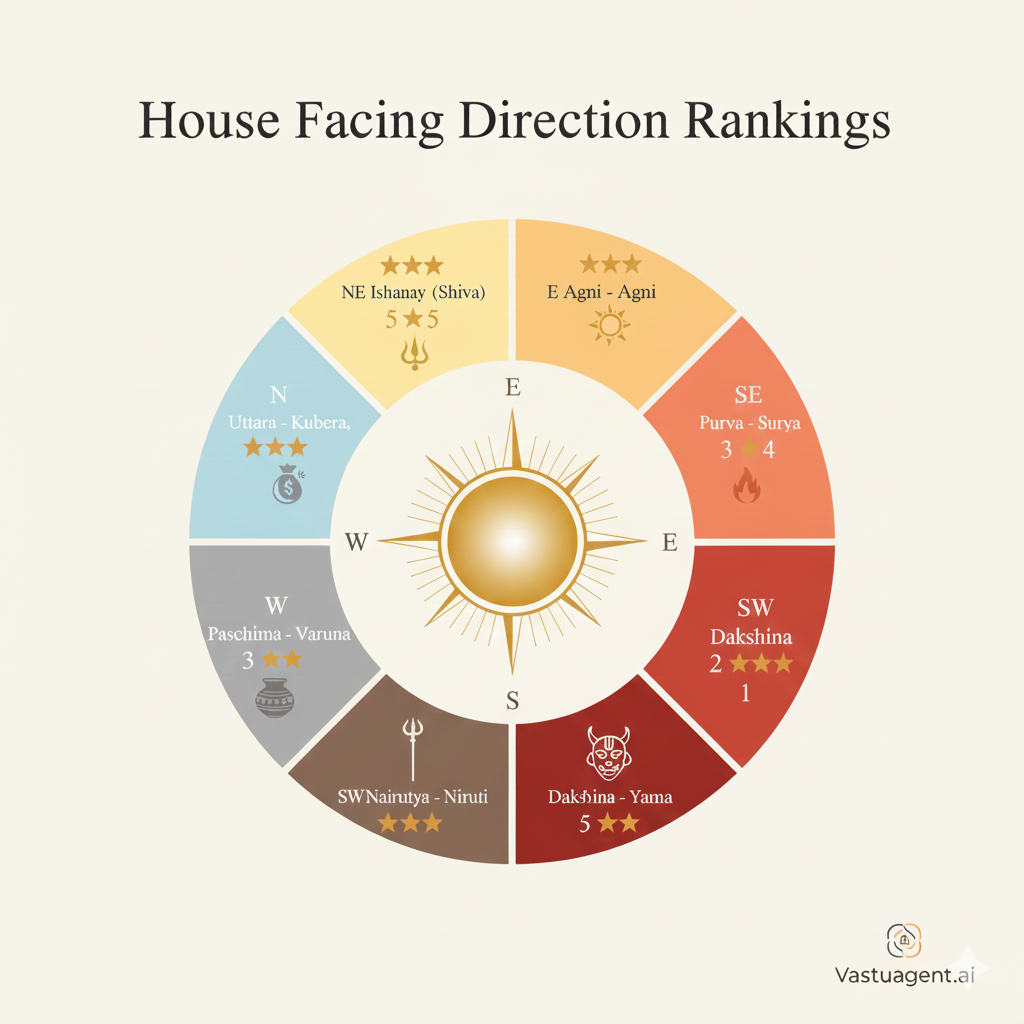
Direction Rankings and Their True Meanings
| Rank | Direction | Rating | Ruled By | Best For | Key Considerations |
|---|---|---|---|---|---|
| 1 | Northeast | ⭐⭐⭐⭐⭐ | Ishanya (Shiva) | Spiritual growth, everyone | Most sacred; keep this zone light and open |
| 2 | North | ⭐⭐⭐⭐⭐ | Kubera (Wealth) | Business, finance, careers | Excellent for wealth generation |
| 3 | East | ⭐⭐⭐⭐⭐ | Indra (King of Gods) | Health, family, new beginnings | Morning sun brings vitality |
| 4 | West | ⭐⭐⭐⭐ | Varuna (Water Lord) | Established professionals, gains | Saturn's discipline brings stability |
| 5 | Southeast | ⭐⭐⭐⭐ | Agni (Fire) | Business owners, chefs | Fire element requires careful handling |
| 6 | Northwest | ⭐⭐⭐⭐ | Vayu (Wind) | Travel, sales, movement | Air element can create instability if unbalanced |
| 7 | South | ⭐⭐⭐ | Yama (Dharma Lord) | Fame, recognition, leadership | Requires careful door placement |
| 8 | Southwest | ⭐⭐⭐ | Nairuti (Earth) | Stability, established families | Heavy energy needs grounding |
Notice that no direction receives fewer than three stars. This reflects the authentic Vastu teaching that all directions have their place and purpose. The "best" direction ultimately depends on your profession, life goals, zodiac sign, and how well you can optimize the internal layout.
The Classical Wisdom
Ancient texts explain the effects of each cardinal direction quite clearly. East-facing homes promote physical comfort and mental peace through morning sun exposure. North-facing homes attract wealth through Kubera's influence. West-facing homes bring material prosperity and accumulated gains. South-facing homes support those seeking recognition, leadership positions, or—in its highest expression—spiritual liberation from material attachments.
🔮 Get a complete AI-powered analysis of your home's Vastu score across all directions. The Detailed Vastu Report ($25) provides 100+ specific findings with personalized remedies. Get Your Complete Analysis →
4. North Facing House Vastu: Complete Guide
North-facing homes enjoy perhaps the most celebrated reputation in popular Vastu culture, and for good reason. The north direction is presided over by Kubera, the divine treasurer and lord of wealth in Hindu mythology. Mercury, the planet of commerce, communication, and intellect, rules this direction, while water and air serve as its primary elements.
Overview
| Attribute | Details |
|---|---|
| Ruling Deity | Kubera (God of Wealth) |
| Ruling Planet | Mercury (Budh) |
| Element | Water |
| Overall Rating | ⭐⭐⭐⭐⭐ Highly Auspicious |
| Best For | Business owners, finance professionals, career-focused individuals |
| Color Association | Green, Blue |
Ideal Room Placement for North Facing Homes
The key principle for north-facing homes is to keep the northern portion of the house relatively lighter, more open, and less cluttered than the southern portion. This allows Kubera's wealth energies to flow freely into the home.
| Room | Best Location | Reasoning |
|---|---|---|
| Main Entrance | North (padas N1-N4, N7-N8) | Direct reception of wealth energy |
| Living Room | North, Northeast | Social prosperity, guest reception |
| Kitchen | Southeast | Fire element in fire zone |
| Master Bedroom | Southwest | Grounding, stability for decision-makers |
| Pooja Room | Northeast | Maximum spiritual energy |
| Bathroom/Toilet | Northwest, West | Appropriate waste placement |
| Study/Office | North, West | Career growth, mental clarity |
| Children's Room | West, Northwest | Growth and creativity |
| Staircase | South, Southwest | Weight in the heavier zones |
| Underground Water Tank | North, Northeast | Water in water zone |
| Overhead Water Tank | Southwest | Weight in SW corner |
The Critical 8 Padas of the North Wall
The north wall of your home is divided into 8 equal segments called padas, each carrying distinct energies. Where your main door falls within these padas dramatically affects the home's overall fortune.
| Pada | Position | Rating | Primary Effects |
|---|---|---|---|
| N1 (Roga) | Far NW corner | ⭐⭐⭐ Good | Moderate wealth, some health concerns if imbalanced |
| N2 (Naga) | Left of center | ⭐⭐⭐⭐ Very Good | Good prosperity, steady income |
| N3 (Mukhya) | Center-left | ⭐⭐⭐⭐⭐ Excellent | Maximum wealth attraction |
| N4 (Bhallata) | Center | ⭐⭐⭐⭐ Good | Balanced energy, good for families |
| N5 (Soma) | Center-right | ⭐⭐ Avoid | Legal issues, disputes |
| N6 (Bhujang) | Right of center | ⭐ Avoid | Heavy financial losses |
| N7 (Aditi) | Far NE area | ⭐⭐⭐ Good | Spiritual growth alongside material success |
| N8 (Diti) | NE corner | ⭐⭐⭐⭐⭐ Excellent | Overall prosperity, divine blessings |
Essential Guidelines for North Facing Homes
Do:
- Keep the north zone relatively open with fewer heavy structures
- Maintain a slightly lower floor level in the north compared to the south
- Use shorter or lower boundary walls on the northern side
- Maximize windows and openings on the northern wall
- Install any underground water storage in the north or northeast
- Place images or symbols of Lord Kubera near the northern entrance
Don't:
- Place the kitchen in the north (causes financial stringency)
- Build toilets in the north or northeast (drains wealth)
- Allow clutter to accumulate in northern rooms
- Construct heavy staircases in the northern zone
- Create extensions that protrude northward beyond the original plot boundary
Benefits When Optimized Correctly
A well-planned north-facing home typically brings financial stability and steady income growth, success in business and career endeavors, improved communication skills and social connections, benefits for female family members' health, and enhanced fertility and family harmony.
Common Challenges and Solutions
| Challenge | Vastu Solution |
|---|---|
| Door in N5 or N6 (inauspicious padas) | Install Kubera Yantra, use brass pyramid above door, paint threshold yellow or green |
| Heavy structure in northern zone | Add water features (fountain, aquarium) to balance the weight |
| Kitchen in north | Place a bowl of sea salt in the kitchen, use more blue/green colors |
| Toilet in north | Keep the door always closed, use air fresheners, add plants nearby |
🔮 Is your north-facing home maximizing Kubera's blessings? Get your personalized Detailed Vastu Report with pada-by-pada analysis and custom remedies. Analyze Your North-Facing Home →
5. South Facing House Vastu: Complete Guide
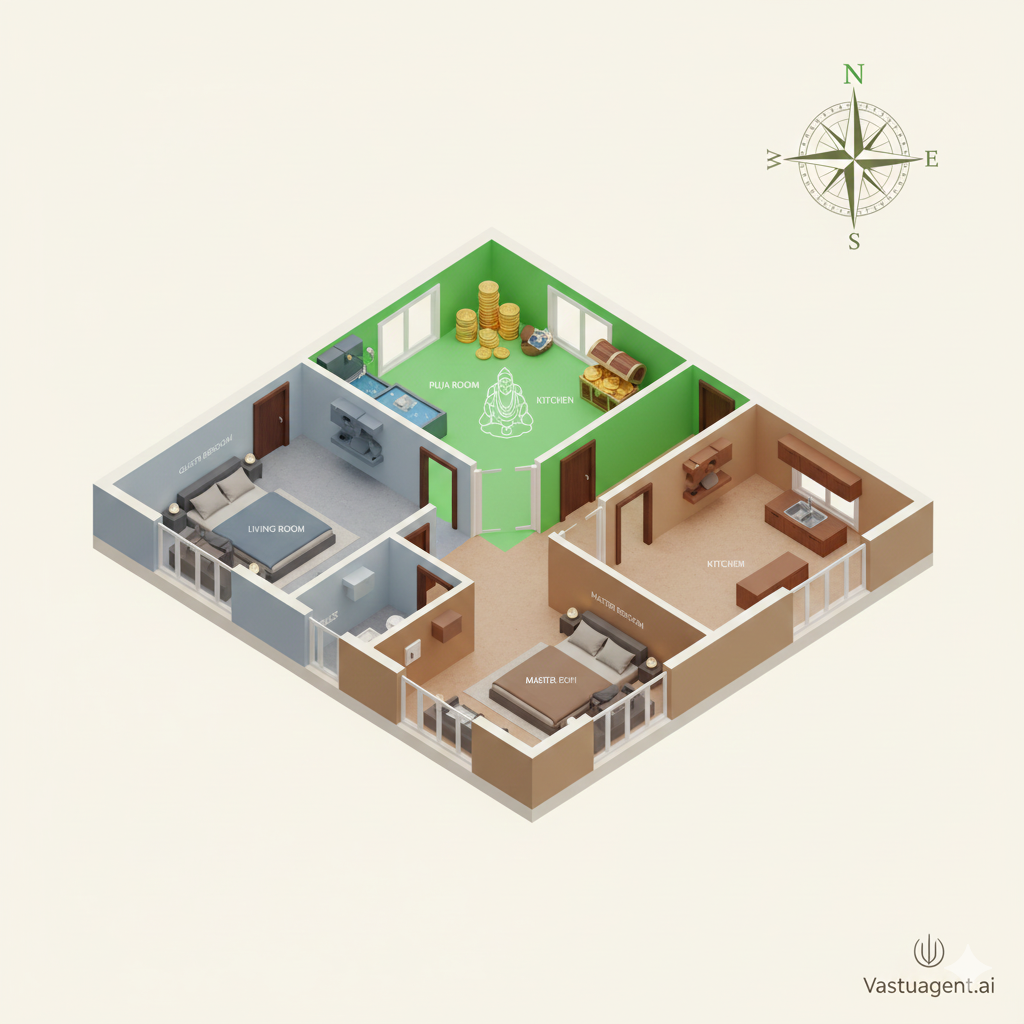
No direction in Vastu has been more unfairly maligned than the south. Countless home buyers have rejected perfectly good properties based solely on their southern orientation, often paying premium prices for inferior north or east-facing alternatives. This represents a profound misunderstanding of classical Vastu principles.
The South Facing Truth
The south direction is governed by Yama, who in Vedic tradition is not merely the lord of death but the lord of Dharma—righteousness, cosmic law, and proper conduct. Mars, the planet of courage, leadership, and decisive action, influences this direction. When properly harnessed, south-facing homes produce leaders, achievers, and individuals of strong character.
| Attribute | Details |
|---|---|
| Ruling Deity | Yama (Lord of Dharma) |
| Ruling Planet | Mars (Mangal) |
| Element | Fire & Earth |
| Overall Rating | ⭐⭐⭐⭐ Good with Proper Planning |
| Best For | Politicians, lawyers, celebrities, business leaders |
| Color Association | Red, Maroon, Coral |
Debunking the South Facing Myth
| Common Myth | Actual Reality |
|---|---|
| "South facing is cursed" | Many successful politicians and business leaders live in south-facing homes with correct door placement |
| "Brings death and illness" | Yama governs righteous living; negative effects only occur with wrong door padas |
| "Should never be purchased" | Properties priced lower due to this myth often represent excellent value |
| "Only priests should live facing south" | South suits anyone seeking fame, recognition, or leadership roles |
Ideal Room Placement for South Facing Homes
| Room | Best Location | Reasoning |
|---|---|---|
| Main Entrance | South (S1, S2, or S4 padas ONLY) | Specific positions harness positive Mars energy |
| Living Room | East, North | Balances the strong southern energy |
| Kitchen | Southeast | Perfect fire-in-fire placement |
| Master Bedroom | Southwest | Maximum stability and authority |
| Pooja Room | Northeast | Preserves sacred energy |
| Bathroom/Toilet | South (non-entrance areas), SW | Appropriate waste zones |
| Study/Office | West, Northwest | Focus and career growth |
| Children's Room | West | Balanced creativity |
| Staircase | Southwest, South | Weight in proper zones |
The Critical 8 Padas of the South Wall
This is where south-facing homes differ dramatically from others. The margin for error is narrower—only specific padas are truly auspicious.
| Pada | Position | Rating | Primary Effects |
|---|---|---|---|
| S1 (Gruhakshat) | Far SE area | ⭐⭐⭐⭐ Good | Fame, positive recognition |
| S2 (Yama) | Left of center | ⭐⭐⭐⭐ Good | Government favor, leadership |
| S3 (Vitatha) | Center-left | ⭐⭐ Caution | Mixed results, requires remedies |
| S4 (Gandharva) | Center | ⭐⭐⭐⭐⭐ Excellent | Maximum success, fame, achievements |
| S5 (Bhringraj) | Center-right | ⭐ Avoid | Health issues, chronic problems |
| S6 (Mriga) | Right of center | ⭐ Avoid | Legal troubles, conflicts |
| S7 (Pitru) | Far right | ⭐ Avoid | Ancestral karma issues, severe losses |
| S8 (Dauwarik) | SW corner | ⭐ Avoid | Relationship breakdown, instability |
Non-Negotiable Rules for South Facing Homes
Absolutely Essential:
- Entrance MUST be in S1, S2, or S4 pada—no exceptions
- Southwest must be the heaviest, most closed zone in the entire home
- More open space must exist in north and east zones
- Floor level in the south must be higher than in the north
- Southern boundary wall should be taller and thicker than northern wall
Critical Avoidances:
- NEVER place main entrance in S5, S6, S7, or S8 padas
- NEVER create large openings or windows in the southwest
- NEVER have underground water storage in the south
- NEVER position the main bedroom in the northeast
Benefits When Done Correctly
A south-facing home with proper door placement and layout optimization can bring remarkable fame and public recognition, success in politics, law, and leadership roles, strong willpower and decisive character, legal victories and favorable judgments, and the courage to pursue ambitious goals.
Remedies for South Facing Challenges
| Challenge | Vastu Solution |
|---|---|
| Door in S5-S8 (inauspicious padas) | Install Panchamukhi Hanuman facing south, use lead helix under threshold, Vastu pyramids |
| Excessive heat or heavy energy | Light colors throughout, water features in north, maximize northeast openings |
| Relationship difficulties | Strengthen southwest with heavy furniture, place rose quartz in bedroom |
| Health concerns | Neem or tulsi plants near entrance, copper pyramid above door |
🔮 Does your south-facing home have its entrance in the right pada? The FREE Vastu Mandal Chakra Tool instantly shows your door's exact position. Check Your Door Placement Now →

6. East Facing House Vastu: Complete Guide
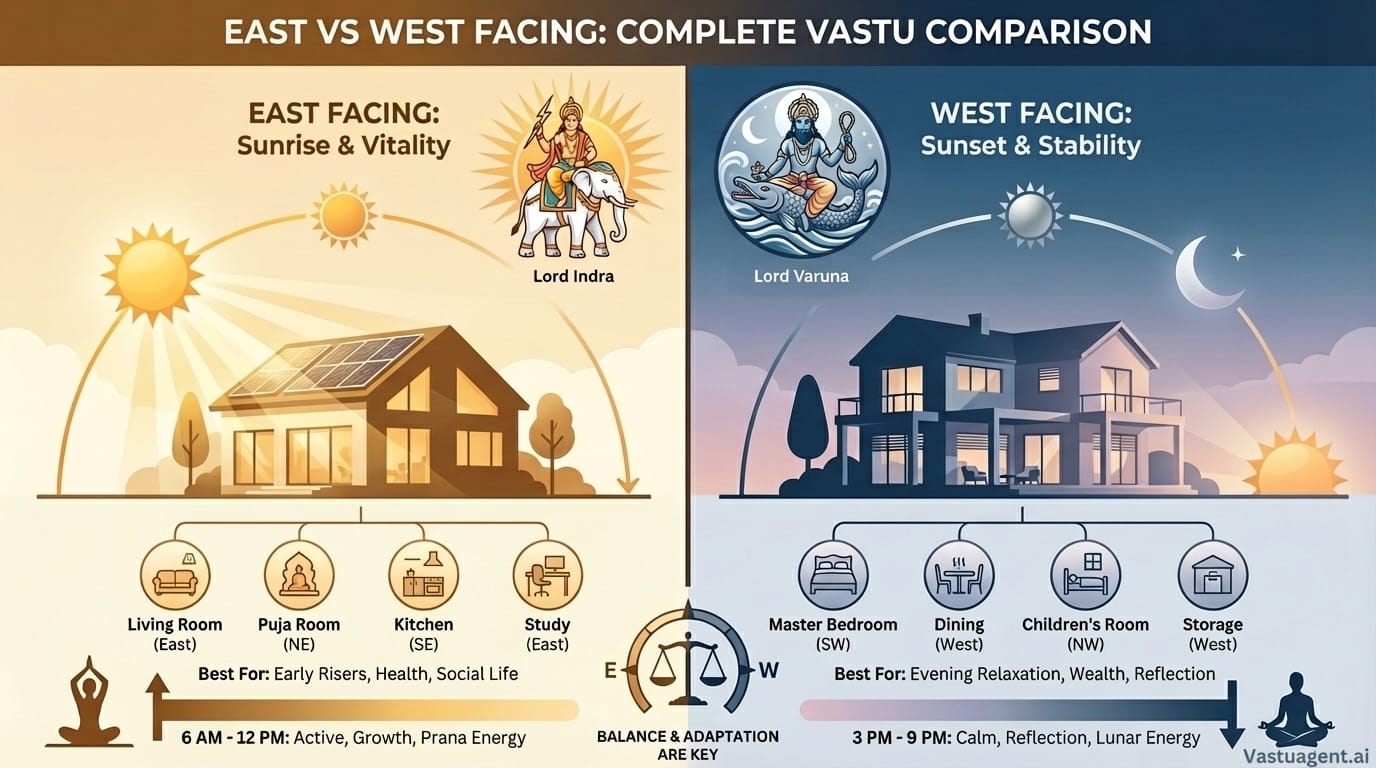
The east direction holds special reverence in virtually every ancient culture, and Vastu Shastra is no exception. This is the direction from which the sun rises, bringing light, warmth, and the vital pranic energy that sustains all life. East-facing homes naturally receive the most beneficial morning sunlight, making them traditionally preferred for family residences.
Overview
| Attribute | Details |
|---|---|
| Ruling Deity | Indra (King of Gods) |
| Ruling Planet | Sun (Surya) |
| Element | Fire (balanced) & Air |
| Overall Rating | ⭐⭐⭐⭐⭐ Highly Auspicious |
| Best For | Government officials, families, health-focused individuals |
| Color Association | Orange, Light Yellow, White |
Why East Facing Commands Traditional Preference
The sun's first rays carry the highest concentration of beneficial ultraviolet light (UV-A) which the body uses to synthesize Vitamin D, regulate circadian rhythms, and boost mood-enhancing serotonin. Ancient Vastu practitioners observed these health benefits millennia before modern science understood the mechanisms.
Beyond the physical, the east represents new beginnings, birth, and the potential of each new day. Spiritually, praying toward the rising sun has been considered auspicious across Hindu, Buddhist, and Jain traditions. The Surya Namaskar (sun salutation) yoga practice, performed facing east, demonstrates this enduring reverence.
Ideal Room Placement for East Facing Homes
| Room | Best Location | Reasoning |
|---|---|---|
| Main Entrance | East (E1-E4 padas) | Receives Surya's direct blessings |
| Living Room | East, Northeast | Morning sun for social gatherings |
| Kitchen | Southeast | Perfect fire element placement |
| Master Bedroom | Southwest | Protected from intense morning light |
| Pooja Room | Northeast | Ideal for sunrise prayers |
| Bathroom/Toilet | Northwest, West | Away from morning sun path |
| Study/Office | Northeast, North | Mental clarity from morning light |
| Children's Room | West | Balanced energy for rest |
| Garden/Lawn | East, North | Receives maximum beneficial sunlight |
The 8 Padas of the East Wall
| Pada | Position | Rating | Primary Effects |
|---|---|---|---|
| E1 (Shikhi) | Far NE area | ⭐⭐⭐⭐⭐ Excellent | Spiritual success alongside material prosperity |
| E2 (Parjanya) | Left of center | ⭐⭐⭐⭐⭐ Excellent | Overall prosperity, divine grace |
| E3 (Jayanta) | Center-left | ⭐⭐⭐⭐ Very Good | Good fortune, steady progress |
| E4 (Indra) | Center | ⭐⭐⭐⭐ Very Good | Balanced success, leadership |
| E5 (Surya) | Center-right | ⭐⭐⭐ Good | Moderate positive results |
| E6 (Satya) | Right of center | ⭐⭐ Caution | Some obstacles, truth-related matters |
| E7 (Bhrisha) | Far SE area | ⭐⭐ Caution | Fire element challenges |
| E8 (Akash) | SE corner | ⭐⭐ Caution | Potential for conflicts, aggression |
Essential Guidelines for East Facing Homes
Do:
- Keep the east completely open with minimal obstructions
- Maintain lower floor levels in the east compared to the west
- Use shorter boundary walls on the eastern side
- Maximize windows, balconies, and verandas on the east wall
- Place a tulsi (holy basil) plant near the eastern entrance
- Use light, bright colors in eastern rooms
Don't:
- Block the east with tall trees, structures, or heavy boundary walls
- Place toilets or bathrooms in the east or northeast
- Build heavy staircases in the eastern zone
- Create storage or cluttered areas in the northeast
- Use dark colors on east-facing walls
Benefits of Well-Planned East Facing Homes
A properly optimized east-facing home typically promotes excellent health and physical vitality, success in government jobs and public service, strong family harmony and social respect, particularly beneficial environment for children's growth, and spiritual progress and mental clarity.
Challenges and Solutions
| Challenge | Vastu Solution |
|---|---|
| Intense morning sun causing discomfort | Create veranda or covered sit-out, use light curtains |
| Door in E6-E8 (less auspicious padas) | Surya yantra, copper sun symbol above door |
| East blocked by neighboring structure | Mirrors on east wall to symbolically open the space |
| Heat accumulation in summers | Cross ventilation, light colors, plants for cooling |
🔮 Maximize the sun god's blessings in your east-facing home. Get room-by-room optimization with the Detailed Vastu Report. Unlock Your Home's Full Potential →
7. West Facing House Vastu: Complete Guide
West-facing homes are perhaps the most underrated in popular Vastu perception. While east-facing homes receive the sun's first light, west-facing homes witness its triumphant finale—the golden hour that photographers and artists treasure. In Vastu terms, the west represents gains, fulfillment, and the rewards of sustained effort.
Overview
| Attribute | Details |
|---|---|
| Ruling Deity | Varuna (Lord of Water & Cosmic Order) |
| Ruling Planet | Saturn (Shani) |
| Element | Air & Space (Akash) |
| Overall Rating | ⭐⭐⭐⭐ Good for Established Professionals |
| Best For | Business owners, researchers, social workers, mature families |
| Color Association | Blue, White, Gray |
The Underrated Direction
Saturn, despite its fearsome astrological reputation, represents discipline, perseverance, justice, and the rewards of hard work. Varuna, the cosmic lord of water and moral order, governs the vast oceans and the sustaining rains. Together, these influences make west-facing homes particularly suitable for those who have established themselves professionally and now seek to consolidate their gains.
| Perception | Reality |
|---|---|
| "Second-class direction" | Excellent for wealth accumulation over time |
| "Too hot and uncomfortable" | Proper planning with verandas eliminates this |
| "Not good for health" | Saturn brings discipline and longevity |
| "Avoid if alternatives exist" | Many successful business families specifically choose west |
Ideal Room Placement for West Facing Homes
| Room | Best Location | Reasoning |
|---|---|---|
| Main Entrance | West (W3, W4, W5 padas) | Receives Varuna's blessings |
| Living Room | North, East | Balance against afternoon energy |
| Kitchen | Southeast | Fire in correct zone |
| Master Bedroom | Southwest | Maximum stability and authority |
| Pooja Room | Northeast | Preserved sanctity |
| Bathroom/Toilet | West (non-entrance areas), NW | Appropriate placement |
| Study/Office | West, Southwest | Deep focus, research work |
| Dining Room | West | Gains through food and hospitality |
| Children's Room | Northwest, West | Growth and movement |
| Overhead Water Tank | Southwest, West | Weight in appropriate zones |
The 8 Padas of the West Wall
| Pada | Position | Rating | Primary Effects |
|---|---|---|---|
| W1 (Asur) | Far SW area | ⭐ Avoid | Heavy losses, negative energies |
| W2 (Shosha) | Left of center | ⭐⭐ Caution | Drying, depleting effects |
| W3 (Papayakshma) | Center-left | ⭐⭐⭐⭐ Good | Wealth gains with effort |
| W4 (Roga-Varuna) | Center | ⭐⭐⭐⭐⭐ Excellent | Maximum prosperity, cosmic order |
| W5 (Pushpadanta) | Center-right | ⭐⭐⭐⭐ Very Good | Good profits, steady growth |
| W6 (Sugriva) | Right of center | ⭐⭐⭐ Good | Support from allies |
| W7 (Dauvarik) | Far NW area | ⭐⭐⭐ Good | Movement, travel opportunities |
| W8 (Marut) | NW corner | ⭐⭐⭐ Good | Support from the wind god |
Essential Guidelines for West Facing Homes
Do:
- Place entrance in W3, W4, or W5 (center padas)
- Keep southwest heavy, closed, and elevated
- Maintain more open space in north and east
- Create a buffer zone (veranda, sit-out) on the west to manage afternoon sun
- Use cool colors (blues, whites) in west-facing rooms
- Keep the west slightly higher than the east in floor level
Don't:
- Place entrance in W1 or W2 (near southwest)
- Create large openings or excessive glass on the west wall
- Leave the southwest open, light, or lowered
- Place the kitchen in the west (fire-water conflict)
- Build underground water storage in the west
Benefits of Properly Planned West Facing Homes
West-facing homes with correct layout typically bring gradual but substantial wealth accumulation, success in business ventures and profit generation, recognition in social and community circles, excellent support for research, analysis, and deep intellectual work, and Saturn's blessings of discipline and long-term stability.
Challenges and Solutions
| Challenge | Vastu Solution |
|---|---|
| Door in W1-W2 (inauspicious) | Vastu pyramid, blue color accents, lead strips under threshold |
| Afternoon/evening sun heat | Build veranda, use thick curtains, plant trees |
| Saturn's slow-moving energy | Add red or orange accents to activate |
| Feeling of heaviness | Increase lighting, use lighter colors, declutter |
🔮 Not sure if your west-facing door is in the prosperity zone? The FREE Vastu Purusha Tool instantly reveals your entrance pada. Check Your Door Position →
8. House Facing by Zodiac Sign & Profession
While proper Vastu compliance outweighs zodiac considerations, aligning your home's direction with your birth chart can provide an additional layer of harmony. This correlation stems from the relationship between zodiac signs and their ruling planets, which in turn govern specific directions.
Optimal House Facing by Zodiac Sign (Rashi)
| Zodiac Sign | Element | Ruling Planet | Best Facing | Second Choice | Generally Avoid |
|---|---|---|---|---|---|
| Aries (Mesh) | Fire | Mars | East | South | West |
| Taurus (Vrishabh) | Earth | Venus | North | West | South |
| Gemini (Mithun) | Air | Mercury | North | West | South |
| Cancer (Karka) | Water | Moon | North | East | South |
| Leo (Simha) | Fire | Sun | East | South | North |
| Virgo (Kanya) | Earth | Mercury | North | East | Southwest |
| Libra (Tula) | Air | Venus | West | North | Southeast |
| Scorpio (Vrischik) | Water | Mars | South | East | Northwest |
| Sagittarius (Dhanu) | Fire | Jupiter | Northeast | East | Southwest |
| Capricorn (Makar) | Earth | Saturn | West | South | Northeast |
| Aquarius (Kumbha) | Air | Saturn | West | North | East |
| Pisces (Meen) | Water | Jupiter | Northeast | North | South |
Optimal House Facing by Profession
Your profession often determines the type of energy that will best support your work and success. Different directions enhance different professional qualities.
| Profession Category | Best Facing | Reasoning | Deity/Planet Influence |
|---|---|---|---|
| Government Service | East | Authority, official recognition | Sun (Surya) |
| Business/Trading | North | Commercial success, transactions | Mercury (Budh), Kubera |
| Politics/Law | South | Fame, public recognition, justice | Mars (Mangal), Yama |
| IT/Communication | North | Mercury's communication boost | Mercury |
| Creative Arts/Design | West | Venus influence through Saturn | Saturn, Venus |
| Healthcare/Medicine | East | Healing energy from sun | Sun |
| Finance/Banking | North | Direct wealth association | Kubera |
| Teaching/Education | Northeast | Jupiter's wisdom | Jupiter (Guru) |
| Research/Science | West | Deep thinking, analysis | Saturn |
| Real Estate/Property | North | Asset accumulation | Kubera |
| Media/Entertainment | South | Fame, public visibility | Mars |
| Spiritual Work | Northeast | Maximum spiritual energy | Ishanya (Shiva) |
Practical Application
This information serves best as a tiebreaker. If you're choosing between two properties with similar pricing and Vastu compliance, selecting the one aligned with your zodiac or profession adds an extra dimension of harmony. However, never prioritize zodiac alignment over fundamental Vastu principles—a Cancer ascendant living in a poorly designed north-facing home will not fare as well as the same person in a well-optimized south-facing property.
🔮 Discover the complete alignment between your birth chart and your home. The Detailed Vastu Report includes zodiac-specific analysis. Get Personalized Insights →
9. Corner Facing Houses: NE, NW, SE, SW
When your main entrance doesn't face a cardinal direction but instead points toward a corner (technically called Vidisha or diagonal plots), different principles apply. These plots rotate the traditional energy grid by 45 degrees, creating unique opportunities and challenges.
Corner Facing Overview
| Corner Direction | Rating | Overall Assessment | Ruling Energy |
|---|---|---|---|
| Northeast (Ishanya) | ⭐⭐⭐⭐⭐ | Most auspicious for residences | Water + Divine blessings |
| Northwest (Vayuvya) | ⭐⭐⭐⭐ | Good for business, movement | Air element |
| Southeast (Agneya) | ⭐⭐⭐ | Requires careful management | Fire element |
| Southwest (Nairuti) | ⭐⭐ | Most challenging, needs strong remedies | Earth (heavy) |
Northeast Facing Houses
Northeast combines the wealth energy of the north with the health and vitality of the east, making it the most universally auspicious corner direction. This corner is governed by Ishanya (Lord Shiva) and represents the zone of divine grace, spiritual advancement, and new beginnings.
Key Guidelines:
- Keep the entire northeast zone open, light, and clutter-free
- Main entrance at exactly the NE corner is highly auspicious
- Ideal for meditation rooms, pooja spaces, and water features
- Never place toilets, heavy storage, or kitchens in the northeast
- Floor level should be lowest in the northeast
Best For: Spiritual seekers, families, professionals, essentially anyone
Northwest Facing Houses
The northwest is the zone of the wind god Vayu and represents movement, change, and circulation. This direction suits those whose work involves travel, sales, logistics, or any form of movement and distribution.
Key Guidelines:
- Good for secondary entrances and guest areas
- Suitable for children's bedrooms (promotes growth and movement)
- Storage of vehicles or garage placement works well here
- Avoid master bedroom in northwest (can create instability)
- Balance air element to prevent excessive restlessness
Best For: Sales professionals, transport businesses, those seeking change
Southeast Facing Houses
The southeast is Agni's (fire god) domain. This powerful corner can be challenging for residential purposes but excellent for businesses involving heat, cooking, or transformation.
Key Guidelines:
- Kitchen placement here is ideal
- Main entrance requires careful pada selection
- Keep fire safety measures in place
- Balance with water elements in northeast
- Use cooling colors to manage fire intensity
Best For: Restaurants, bakeries, manufacturing units, women-led businesses
Southwest Facing Houses
The southwest is the most challenging corner direction for residential purposes. Governed by Nairuti, this zone carries the heaviest, most stable earth energy—beneficial when contained but problematic when serving as an entrance.
Key Guidelines:
- If SW entrance is unavoidable, use extensive remedies
- Make SW the heaviest, most closed zone
- Ideal for master bedroom placement
- Never place water features or windows here
- Requires strong grounding remedies
Best For: Hardware stores, construction offices, mining-related businesses
Corner Plot Special Considerations
| Factor | Impact | Management Strategy |
|---|---|---|
| Road Thrust | Direct road pointing at corner creates Vedha (obstruction) | Install deflecting elements, curved driveway |
| T-Junction | Road hitting at corner is severely inauspicious | Major remedies required, consider alternatives |
| Cut/Missing Corner | NE cut is worst; SW cut can be managed | Build symbolic completion with landscaping |
| Extension | NE extension is beneficial; SW extension is problematic | Avoid SW extensions entirely |
🔮 Living in a corner-facing property? Get specific optimization strategies with the Detailed Vastu Report—includes corner-specific analysis. Analyze Your Corner Property →

10. Main Door Placement for Each Direction
The main entrance is the most critical element in Vastu, often described as the "mouth of the home" through which all life energy enters. Even if every other aspect of your home is perfectly aligned, an incorrectly positioned main door can undermine the entire structure's Vastu.
Universal Main Door Principles
Before examining direction-specific placements, these universal rules apply to all main entrances regardless of facing.
| Principle | Requirement |
|---|---|
| Height | Main door should be the tallest in the house |
| Width | At least 3 feet wide, preferably 3.5-4 feet |
| Number | Single door preferred; if double, both panels equal |
| Opening | Should open inward and clockwise |
| Material | Solid wood preferred over glass, metal, or synthetic |
| Threshold | Must have a raised threshold (dehleez) |
| Lighting | Always well-lit, never in shadow |
| Clearance | No obstructions directly outside for at least 6 feet |
Auspicious Pada Summary by Direction
| House Facing | Highly Auspicious Padas | Acceptable Padas | Avoid at All Costs |
|---|---|---|---|
| North | N3, N8 | N1, N2, N4, N7 | N5, N6 |
| South | S4 | S1, S2 | S3, S5, S6, S7, S8 |
| East | E1, E2 | E3, E4, E5 | E6, E7, E8 |
| West | W4, W5 | W3, W6, W7, W8 | W1, W2 |
Calculating Your Door's Pada Position
To determine which pada your door occupies, divide your wall's length into 9 equal parts. The first and ninth parts (corners) don't count, leaving 8 segments (padas) numbered from left to right.
Your door's position falls into whichever pada its center point occupies. If the door spans multiple padas, the pada containing the most door area determines its classification.
Main Door Enhancements
These additions elevate any auspicious entrance while providing partial correction for less favorable positions.
| Enhancement | Purpose | Placement |
|---|---|---|
| Toran (door hanging) | Invites Lakshmi, creates protective barrier | Across the top of door frame |
| Ganesha idol | Removes obstacles, protects entrance | Above door or on right side facing in |
| Swastik symbol | Ancient protection, cosmic harmony | Painted on door or placed above |
| Nameplate | Identity, prosperity, recognition | Right side at eye level |
| Welcome mat | Greets positive energy | Outside threshold |
| Brass bells/Wind chimes | Activates and circulates energy | Near door, sounds on opening |
| Auspicious colors | Direction-specific enhancement | Threshold or door itself |
Elements to Avoid Near Main Door
| Element | Problem Created | Remedy |
|---|---|---|
| Shoe rack visible | Carries negative, stale energy | Enclosed cabinet or moved inside |
| Dustbin | Poverty consciousness | Hide from door's line of sight |
| Broken/cracked door | Leaks positive energy | Repair or replace immediately |
| Squeaky hinges | Creates obstacles in life | Oil regularly or replace hinges |
| Dark entrance | Blocks opportunities | Add lighting—natural or artificial |
| Cluttered entrance | Blocks energy flow | Clear space, minimal decor |
| Thorny plants | Creates obstacles | Replace with smooth-leaved plants |
| Dead/dying plants | Brings stagnant energy | Remove immediately |
🔮 See exactly which pada your main door occupies. The FREE Vastu Mandal Chakra Tool visualizes your entrance position instantly. Find Your Door's Pada →
11. Common Myths About House Facing Debunked
Vastu wisdom has been passed down through generations, but along the way, authentic teachings have often been mixed with superstition, regional beliefs, and commercial interests. Let's separate fact from fiction.
The Truth Behind Common Beliefs
| # | The Myth | The Reality | Truth Rating |
|---|---|---|---|
| 1 | "South facing houses are cursed and bring death" | South facing with S1, S2, or S4 entrance is highly auspicious. Yama represents dharma (righteousness), not merely death. Many successful leaders live in south-facing homes. | ❌ FALSE |
| 2 | "Only North and East facing are good" | All four cardinal and four corner directions have auspicious door positions. West-facing brought wealth to many successful families. No direction is inherently bad. | ❌ FALSE |
| 3 | "West facing causes health problems" | No evidence supports this. West facing with proper internal layout is excellent for business success and material accumulation. Saturn brings discipline and longevity. | ❌ FALSE |
| 4 | "All corner plots are problematic" | Northeast corner is the most auspicious position possible. Only Southwest corner entrance requires significant remedies. | ❌ FALSE |
| 5 | "House facing determines 100% of Vastu" | House facing contributes roughly 20-30% to overall Vastu. Internal layout, room placement, and elemental balance often matter more. | ❌ FALSE |
| 6 | "Road facing equals house facing" | House facing is determined by main entrance direction, not road position. A house on a north road with east entrance is east-facing. | ❌ FALSE |
| 7 | "The same facing suits everyone" | Best facing depends on profession, zodiac sign, life goals, and ability to optimize internal layout. One size does not fit all. | ❌ FALSE |
| 8 | "You must demolish if facing is wrong" | Remedies can correct 70-80% of facing issues without structural changes. Only extreme cases require major reconstruction. | ❌ FALSE |
Why These Myths Persist
| Reason | Explanation |
|---|---|
| Incomplete Knowledge | Half-learned Vastu creates fear and absolutist thinking |
| Regional Variations | Different Vastu schools (Kerala, Tamil, North Indian) emphasize different aspects |
| Commercial Interests | Fear sells expensive consultations and unnecessary remedies |
| Confirmation Bias | Negative experiences get attributed to Vastu; positive ones go unnoticed |
| Oversimplification | Complex science reduced to "good direction, bad direction" |
| Oral Tradition Distortion | Teachings change as they pass through generations |
The Golden Rule
Any direction can be auspicious with proper door placement and internal layout. The "worst" north-facing house with entrance in N5 or N6 pada will underperform a "stigmatized" south-facing house with correct door position in S4. Judge properties by their complete Vastu picture, not by facing direction alone.
12. House Facing Remedies for Inauspicious Directions
When your home's facing or entrance position isn't ideal, Vastu offers a rich tradition of remedies that can significantly improve the energy flow without structural modifications. These corrections work by introducing balancing elements, deflecting negative energies, or enhancing positive influences.
Direction-Specific Remedy Guide
| House Facing | Problem | Recommended Remedies |
|---|---|---|
| North (N5, N6 door) | Financial losses, legal disputes | Kubera yantra near entrance, brass pyramid above door, yellow/green threshold color |
| South (S5-S8 door) | Health issues, obstacles, heavy karma | Panchamukhi Hanuman facing south, lead helix under threshold, red/maroon accents |
| East (E6-E8 door) | Aggression, fire-related problems | Surya yantra, water feature near entrance, copper sun symbol above door |
| West (W1-W2 door) | Heavy losses, depression, stagnation | Vastu pyramid, blue color accents, lighter overall color scheme |
| Southwest entrance | Relationship issues, extreme instability | Heavy brass items both sides of door, Nandi idol, earth-tone colors throughout |
| Southeast entrance | Fire hazards, conflicts, aggression | Water bowl near entrance, blue/green colors, avoid red tones entirely |
Universal Remedies That Work for Any Direction
| Remedy | Application Method | Expected Benefit |
|---|---|---|
| Vastu Pyramid | Place inside entrance above door frame | Balances and harmonizes any directional defect |
| Camphor Burning | Light daily at entrance during evening | Purifies accumulated negative energy |
| Rock Salt Bowl | Place inside entrance, replace weekly | Absorbs negativity before it enters living space |
| Bright Lighting | Ensure entrance is well-lit 24/7 | Activates positive energy, prevents stagnation |
| Living Plants | Healthy plants on either side of entrance | Introduces growth energy, balances elements |
| Wind Chimes | Metal wind chimes that sound on door opening | Activates and circulates stagnant energy |
| Copper Strip | Install under threshold | Conducts and purifies entering energy |
| Ganesha Idol | Above door or right side facing inward | Removes obstacles, protects the household |
| Fresh Flowers | Daily or weekly fresh flowers near entrance | High vibration energy, prosperity consciousness |
| Clean Threshold | Daily cleaning of entrance area | Prevents accumulation of negative residue |
When Professional Intervention Is Needed
| Situation | Recommended Action |
|---|---|
| Multiple Vastu defects beyond entrance | Comprehensive professional audit |
| Major life problems persisting despite remedies | In-depth analysis with detailed remedies |
| Before purchasing property | Pre-purchase Vastu evaluation |
| Planning significant renovation | Integration of structural Vastu corrections |
| Ongoing relationship or health crises | Personalized remedy prescription |
Remedy Effectiveness Expectations
It's important to maintain realistic expectations. Remedies work by introducing balancing energies and reducing the intensity of defects—they don't completely eliminate the underlying structural issues.
| Defect Severity | Remedy Effectiveness | Best Approach |
|---|---|---|
| Minor (wrong pada but within 1 zone of ideal) | 80-90% correction possible | Standard remedies sufficient |
| Moderate (2-3 zones from ideal) | 60-75% correction possible | Multiple layered remedies needed |
| Severe (corner position like SW entrance) | 40-60% correction possible | Extensive remedies + behavioral adjustments |
| Extreme (multiple severe defects) | Limited correction possible | Consider relocation or major reconstruction |
🔮 Get personalized remedies based on your home's specific Vastu defects. The Detailed Vastu Report ($25) includes room-by-room analysis with custom corrections. Get Your Personalized Remedy Plan →
13. FAQs About House Facing Vastu
These frequently asked questions target Google's "People Also Ask" boxes and featured snippets, providing direct, authoritative answers to common queries.
Q1: Which direction is best for house facing?
Northeast, North, and East are traditionally considered the most universally auspicious directions. However, any direction can be highly beneficial when the main door is positioned in the correct pada and the internal layout follows Vastu principles. The "best" direction also depends on individual factors like profession and zodiac sign. A south-facing home with proper door placement (S4 pada) can outperform a poorly designed north-facing home.
Q2: Is South facing house good or bad?
South facing is NOT inherently bad—this is the most persistent myth in popular Vastu. South facing with entrance in S1, S2, or S4 pada brings fame, success, recognition, and leadership abilities. Many politicians, celebrities, and successful business leaders thrive in south-facing homes. The negative reputation comes from the danger of incorrect door placement (S5-S8 padas), which indeed causes problems—but this is true for wrong door positions in any direction.
Q3: Which facing house is best for wealth?
North facing is traditionally considered best for wealth as this direction is governed by Kubera, the divine treasurer. North-facing homes with entrance in the N3 pada are considered ideal for financial prosperity. However, west-facing homes (W4 pada entrance) are also excellent for wealth accumulation, particularly for established businesspeople. The key is correct door placement rather than direction alone.
Q4: How do I find my house facing direction?
Stand at your main entrance threshold, face outward (as if leaving the house), and check your compass direction. Use a physical compass or reliable smartphone app. The direction you face when exiting through the main door determines your house facing. Important: Take measurements at different times of day and avoid standing near metal objects or electronics that might affect the reading.
Q5: Can I change my house facing?
You cannot change your plot's orientation, but you can modify your main entrance position if structurally feasible. Moving a door even a few feet can change which pada it occupies, potentially transforming your home's Vastu. If structural changes aren't possible, powerful remedies can correct 60-80% of directional defects. Consult a qualified Vastu expert before undertaking structural modifications.
Q6: Is West facing house good for business?
Yes, West facing is excellent for business owners, especially established entrepreneurs. This direction is ruled by Varuna (cosmic order) and Saturn (discipline, perseverance). West-facing homes with W4 or W5 pada entrances support wealth accumulation, profit generation, and long-term business stability. Many successful business families have intentionally chosen west-facing properties for their steady, accumulating energy.
Q7: What if my house has two entrances?
The main door—the one used most frequently for daily entry—determines the house facing. Secondary entrances should also follow Vastu principles but don't define the property's overall facing. If both doors are used equally, the more formal entrance (front door vs. garage entry) takes precedence. Ensure secondary entrances don't fall in inauspicious padas for their respective directions.
Q8: Does flat/apartment facing matter?
Yes, the same Vastu principles apply to apartments. Consider your apartment's main entrance direction for personal Vastu. However, the overall building's Vastu also influences all residents—a well-designed building amplifies individual apartment Vastu, while a poorly designed one can diminish it. The building's main entrance direction and the placement of your apartment within the building both matter.
Q9: Which facing is worst as per Vastu?
No direction is inherently worst—only specific entrance positions within each direction are problematic. The most challenging positions are Southwest entrance (SW corner), South facing with S5-S8 doors, North facing with N5-N6 doors, and West facing with W1-W2 doors. These positions require strong remedies or, ideally, door repositioning. The severity of effects depends on how far from the ideal pada the entrance falls.
Q10: Should I avoid buying a South facing house?
Absolutely not—don't reject properties based on facing direction alone. Check the door position using a pada chart. South facing with S1, S2, or S4 entrance is highly auspicious for certain professions (politics, law, leadership) and zodiac signs (Scorpio, Leo). South-facing properties are often underpriced due to this misconception, representing excellent value for informed buyers who understand proper Vastu optimization.
Conclusion: Making House Facing Work for You
After exploring every facet of house facing Vastu—from determining your home's direction to optimizing room placements and implementing remedies—one truth emerges clearly: No direction is your destiny. The ancient rishis who developed Vastu Shastra understood that humans, through knowledge and correct action, can harmonize with any directional energy.
The four cardinal directions each carry their unique gifts. East brings health and new beginnings through the rising sun. North channels wealth through Kubera's blessings. West accumulates gains through Saturn's discipline. South bestows recognition through Yama's dharmic influence. The key lies not in finding the "perfect" direction but in optimizing whatever direction you have.
If you're buying a new home, use this guide to evaluate properties beyond just their facing—examine the pada position of the main entrance, the internal room layout possibilities, and your personal alignment factors. If you already own your home, focus on what you can control: internal arrangements, room functions, and appropriate remedies for any defects.
Remember these core principles:
- House facing contributes only 20-30% to overall Vastu
- Correct door pada matters more than direction
- Any direction can be optimized with proper internal layout
- Remedies effectively correct 60-80% of defects
- Your zodiac and profession can guide preferences but shouldn't override fundamentals
Vastu Shastra, at its heart, is about living in harmony with natural forces—the sun's path, the earth's magnetism, the flow of the five elements. When you align your home with these cosmic principles, you create a space that supports rather than struggles against your life's purpose.
🔮 Ready to unlock your home's full potential? Get your comprehensive AI-powered Vastu analysis today. The Detailed Vastu Report ($25) provides 100+ specific findings, room-by-room optimization, and personalized remedies based on your exact floor plan and facing direction. Join thousands of homeowners who've transformed their spaces through scientific Vastu. Get Your Complete Vastu Report Now →
About VastuAgent.ai: We're democratizing ancient architectural wisdom through artificial intelligence. Our platform provides comprehensive Vastu analysis at a fraction of traditional consultation costs—making the 5,000-year-old science of harmonious living accessible to everyone. Try our FREE tools today at vastuagent.ai.