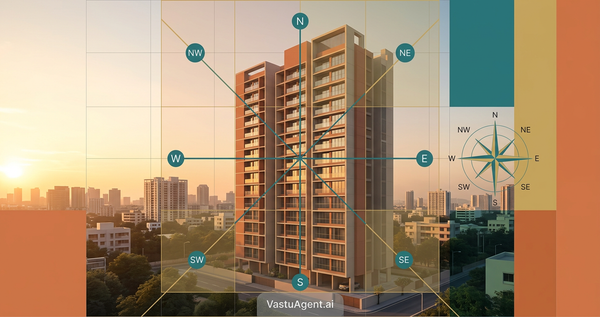
How to Determine Home Entrance and Facing Direction in Vastu?
Learn how to determine your house facing direction accurately from the Brahmasthan or main entrance. Free Vastu compass tool inside for instant analysis.

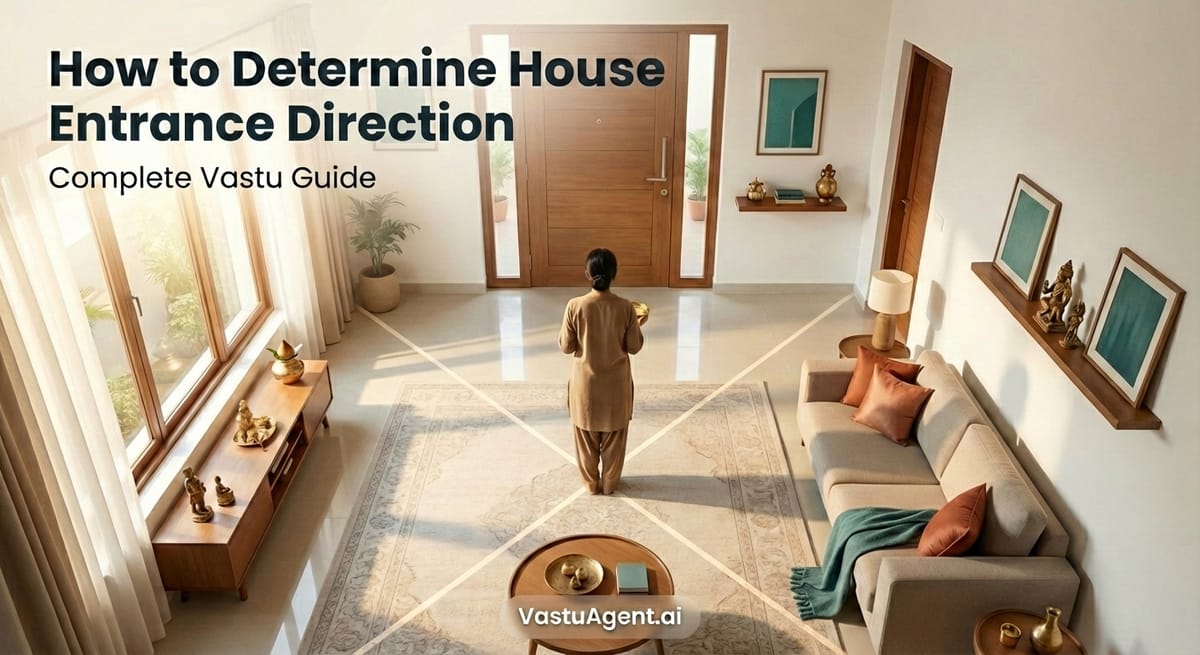
Before diving into Vastu analysis, you need to understand two foundational concepts that serve different purposes:
1. Brahmasthan: The Home Centre Point for Vastu Analysis
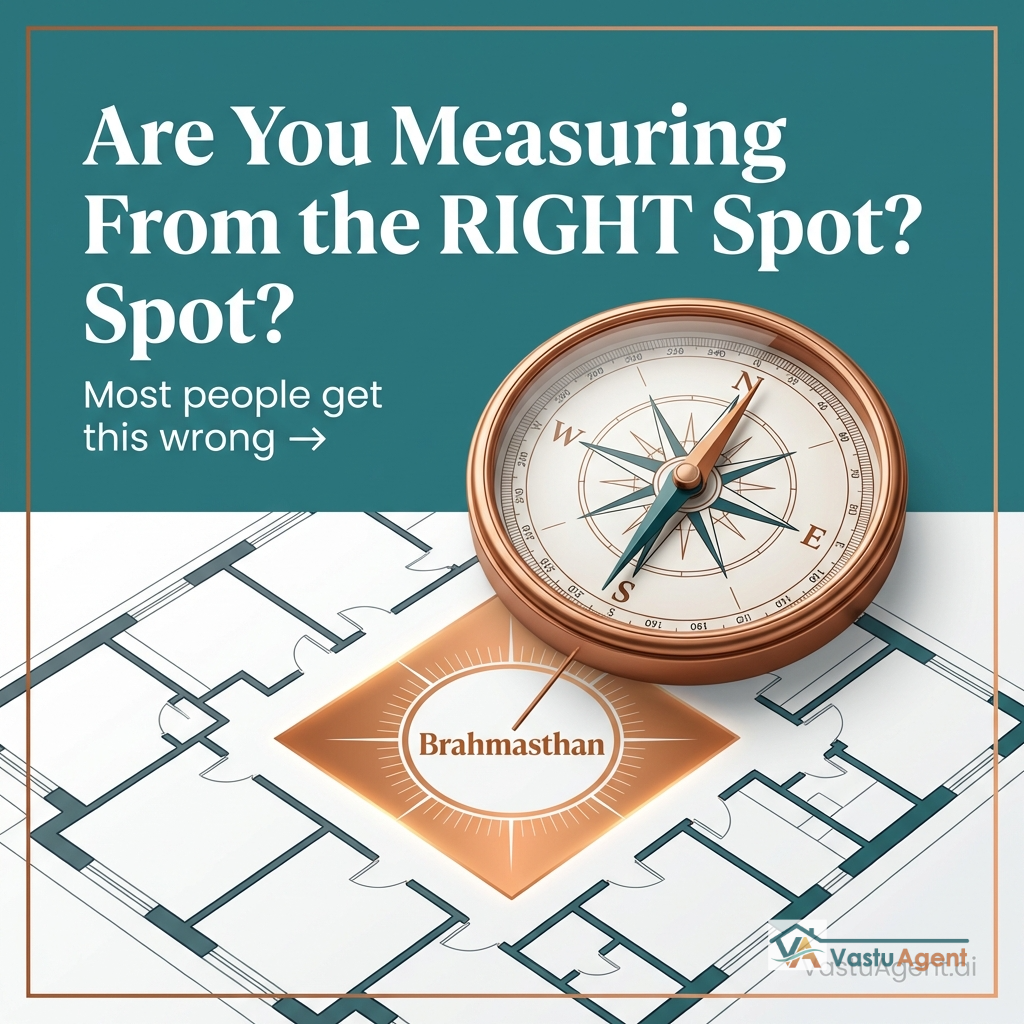
The Brahmasthan is the geometric centre of your home—found by drawing diagonal lines from corner to corner. This central point is essential for complete Vastu analysis of your entire home.
The Vastu Purusha Mandala (the sacred 81-cell grid mapping 45 deities) is overlaid from this centre point. This determines which energy zones govern which areas of your floor plan. All room placement analysis, defect identification, and remedy recommendations depend on correctly locating the Brahmasthan first.
2. House Facing Direction: Understanding Entrance Energy Flow
Your house facing direction is determined by standing at your main entrance and facing outward. This tells you which direction your home opens to the world and how cosmic energy (Prana) enters your living space.
Since the main door is the primary entry point for energy, the direction it faces directly affects:
- The quality of Prana flowing into your home
- Natural light and ventilation patterns
- The auspiciousness of your entrance placement within its wall (pada position)
How They Work Together
Both concepts serve the complete picture: the Brahmasthan establishes your home's internal energy grid for analysis, while the facing direction determines how external energy enters and flows through that grid.
This guide covers both—how to find your Brahmasthan for home analysis, and how to determine your house facing direction for understanding entrance energy flow. You can use VastuAgent.ai's free Vastu Compass tool to measure both accurately.
Why House Facing Direction Matters
According to a 2023 survey by Magicbricks, 73% of Indian homebuyers consider Vastu compliance before purchasing property. Of these, over 80% specifically ask about house facing direction first.
This isn't superstition—it's practical wisdom refined over 5,000 years of observation.
Energy Flow and the Main Entrance
Vastu is fundamentally concerned with the flow of energy into the home. Since the main door is the primary entry point for this energy, the direction it faces determines the quality of Prana (life force) entering your space.
The Brahma Sutra—an imaginary line running from the front door, through the Brahmasthan, to the back of the house—represents this axis of energy flow. A clear, unobstructed Brahma Sutra allows positive energy to permeate the entire home.
Sunlight and Natural Energy
Each direction receives different quality and quantity of sunlight throughout the day:
| Direction | Morning Sun | Afternoon Sun | Energy Quality |
|---|---|---|---|
| East | Direct, strong | Indirect | Energizing, purifying |
| West | Indirect | Direct, intense | Warming, sometimes harsh |
| North | Soft, diffused | Soft, diffused | Stable, cooling |
| South | Angled | Strong, hot | Intense, fiery |
East-facing entrances receive beneficial morning sun—rich in UV light that naturally purifies air and boosts vitamin D synthesis. The Surya Siddhanta, an ancient astronomical text, describes morning sun rays as carrying Prana most abundantly.
Practical Modern Benefits
Beyond traditional energy concepts, house facing direction affects:
- Electricity bills: East and North-facing homes often require less artificial lighting in morning hours
- Interior comfort: South-facing homes in hot climates may need more cooling
- Plant growth: Indoor plants thrive differently based on light direction
- Resale value: Vastu-compliant homes command 5-15% premium in Indian real estate markets
After analyzing over 10,000 floor plans at VastuAgent.ai, we've found that homes where facing direction aligns well with room functions report higher satisfaction in surveys about comfort, peace, and overall wellbeing.
📐 Curious how your home's facing direction affects each room? Upload your floor plan to VastuAgent.ai's Floor Plan Optimizer for instant zone-by-zone analysis—completely free.
→ Analyze Your Floor Plan: vastuagent.ai/floor-plan-optimizer
What Is House Facing Direction in Vastu?
Your house facing direction is the compass direction of your home's primary orientation. In classical Vastu texts like the Brihat Samhita and Mayamata, this orientation determines how the entire Vastu Purusha Mandala—the sacred 81-cell grid mapping 45 deities—aligns with your floor plan.
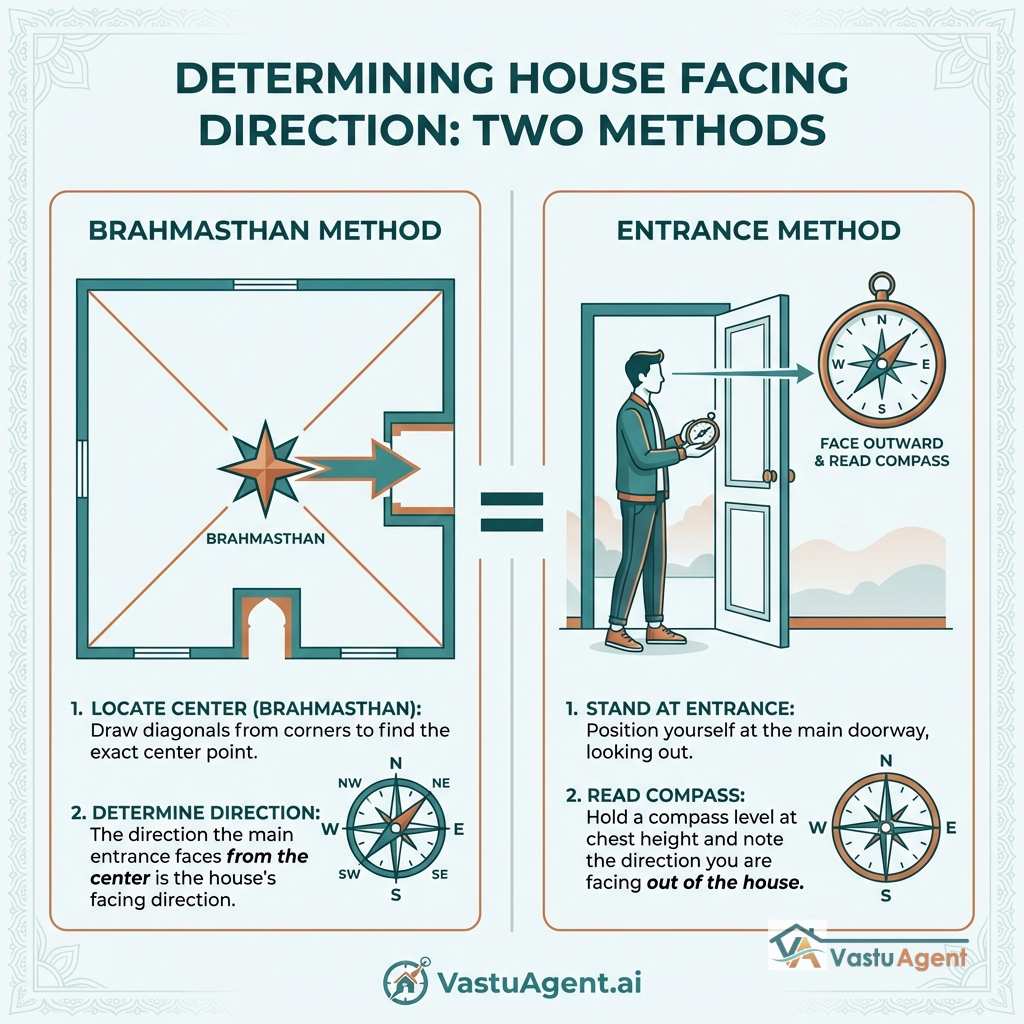
There are two ways to understand "facing direction," and both are important:
1. Architectural Facing Direction (from Brahmasthan) This is determined by standing at the geometric center of your home and looking toward the main architectural front. This method establishes the overall orientation of the Vastu Purusha Mandala on your property.
2. Entrance Facing Direction (from Main Door) This is the direction you face when standing at your main entrance looking outward. This method determines how cosmic energy—or Prana—primarily enters your home.
Both measurements matter. The Brahmasthan method establishes your home's fundamental grid alignment, while the entrance method determines the quality and direction of energy flow into your living space.
Think of it this way: if your home were a person, the Brahmasthan would be the navel (the center of balance), while the main entrance would be the face (where sensory input and life force enter).
You can verify your home's exact facing direction in seconds using VastuAgent.ai's free Vastu Compass tool—it helps you accurately determine both your architectural and entrance orientations.
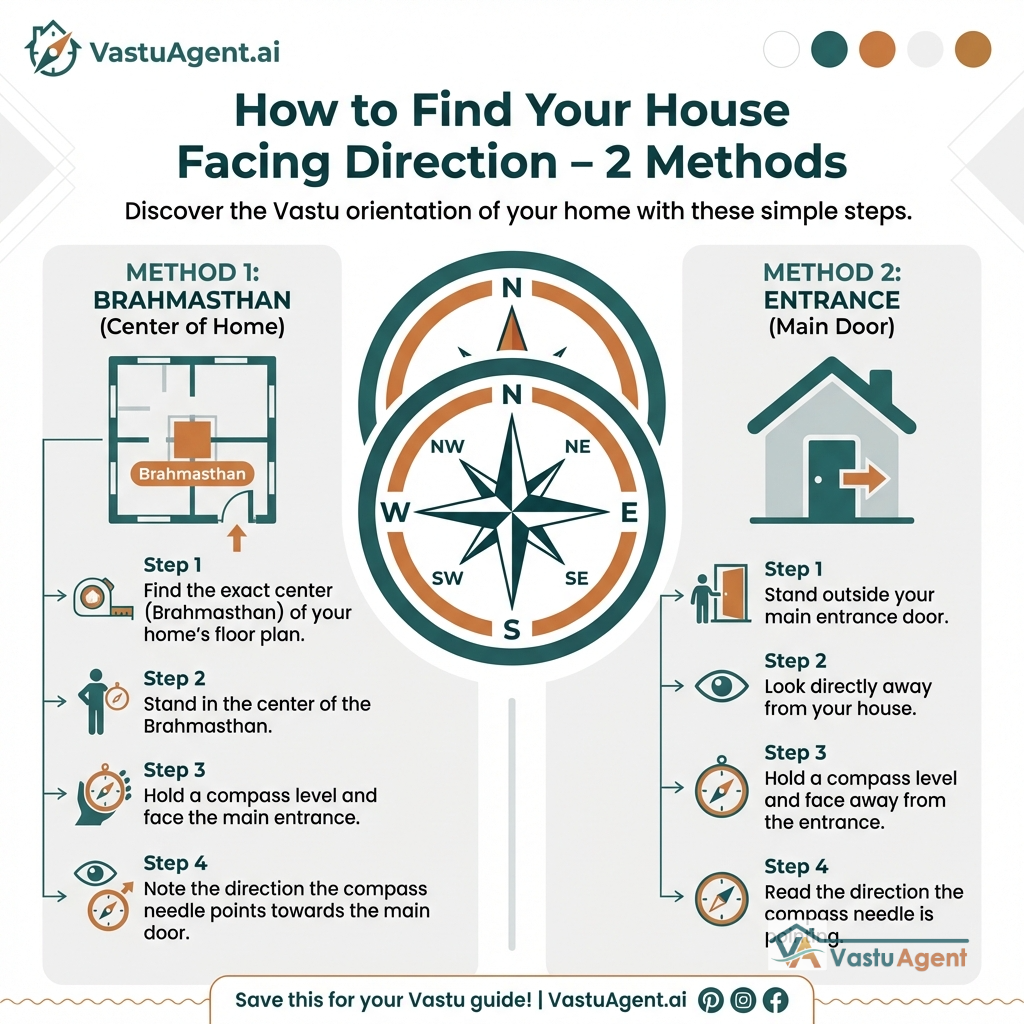
🧭 Not sure which way your home actually faces? VastuAgent.ai's free Vastu Compass tool helps you measure accurately—no guesswork required.
→ Try Free Vastu Compass: vastuagent.ai/free-resources/vastu-compass
Why House Facing Direction Matters
According to a 2023 survey by Magicbricks, 73% of Indian homebuyers consider Vastu compliance before purchasing property. Of these, over 80% specifically ask about house facing direction first.
This isn't superstition—it's practical wisdom refined over 5,000 years of observation.
Energy Flow and the Main Entrance
Vastu is fundamentally concerned with the flow of energy into the home. Since the main door is the primary entry point for this energy, the direction it faces determines the quality of Prana (life force) entering your space.
The Brahma Sutra—an imaginary line running from the front door, through the Brahmasthan, to the back of the house—represents this axis of energy flow. A clear, unobstructed Brahma Sutra allows positive energy to permeate the entire home.
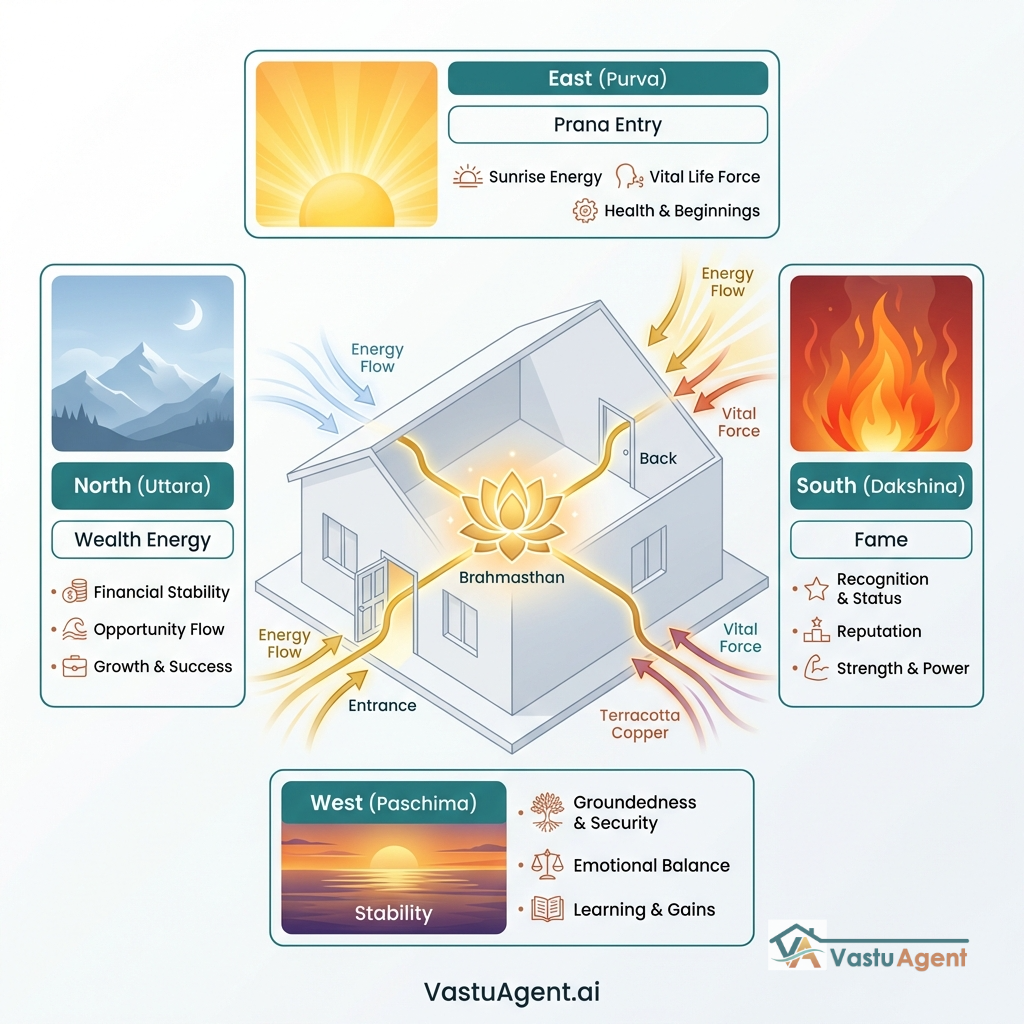
Sunlight and Natural Energy
Each direction receives different quality and quantity of sunlight throughout the day:
| Direction | Morning Sun | Afternoon Sun | Energy Quality |
|---|---|---|---|
| East | Direct, strong | Indirect | Energizing, purifying |
| West | Indirect | Direct, intense | Warming, sometimes harsh |
| North | Soft, diffused | Soft, diffused | Stable, cooling |
| South | Angled | Strong, hot | Intense, fiery |
East-facing entrances receive beneficial morning sun—rich in UV light that naturally purifies air and boosts vitamin D synthesis. The Surya Siddhanta, an ancient astronomical text, describes morning sun rays as carrying Prana most abundantly.
Practical Modern Benefits
Beyond traditional energy concepts, house facing direction affects:
- Electricity bills: East and North-facing homes often require less artificial lighting in morning hours
- Interior comfort: South-facing homes in hot climates may need more cooling
- Plant growth: Indoor plants thrive differently based on light direction
- Resale value: Vastu-compliant homes command 5-15% premium in Indian real estate markets
After analyzing over 10,000 floor plans at VastuAgent.ai, we've found that homes where facing direction aligns well with room functions report higher satisfaction in surveys about comfort, peace, and overall wellbeing.
📐 Curious how your home's facing direction affects each room? Upload your floor plan to VastuAgent.ai's Floor Plan Optimizer for instant zone-by-zone analysis—completely free.
→ Analyze Your Floor Plan: vastuagent.ai/floor-plan-optimizer
Method 1: Determining House Facing Direction from the Brahmasthan
The Brahmasthan method establishes your home's fundamental orientation by measuring from the geometric center. This is the classical Vastu approach that determines how the Vastu Purusha Mandala aligns with your property.
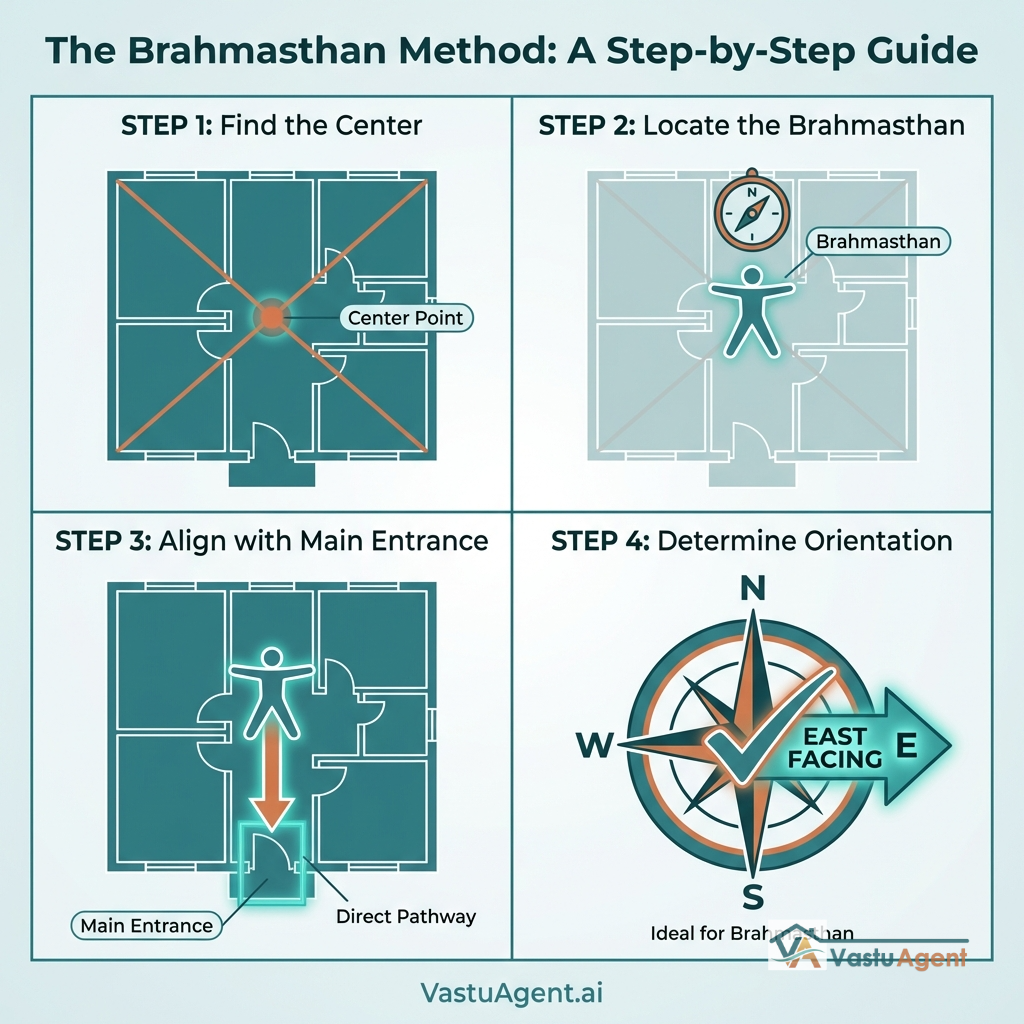
Step 1: Locate the Brahmasthan (Centroid)
The Brahmasthan is the "navel" or central portion of your home. In the Vastu Purusha Mandala, this occupies the central 9 squares of an 81-square grid.
For Square or Rectangular Plots: Draw diagonal lines from corner to corner of your main structure. The point where they intersect is your Brahmasthan.
For Irregular Plots: Divide the plot into squares or rectangles first, then determine the gravitational center. The Brahmasthan must be precisely located for accurate measurements.
Step 2: Position Yourself for Measurement
Once you've identified the centroid, all directional measurements must originate from this point.
On-Site Method: Stand approximately in the middle of your plot at the Brahmasthan. Hold your compass flat and steady at chest level.
Using a Floor Plan: Spread your floor plan on a flat surface. Mark the Brahmasthan point (where diagonals intersect). Place a magnetic compass exactly over this marked point.
Step 3: Align with North
Rotate your compass until the needle (typically colored red or marked 'N') aligns exactly with the North marking on the dial.
Important Note on True North vs. Magnetic North: A compass shows Magnetic North, but strict Vastu principles often require True North (Geographic North). The difference between these—called magnetic declination—varies by location. In most of India, this difference is 0-2 degrees, which is negligible for practical purposes. If you're in regions with higher declination, consider adjusting your reading.
Step 4: Determine the Facing Direction
The "facing" of the house is defined by the architectural front of the building as viewed from the Brahmasthan looking outward.
Stand at the Brahmasthan and face toward the main architectural front (usually where your main gate or door is located). The direction you are facing—outward from the center—is your House Facing Direction.
Example: If you stand at the Brahmasthan, look toward your main architectural front, and you're facing East according to your compass, you have an East-facing house.
The Brahma Sutra Confirmation
Vastu requires a clear "line of sight" or "thread of light" traveling from the front door, through the Brahmasthan, to the back of the house. This axis—called the Brahma Sutra—helps confirm your orientation is correct. If this line passes cleanly through the center without major obstructions, your measurement is likely accurate.
🕉️ Want to see how the 81-cell Vastu Purusha Mandala applies to your home? VastuAgent.ai's Vastu Purusha tool maps the ancient grid onto modern floor plans interactively.
→ Explore Vastu Purusha: vastuagent.ai/vastu-purusha
Method 2: Determining Entrance Facing Direction from the Main Door
The entrance facing direction tells you how energy enters your home. This is the direction you face when standing at your main entrance looking outward—and it's crucial for understanding your home's Prana flow.
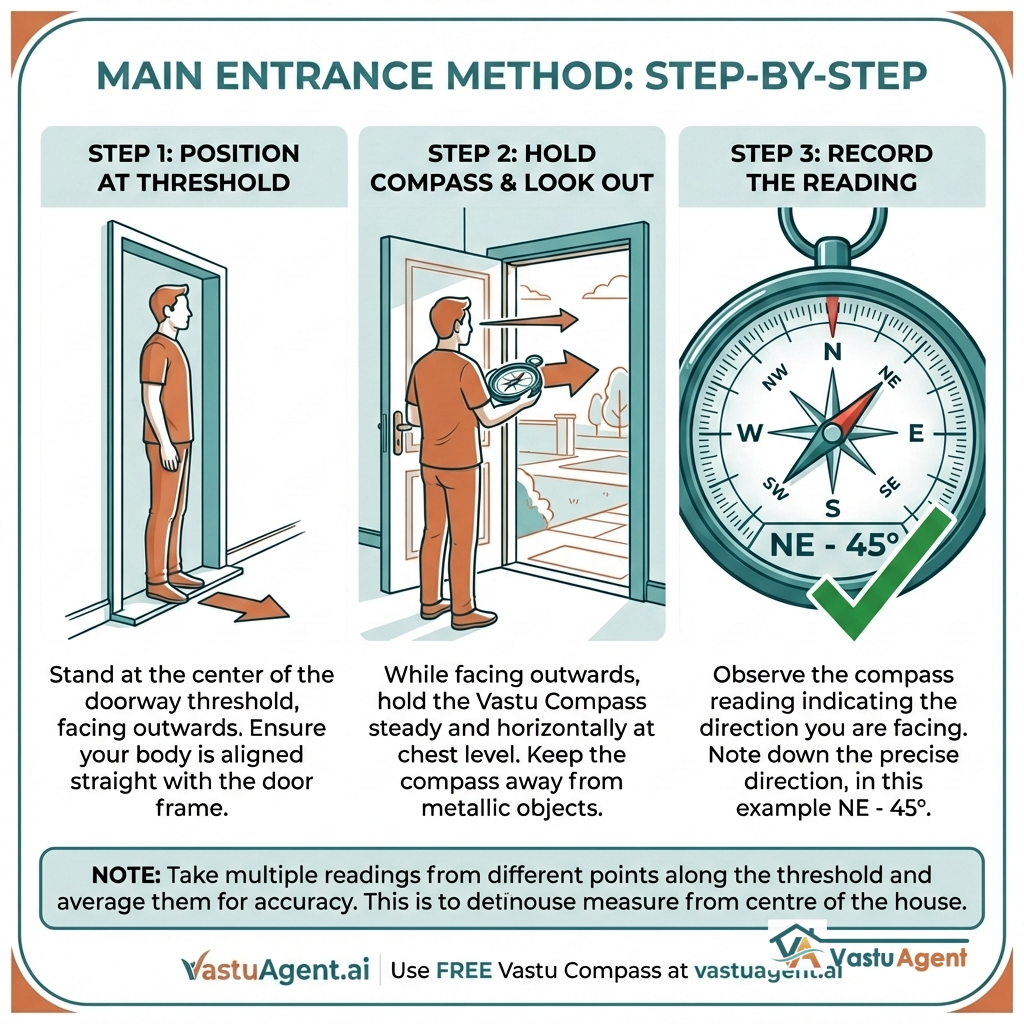
The correct way to check the direction of your house's main entrance:
Step 1: The Standing Position
- Stand exactly at the center of your main entrance door
- Face outward, as if you are about to step out of the house
- Hold a compass (physical or reliable smartphone app) flat and steady at chest level
Step 2: The Measurement
- Let the compass needle settle completely (10-15 seconds)
- The direction you are facing (North, East, South, West, or a sub-direction like Northeast) is the direction of your house's main entrance
- Tip: Take multiple readings from the doorway AND near the center of the house to ensure accuracy, as local magnetic interference (metal objects, electrical wiring) can affect readings
Why This Method Matters
Vastu is concerned with the flow of energy into the home. Since the main door is the primary entry point for this energy, the direction you look when you exit—the direction the door opens onto—is the crucial directional alignment.
This entrance direction determines:
- The quality of Prana entering your home
- Which deities govern your entrance zone
- The appropriate remedies if corrections are needed
- The auspiciousness of your door's specific placement
The Simplest Way: Use VastuAgent.ai's Free Vastu Compass
Skip the manual calculations entirely. VastuAgent.ai offers a free Vastu Compass tool that helps you:
- Accurately measure your entrance direction
- Identify which of the 16 zones your door falls in
- Understand the Vastu implications instantly
→ Access Free Vastu Compass: vastuagent.ai/free-resources/vastu-compass
The tool guides you through the measurement process and provides instant analysis of your entrance direction's Vastu significance.
🧭 Get accurate direction readings instantly. VastuAgent.ai's free Vastu Compass tool eliminates guesswork and shows you exactly what your entrance direction means.
→ Try Free Vastu Compass: vastuagent.ai/free-resources/vastu-compass
Understanding the 8 Vastu Directions
Each direction carries specific energy characteristics governed by particular deities. Understanding these helps you interpret what your house facing direction means.

The Four Cardinal Directions
North (Uttara) — Lord Kubera's Domain
The North is governed by Kubera, the deity of wealth and prosperity. North-facing entrances are considered highly auspicious for business owners, entrepreneurs, and those seeking financial growth.
Energy characteristics:
- Magnetic energy flows from North
- Associated with the water element
- Best for: Offices, living rooms, treasury rooms
East (Purva) — Lord Indra's Domain
The East belongs to Indra, king of the gods, associated with the rising sun, new beginnings, and vitality. East-facing entrances receive the earliest morning light and are considered excellent for family health and social status.
Energy characteristics:
- Source of morning Prana (life force)
- Associated with growth and health
- Best for: Main entrance, prayer rooms, living areas
South (Dakshina) — Lord Yama's Domain
The South is ruled by Yama, the god of dharma. While often misunderstood as inauspicious, South-facing homes aren't inherently bad—they simply require specific design considerations.
Energy characteristics:
- Associated with fire element and fame
- Receives intense afternoon sun
- Best for: Storage, heavy construction, closed spaces
West (Paschima) — Lord Varuna's Domain
The West belongs to Varuna, deity of water and oceans. West-facing entrances receive the setting sun and are associated with satisfaction, stability, and gains after effort.
Energy characteristics:
- Evening light, reflective energy
- Associated with water element
- Best for: Dining rooms, children's study areas
The Four Inter-Cardinal Directions
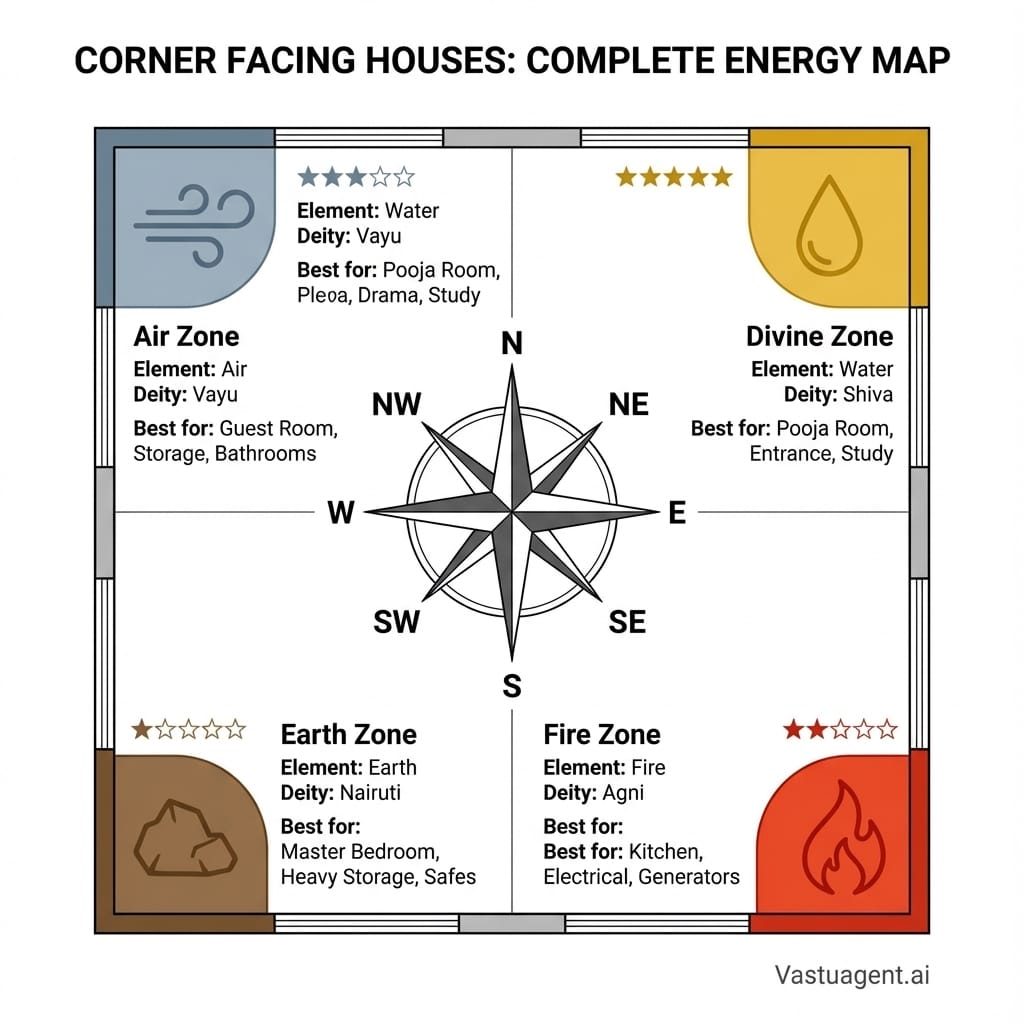
Northeast (Ishanya) — Lord Ishana's Domain The most sacred direction. Ideal for prayer rooms, water elements, open spaces. Avoid toilets, heavy storage, clutter.
Southeast (Agneya) — Lord Agni's Domain The fire corner. Ideal for kitchen, electrical panels, generators. Avoid bedrooms, water storage.
Southwest (Nairitya) — Lord Nairuthi's Domain The zone of stability. Ideal for master bedroom, storage of valuables. Avoid main entrance, water features.
Northwest (Vayavya) — Lord Vayu's Domain The air corner. Ideal for guest rooms, bathrooms, garage. Avoid master bedroom, treasury.
🧭 See exactly how these 8 directions map onto YOUR floor plan. VastuAgent.ai's Vastu Chakra tool creates an instant visual overlay of all energy zones.
→ Try Vastu Chakra: vastuagent.ai/vastu-chakra
The Role of Padas: Why Exact Door Position Matters
Once you determine the main direction (e.g., East), you need to apply the concept of Pada Vinnyasa to determine the exact auspiciousness of the door's placement along that wall.
What Are Padas?
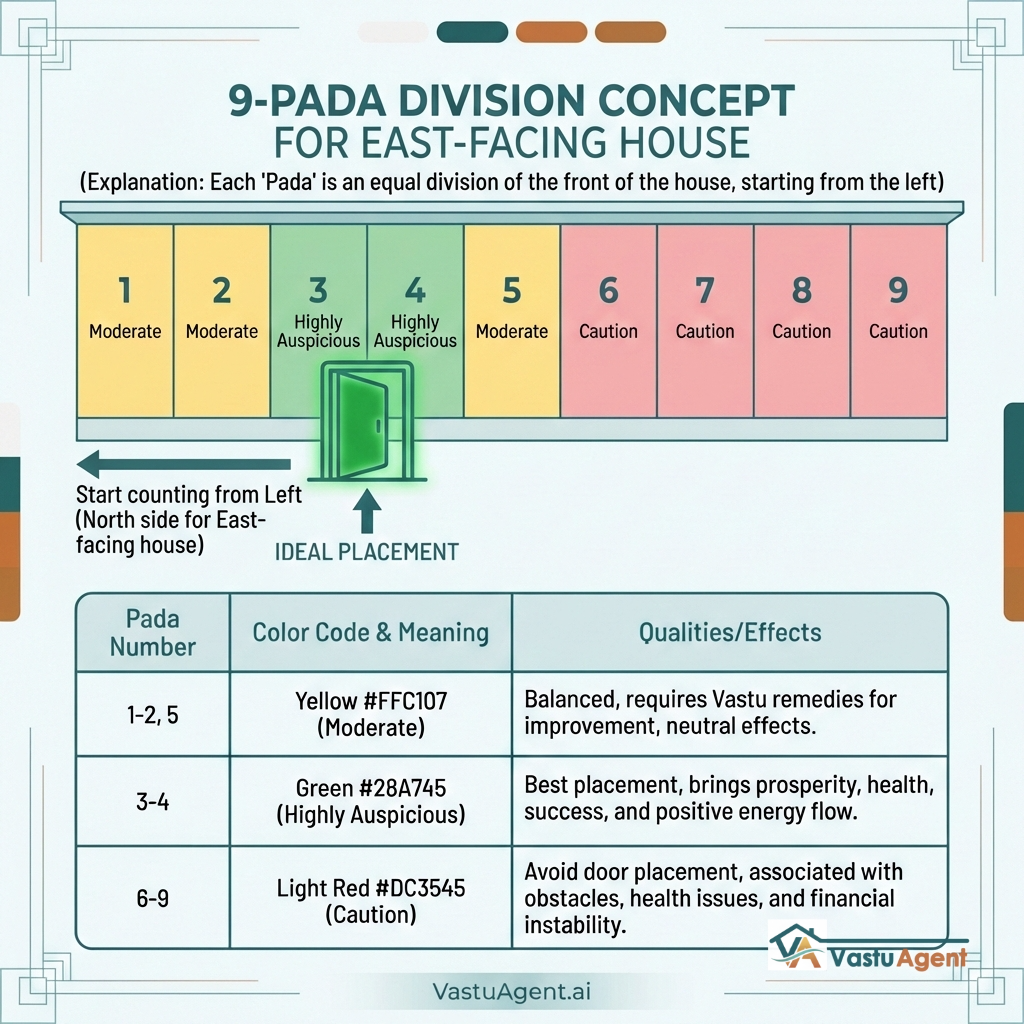
Padas are equal segments that divide each wall of your home. The entire length of the wall containing your main door is divided into 9 segments (or sometimes 32 in more detailed analysis). Each pada is associated with specific energy qualities—some highly auspicious, others to be avoided.
How Pada Placement Works
Step 1: Identify which wall contains your main entrance (e.g., the East wall)
Step 2: Divide that wall's length into 9 equal segments, counting from the corner
Step 3: Identify which pada(s) your door occupies
Step 4: Check the Vastu significance of those specific padas
Example: East-Facing House
For an East-facing house, the padas are counted from the Northeast corner moving toward the Southeast corner:
| Pada | Position | Vastu Quality |
|---|---|---|
| 1st | Closest to NE | Mixed |
| 2nd | Generally positive | |
| 3rd | Highly auspicious (wealth) | |
| 4th | Highly auspicious (prosperity) | |
| 5th | Center | Neutral |
| 6th | Caution advised | |
| 7th | Avoid if possible | |
| 8th | Avoid if possible | |
| 9th | Closest to SE | Not recommended |
The 3rd and 4th padas from the Northeast corner are often considered most auspicious for East-facing homes, associated with wealth, health, and prosperity.
Why Pada Analysis Matters
While your facing direction tells you the general flow of energy, the pada tells you the precise location on that wall to place the door for optimal results. Two East-facing houses can have vastly different Vastu qualities depending on which pada contains their main entrance.
VastuAgent.ai's analysis tools automatically calculate your door's pada position and provide specific recommendations based on your exact placement.
📐 Discover your door's exact pada position. VastuAgent.ai's Floor Plan Optimizer identifies which segment your entrance occupies and what it means for your home.
→ Analyze Your Entrance: vastuagent.ai/floor-plan-optimizer
Common Mistakes When Finding House Direction
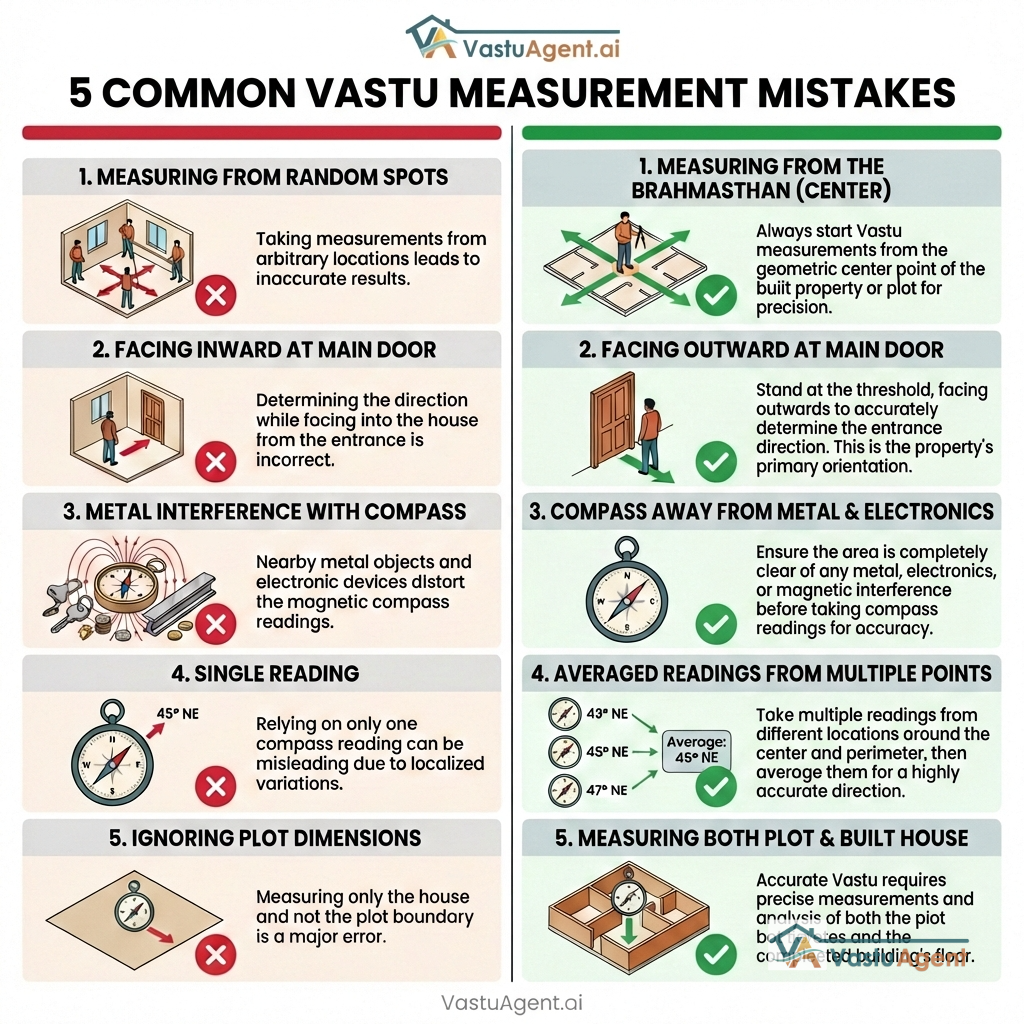
After reviewing thousands of Vastu consultations, certain errors appear repeatedly. Avoid these to ensure accurate analysis.
Mistake 1: Measuring From the Wrong Position
Many people measure direction while standing at the main door facing inward, or from random spots in the house.
Correct approach:
- For architectural facing: Measure from the Brahmasthan (geometric center) facing outward toward the main front
- For entrance facing: Stand at the door threshold facing outward
Mistake 2: Confusing Architectural Front With Main Door
The main door defines the entrance direction, but if the door is on one wall while the architectural front faces another direction, both matter.
Example: A home with its architectural facade facing South but the main door angled toward the East is still considered a South-facing house architecturally, though the entrance direction is East.
Mistake 3: Ignoring Magnetic Interference
Metal objects distort compass readings significantly. Common culprits:
- Iron door frames and grills
- Electrical wiring in adjacent walls
- Reinforced concrete with steel rebar
- Smartphones and smart watches
- Nearby vehicles
Solution: Take readings 2-3 feet away from metal objects. Take multiple measurements and average them.
Mistake 4: Not Taking Multiple Readings
Taking just one compass reading can lead to errors.
Correct approach:
- Take at least 3 readings from the doorway
- Take additional readings near the Brahmasthan
- Average the results
- Cross-verify with a different compass or app
Mistake 5: Confusing Plot Direction With House Direction
Your plot may face one direction while your house faces another. The built structure's orientation matters for Vastu, not the plot boundaries.
🧭 Eliminate measurement errors completely. Use VastuAgent.ai's free Vastu Compass for guided, accurate directional analysis.
→ Free Vastu Compass: vastuagent.ai/free-resources/vastu-compass
House Facing Direction and Room Placement
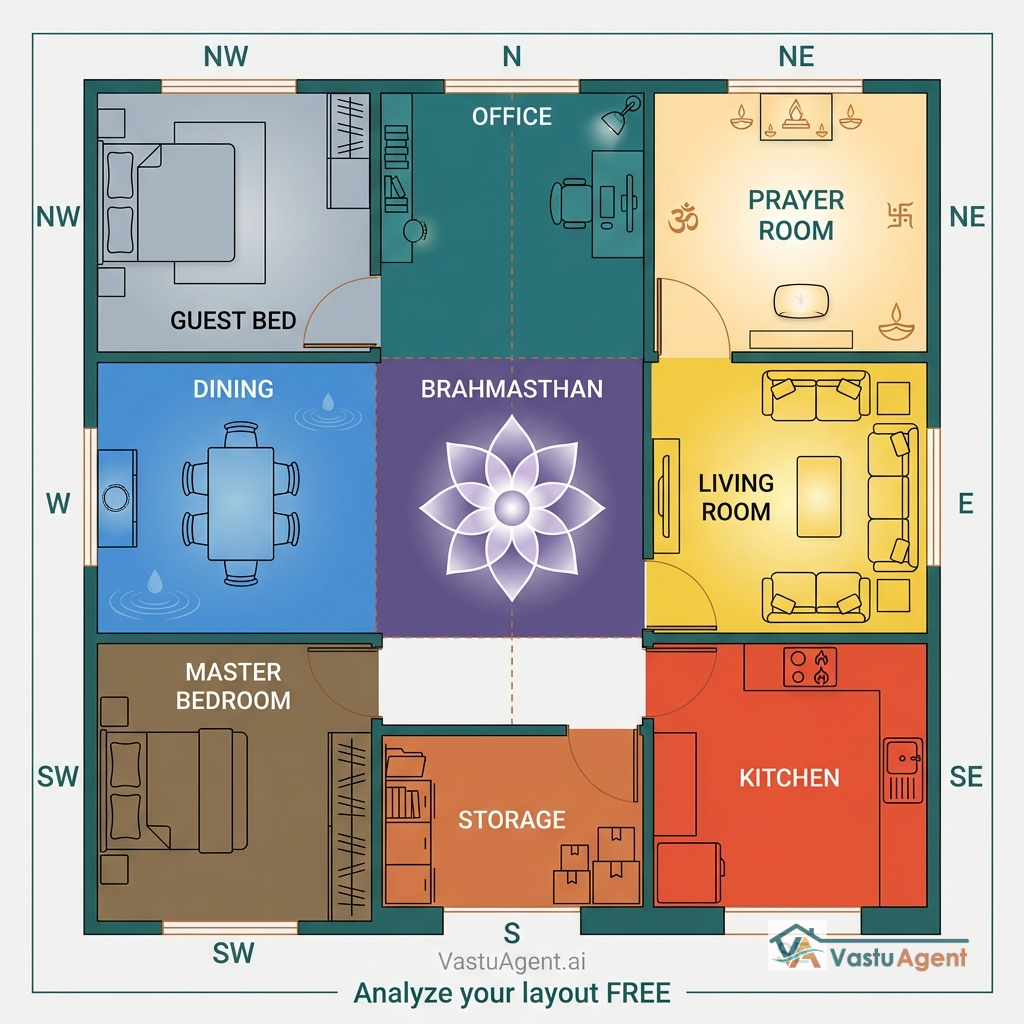
Once you know your house facing direction, you can evaluate whether your room placements align with Vastu principles.
Ideal Room Placements by Zone
| Room | Best Zone(s) | Avoid Zone(s) |
|---|---|---|
| Master Bedroom | Southwest, South | Northeast, Southeast |
| Kitchen | Southeast | Northeast, Southwest |
| Living Room | North, East, Northeast | Southwest |
| Bathroom/Toilet | West, Northwest, South | Northeast, East |
| Prayer Room | Northeast | South, Southwest |
| Children's Bedroom | West, North | Southeast |
| Guest Room | Northwest | Southwest |
| Home Office | North, Northeast | South |
| Staircase | South, West | Northeast, Center |
How Facing Direction Affects Placements
Your house facing direction determines where each zone falls in your actual floor plan.
North-Facing House:
- Northeast is to the front-right
- Southwest is to the back-left
- Master bedroom should ideally be in the back-left (Southwest) zone
East-Facing House:
- Northeast is to the front-left
- Southwest is to the back-right
- Room placements rotate accordingly
The classical text Manasara emphasizes that correct room placement relative to facing direction can amplify positive effects significantly, while incorrect placement can neutralize even the benefits of an auspicious facing direction.
📊 Get a complete zone-by-zone analysis of your home. VastuAgent.ai's Free Report delivers 25+ pages of personalized insights based on YOUR specific layout.
→ Get Your FREE Report: vastuagent.ai/free-report
What If Your House Faces an Inauspicious Direction?
Not every home can face East or North. If your house facing direction is considered less favorable—South or West—Vastu offers effective remedies.

Understanding "Inauspicious" Directions
No direction is truly bad. Each direction has specific strengths and requires specific approaches.
South-facing homes are excellent for:
- Politicians and those in public positions
- People in fame-related professions
- Those seeking recognition and reputation
West-facing homes are excellent for:
- Business people (especially retail)
- People seeking stability and long-term gains
- Those in teaching or knowledge-sharing professions
The Mayamata text states that "a skilled architect can make any direction auspicious through proper design and correction."
Practical Remedies by Facing Direction
For South-Facing Homes:
- Place heavy objects and tall furniture in the Southwest
- Keep North and Northeast as open and clutter-free as possible
- Use light colors (white, cream, light blue) in Northern rooms
- Place a small water feature in the North or Northeast
- Ensure the main entrance has a threshold and is well-lit
For West-Facing Homes:
- Create a heavier presence in the West and Southwest
- Use earth tones and yellow shades in Western rooms
- Place a mirror on the Eastern wall of the entrance lobby
- Keep windows in East and North larger than those in West and South
- Use copper or brass elements near the entrance
The Importance of Pada Selection
Even within a "less favorable" direction, the exact pada (segment) of your door placement can significantly improve outcomes. A South-facing home with the entrance in an auspicious pada of the Southern wall can be highly beneficial.
VastuAgent.ai's analysis identifies your door's exact pada position and provides customized remedies based on your specific situation.
✨ Get personalized remedies for YOUR home's specific layout. VastuAgent.ai analyzes your floor plan and provides customized corrections.
→ Start Free Analysis: vastuagent.ai/free-report
Quick Reference: How to Find Your House Facing Direction
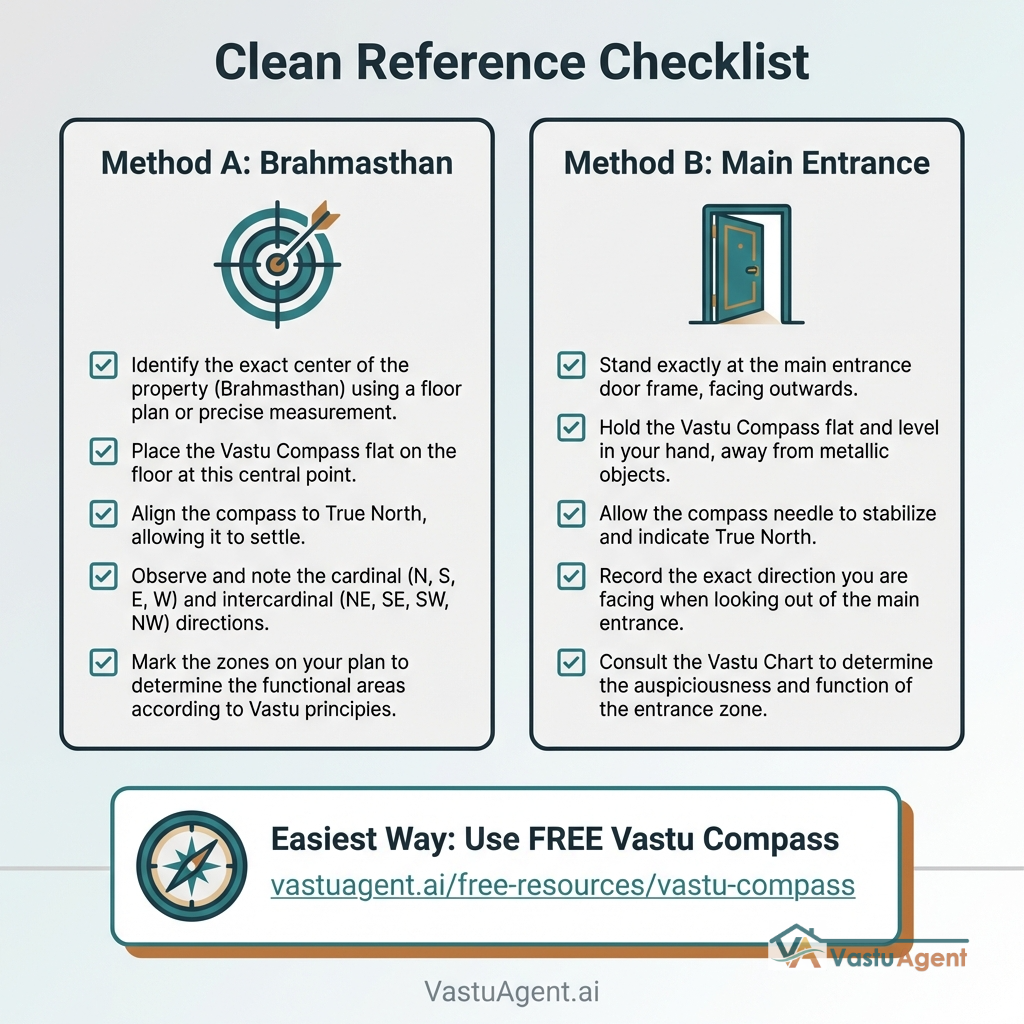
Method A: From the Brahmasthan (Architectural Orientation)
- Find the Center: Draw diagonals on your floor plan—where they intersect is your Brahmasthan
- Stand or Place Compass: Position yourself (or your compass) at this center point
- Face the Front: Look toward your main architectural front (where the main gate/door is)
- Read Direction: The direction you're facing outward is your House Facing Direction
Method B: From the Main Entrance (Energy Flow)
- Stand at Door: Position yourself at the center of your main entrance threshold
- Face Outward: Look out as if you're about to step outside
- Hold Compass Level: Keep it flat at chest height, wait for needle to settle
- Read Direction: The direction you're facing is your Entrance Facing Direction

The Easiest Way: Use Free Tools
VastuAgent.ai's Free Vastu Compass: vastuagent.ai/free-resources/vastu-compass
- Guides you through accurate measurement
- Shows your direction's Vastu significance
- Identifies your entrance zone instantly
Frequently Asked Questions
Q: How do I find the facing direction of my house?
There are two methods. For architectural orientation, stand at the Brahmasthan (geometric center) and face toward your main architectural front—that direction is your house facing direction. For entrance direction, stand at your main door facing outward, and the direction you're looking is your entrance facing direction. Both measurements matter for complete Vastu analysis.
Q: What is the Brahmasthan and why does it matter?
The Brahmasthan is the geometric center or "navel" of your home—found by drawing diagonals from corner to corner. In the Vastu Purusha Mandala, it occupies the central 9 squares of the 81-cell grid. All directional measurements for the overall house orientation should originate from this point.
Q: Which house facing direction is best according to Vastu?
East-facing and North-facing homes are traditionally considered most auspicious. East-facing homes receive beneficial morning sun and are associated with health, while North-facing homes are linked to prosperity and wealth. However, any direction can be made auspicious with proper design, door placement in the right pada, and appropriate remedies.
Q: Is South-facing house bad in Vastu?
South-facing homes are not inherently bad. They're particularly suitable for people in public-facing professions, politics, or those seeking fame and recognition. The key is ensuring the entrance is in an auspicious pada (segment) of the South wall, and that the Southwest is properly weighted while the Northeast remains light and open.
Q: What is a pada and why does it matter?
A pada is one of the 9 equal segments that divide each wall of your home. Your main door's position within these segments significantly affects Vastu outcomes. Even in a favorable direction, a door in the wrong pada can create challenges, while a door in an auspicious pada can enhance positive energy regardless of the main direction.
Q: How do I use the Vastu Compass tool?
Visit vastuagent.ai/free-resources/vastu-compass. The tool guides you through the measurement process—helping you stand in the correct position, take accurate readings, and instantly understand what your direction means for Vastu purposes. It's completely free and eliminates common measurement errors.
Q: Does apartment facing direction matter?
Yes, apartment facing direction follows the same principles as independent homes. The main apartment door determines the entrance facing direction—not the building lobby entrance. Stand at your apartment door facing outward and measure that direction.
Q: What if my compass shows degrees instead of directions?
Degrees translate directly to directions: 0°/360° is North, 90° is East, 180° is South, 270° is West. Ranges between indicate sub-directions (e.g., 45° is Northeast, 135° is Southeast). VastuAgent.ai's tools handle this conversion automatically.
Q: Can I use a smartphone compass for Vastu measurements?
Yes, smartphone compasses are sufficiently accurate for Vastu purposes. Calibrate by moving your phone in a figure-8 pattern before measuring. Take readings away from metal objects and electronic devices. Multiple readings averaged together help ensure accuracy.
Q: What is the Brahma Sutra?
The Brahma Sutra is an imaginary line running from your front door, through the Brahmasthan (center), to the back of your home. This axis represents the main energy flow path. A clear, unobstructed Brahma Sutra allows positive energy to permeate the entire house and helps confirm your directional measurement is correct.
Q: My house has multiple entrances. Which one determines facing direction?
Use the door that was architecturally designed as the primary entrance—typically the larger door, the one with more prominent design features, or the one facing the main road. If truly equal, analyze each separately, giving more weight to the more frequently used entrance.
Q: How accurate does my direction measurement need to be?
For basic Vastu analysis, knowing the cardinal or inter-cardinal direction (N, NE, E, SE, etc.) is sufficient. For advanced pada analysis, measurements accurate to within 5-10 degrees are recommended. Taking multiple readings and averaging them typically achieves this accuracy.
Transform Your Home with VastuAgent.ai
[IMAGE: VastuAgent.ai CTA]
Knowing your house facing direction is the foundation of all Vastu analysis. Now that you understand both the Brahmasthan method and the entrance method, you're ready to apply this knowledge to your home.
VastuAgent.ai brings 5,000 years of ancient wisdom into your hands with free, instant AI-powered analysis:
| Tool | What It Does | Best For |
|---|---|---|
| Free Vastu Compass | Guided directional measurement | Accurate direction finding |
| Vastu Chakra | Interactive compass with 16-zone mapping | Understanding energy zones |
| Vastu Purusha | 81-cell Mandala explorer with deity positions | Deep Vastu study, pada analysis |
| Floor Plan Optimizer | AI-powered defect detection | Existing home analysis |
| Floor Plan Generator | Create Vastu-compliant designs | New construction planning |
| Free Report | 25+ page comprehensive analysis | Complete home assessment |
Traditional Vastu consultants charge ₹15,000-50,000 for the same analysis. VastuAgent.ai delivers it free, instantly, from anywhere.
→ Start with the Free Vastu Compass: vastuagent.ai/free-resources/vastu-compass
→ Get Your Complete Free Report: vastuagent.ai/free-report
Join 10,000+ homeowners who've already transformed their spaces with VastuAgent.ai.