Seasonal Vastu Adjustments: Your Complete Guide to Year-Round Harmony
Discover how to adapt Vastu practices for every season and festival. Learn the Vastu Purusha rotation, auspicious months for construction, and dynamic tips for year-round harmony.


Your home felt perfect when you moved in during summer. But come winter, something shifted. The master bedroom feels colder, heavier. The kitchen lacks the warmth it once had. What changed?
According to classical Vastu texts, nothing about your home's structure changed—but the cosmic energy governing it did. The Vastu Purusha, the deity whose body forms the energetic blueprint of every structure, rotates his position every three months. This ancient understanding reveals that Vastu Shastra is not a static science. It breathes, moves, and transforms with the seasons.
Approximately 73% of Indians consider Vastu principles when making housing decisions. Yet most homeowners treat Vastu as a one-time checkbox—something to verify during purchase and forget thereafter. This approach misses the profound seasonal dimension that classical texts like the Mayamata and Vishwakarma Prakash emphasize repeatedly.
This guide reveals how to align your home with nature's rhythms throughout the year. You'll discover the quarterly rotation of the Vastu Purusha, the most auspicious months for major activities, festival-specific adjustments, and practical tips you can implement based on the current date and your location.
Understanding the Vastu Purusha's Seasonal Rotation
The Vastu Purusha doesn't lie still. He rotates his position based on the lunar calendar, completing a full cycle every year. This rotation determines which zones of your home are "active" and which should remain undisturbed during specific periods.
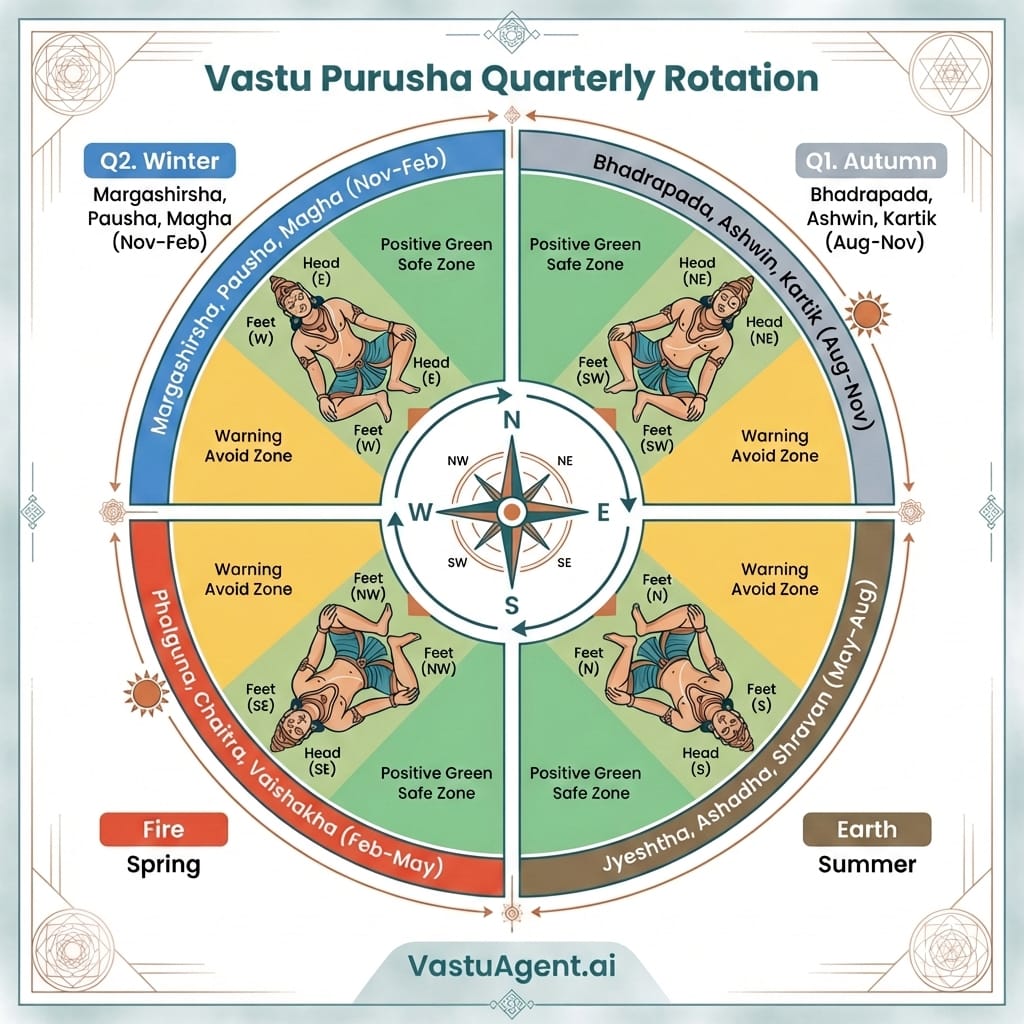
Think of it this way: if someone is sleeping with their head in a particular direction, you wouldn't want to disturb that area. The same principle applies to the Vastu Purusha. His head and feet positions mark zones where construction, renovation, or heavy digging should be avoided.
Classical texts prescribe this quarterly rotation with remarkable precision. The Brihat Samhita and Vishwakarma Prakash both confirm this cycle, linking it directly to the Sun's position in the sky.
August to November (Bhadrapada, Ashwin, Kartik)
During these months, the Vastu Purusha positions himself with:
| Body Part | Direction | Implication |
|---|---|---|
| Head | East | Do NOT dig or construct here |
| Feet | West | Avoid heavy work in this zone |
| Stomach | Center | Safe for activity |
The "stomach" region—the central and diagonal areas—remains safe for construction activity. This aligns scientifically with the Sun's eastward position during sunrise in these months.
If you're planning renovations during autumn, focus on the North-South axis rather than the East-West zones. The Vastu Purusha's vital organs (head and feet) rest along the East-West line during this period.
November to February (Margashirsha, Pausha, Magha)
Winter brings a significant shift:
| Body Part | Direction | Implication |
|---|---|---|
| Head | South | Avoid construction in South zone |
| Feet | North | Do NOT disturb the North sector |
| Stomach | Center | Safe for activity |
Notice how the axis rotates 90 degrees. Now the North-South line becomes sensitive. If you're planning to extend your home's northern boundary or add a basement in the South, wait until after February.
Interestingly, November to February represents the Uttarayan period when the Sun travels northward—considered highly auspicious for new beginnings despite the head-feet positioning.
February to May (Phalguna, Chaitra, Vaishakha)
Spring reverses the autumn orientation:
| Body Part | Direction | Implication |
|---|---|---|
| Head | West | Avoid heavy work in West zone |
| Feet | East | Do NOT dig in the East sector |
| Stomach | Center | Safe for activity |
This period includes some of the most auspicious months for construction (Phalguna and Vaishakha) according to classical texts. However, you must still respect the head-feet zones.
May to August (Jyeshtha, Ashadha, Shravan)
Summer brings another rotation:
| Body Part | Direction | Implication |
|---|---|---|
| Head | North | Avoid construction in North zone |
| Feet | South | Do NOT disturb the South sector |
| Stomach | Center | Safe for activity |
The North-South axis becomes sensitive again. This is important because many families undertake summer renovations when children are on vacation. Ensure your contractor avoids deep excavation in the North or South during these months.
You can visualize exactly how these zones map onto your actual floor plan using VastuAgent.ai's Vastu Chakra tool—it overlays the 16-zone grid onto your home's layout in seconds.
🧭 Not sure which zone falls where in YOUR home? VastuAgent.ai's Vastu Chakra tool maps all seasonal zones onto your floor plan instantly—completely free.
→ Try Vastu Chakra: vastuagent.ai/vastu-chakra
The Solar Calendar: Auspicious and Inauspicious Months
Beyond the Vastu Purusha's rotation, classical texts prescribe specific months for beginning construction, renovation, or Griha Pravesh (house-warming). Each lunar month carries distinct energies that influence the outcomes of activities started during that period.
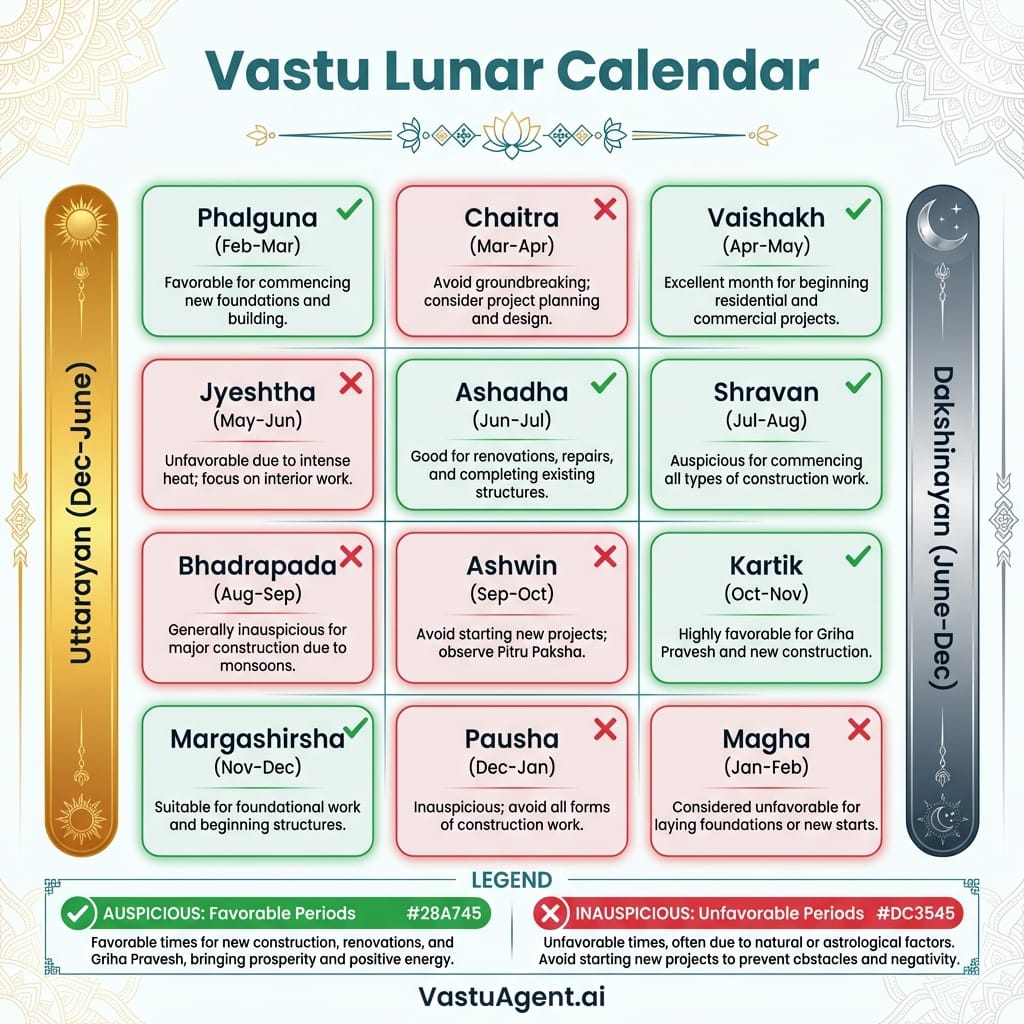
This isn't mere superstition. The ancient sages observed correlations between seasonal conditions—monsoon intensity, solar positioning, temperature extremes—and construction outcomes over centuries. Their observations crystallized into these guidelines.
Spring: February to April
Phalguna (February-March): One of the most auspicious months for construction. Starting work during Phalguna is associated with prosperity and progeny. The weather is temperate, neither too hot nor too cold, creating ideal conditions for construction materials to cure properly.
Chaitra (March-April): Traditionally avoided for construction. Classical texts associate this month with ailments and disease. From a practical standpoint, Chaitra marks the transition into summer heat, and construction started now faces the harshest curing conditions.
Vaishakh (April-May): Highly auspicious, bringing wealth and riches. Despite the increasing heat, Vaishakh is considered excellent for laying foundations. The dry conditions actually benefit concrete curing before monsoon arrives.
Summer: May to July
Jyeshtha (May-June): Avoid this month entirely. Classical texts associate Jyeshtha with death or alienation of the family head. The extreme heat makes construction conditions dangerous, and any work started now faces monsoon interruption.
Ashadha (June-July): Good for wealth, helpers, and acquiring vehicles or animals. The monsoon's arrival makes outdoor construction challenging, but interior work can proceed. This month favors activities related to accumulation and growth.
Monsoon: July to September
Shravan (July-August): Beneficial for gaining friends, contacts, and growing wealth. Despite heavy rains, Shravan is considered positive. Focus on planning, interior finishing, and relationship-building rather than foundation work.
Bhadrapada (August-September): Avoid—leads to loss and waste. The peak monsoon conditions create genuine construction risks. Even interior work faces humidity challenges during this period.
Ashwin (September-October): Avoid—associated with conflict and war. The tail-end of monsoon brings unstable weather patterns. Wait for October's more settled conditions.
Autumn and Winter: October to February
Kartik (October-November): Auspicious, bringing money and riches. Post-monsoon conditions are ideal for construction. The weather stabilizes, and work started now has clear sailing through winter.
Margashirsha (November-December): Very auspicious—brings money and food. This is considered one of the best months for Griha Pravesh. The comfortable temperatures and festive atmosphere add positive energy to new beginnings.
Pausha (December-January): Avoid—creates fear of theft. While the weather is pleasant, classical texts warn against starting major work during this period.
Magha (January-February): Avoid—creates fear of fire. The dry winter air increases fire risks during construction, providing a practical basis for this caution.
| Month | Auspicious? | Classical Association | Modern Practical Note |
|---|---|---|---|
| Phalguna | ✅ Yes | Prosperity, progeny | Ideal weather conditions |
| Chaitra | ❌ No | Ailments, disease | Transition to harsh heat |
| Vaishakh | ✅ Yes | Wealth, riches | Dry conditions favor concrete |
| Jyeshtha | ❌ No | Death, alienation | Extreme heat, monsoon approaching |
| Ashadha | ✅ Yes | Wealth, helpers | Early monsoon, interior focus |
| Shravan | ✅ Yes | Friends, contacts | Heavy rains, planning time |
| Bhadrapada | ❌ No | Loss, waste | Peak monsoon risks |
| Ashwin | ❌ No | Conflict, war | Unstable weather |
| Kartik | ✅ Yes | Money, riches | Post-monsoon stability |
| Margashirsha | ✅ Yes | Money, food | Best for Griha Pravesh |
| Pausha | ❌ No | Fear of theft | Pleasant but cautioned |
| Magha | ❌ No | Fear of fire | Dry air, fire risk |
If you're uncertain which lunar month you're currently in, VastuAgent.ai's tools can help you identify the right timing for your renovation or house-warming.
📊 Planning a major renovation or Griha Pravesh? Get your FREE comprehensive Vastu report that includes timing recommendations based on classical texts.
→ Get Your Free Report: vastuagent.ai/free-report
Uttarayan vs. Dakshinayan: The Solar Half-Years
Beyond monthly considerations, Vastu Shastra divides the year into two major periods based on the Sun's apparent movement—Uttarayan and Dakshinayan. This distinction fundamentally affects which activities to undertake.

Uttarayan (Approximately December 21 to June 21)
When the Sun travels northward, it's considered the period of the gods—a time of light, positivity, and new beginnings. This six-month window is ideal for:
- Laying foundation stones for new construction
- Griha Pravesh (house-warming ceremonies)
- Major renovations that transform the home's energy
- Installing pooja rooms and sacred spaces
The Bhishma Pitamaha of the Mahabharata chose to leave his body during Uttarayan, underscoring its spiritual significance. Any construction or home-related activity started during this period benefits from the ascending solar energy.
Dakshinayan (Approximately June 21 to December 21)
When the Sun travels southward, the energy shifts. This period is generally avoided for new beginnings, but it's not entirely inauspicious. Dakshinayan is suitable for:
- Installing fierce deities like Bhairav or Narsingh
- Protective remedies and defensive Vastu corrections
- Completion work on projects started during Uttarayan
- Planning and preparation for future activities
If you must begin construction during Dakshinayan, the Brihat Samhita recommends specific rituals to counterbalance the descending solar energy. Consulting a qualified Vastu practitioner for these ceremonies is advisable.
The transition points—the winter solstice (Makar Sankranti) and summer solstice—carry particularly potent energy. These are powerful days for setting intentions regarding your home's energy.
🕉️ Want to understand the deeper spiritual dimensions of Vastu? Explore VastuAgent.ai's interactive Vastu Purusha tool to see how cosmic energies map onto your home's structure.
→ Explore Vastu Purusha: vastuagent.ai/vastu-purusha
Festival-Specific Vastu Adjustments
India's festival calendar offers natural opportunities to refresh and recalibrate your home's Vastu energy. Each major festival carries specific energies that can be amplified through conscious Vastu adjustments.

Diwali (Deepavali): The Festival of Lights
Diwali falls on Amavasya (new moon) in the month of Kartik—the darkest night of the year. According to Vastu texts, evil forces become particularly active during this time. The millions of lamps lit during Diwali serve a Vastu purpose: they weaken negative energies and invite positive vibrations.
Specific Vastu Adjustments for Diwali:
| Placement | Zone | Item | Purpose |
|---|---|---|---|
| Fame enhancement | South | Red Horses (figurines) | Power and recognition |
| Social connections | East | Brass Sun | Enhanced relationships |
| Wealth invitation | North | Lit diyas in row | Attract prosperity |
| Center blessing | Brahmasthan | Large central lamp | Energize the whole home |
Practical Steps:
Light diyas in every corner of your home, especially areas that remain dark or underused. The corners where walls meet accumulate stagnant energy; lamplight activates these zones.
Place your new purchases (especially for business or wealth) in the North zone before using them. The Kubera direction blesses new acquisitions.
Clean the South-West corner thoroughly before Diwali. This zone governs stability and relationships; clearing clutter here amplifies Lakshmi's blessings.
Naga Panchami: The Snake Festival
This festival addresses Pitru Dosh (ancestral defects) and Rahu-related imbalances. If you've been experiencing delays in childbearing or unexpected obstacles, Naga Panchami offers a specific remedy window.
Vastu Adjustments:
Offer milk to a snake image or deity in the North-East zone of your home. The Ishana corner governs divine grace and blessings.
If your home has a South-West defect (toilet, kitchen sink, or cut in this zone), Naga Panchami is an especially important time for snake worship to counterbalance ancestral disturbances.
Avoid any construction or excavation in the West zone on this day, as the Vastu Purusha's feet may rest here depending on the month.
Pitru Paksha: The Ancestor Fortnight
This 15-day period is dedicated to honoring ancestors. Since ancestors are connected to the South-West zone (the direction of Nairitya), this fortnight offers a powerful window for correcting South-West defects.
Vastu Adjustments:
Create a temporary ancestral altar in the South-West corner of your home. Place photographs of deceased ancestors here with water and food offerings.
If your South-West has Vastu defects (low height, toilet, water element, or cut), use this period to implement remedies:
- Add heavy objects to strengthen the zone
- Place yellow flowers to invoke ancestral blessings
- Burn incense specifically in this corner
Special Ritual for Pithri Amavasya (Final Day):
Prepare 5 dough lamps using black sesame oil. Place 4 lamps in the four cardinal directions of your home and 1 at the main entrance. Light them at dusk and allow them to burn out naturally. This ritual cleanses directional energies and honors ancestors simultaneously.
Navratri: Nine Nights of the Goddess
Navratri spans nine days, with each day governed by a different form of Durga. This festival is particularly relevant for the South zone (Yama's direction) and the East zone (Indra's direction).
Vastu Adjustments:
Set up your Navratri altar in the East or North-East zone. These directions amplify divine feminine energy.
Avoid disturbing the South zone during Navratri. Keep this area clean but inactive—no new furniture placement or renovation.
Light a continuous lamp (akhand jyoti) in your pooja room throughout the nine days. If your pooja room is in a Vastu-defective location, Navratri's energy can help purify it.
Makar Sankranti: The Solar Transition
Makar Sankranti marks the Sun's northward journey—the beginning of Uttarayan. This is one of the most powerful days for home-related intentions.
Vastu Adjustments:
Open all East-facing windows and doors at sunrise. The early morning rays carry particularly potent positive energy on this day.
If you've been postponing a Griha Pravesh or major home activity, Makar Sankranti is an auspicious starting point.
Place sesame and jaggery offerings in the North zone (Kubera) to invoke prosperity for the coming Uttarayan period.
VastuAgent.ai's Floor Plan Optimizer can identify exactly which zones in your home need attention before these festivals.
📐 Want to identify defects in your specific zones before the next festival? Upload your floor plan and get instant AI-powered analysis of every zone.
→ Try Floor Plan Optimizer: vastuagent.ai/floor-plan-optimizer
Dynamic Daily Adjustments for Year-Round Harmony
Beyond seasonal and festival-specific adjustments, Vastu Shastra prescribes daily practices that align you with solar and magnetic rhythms regardless of the time of year.
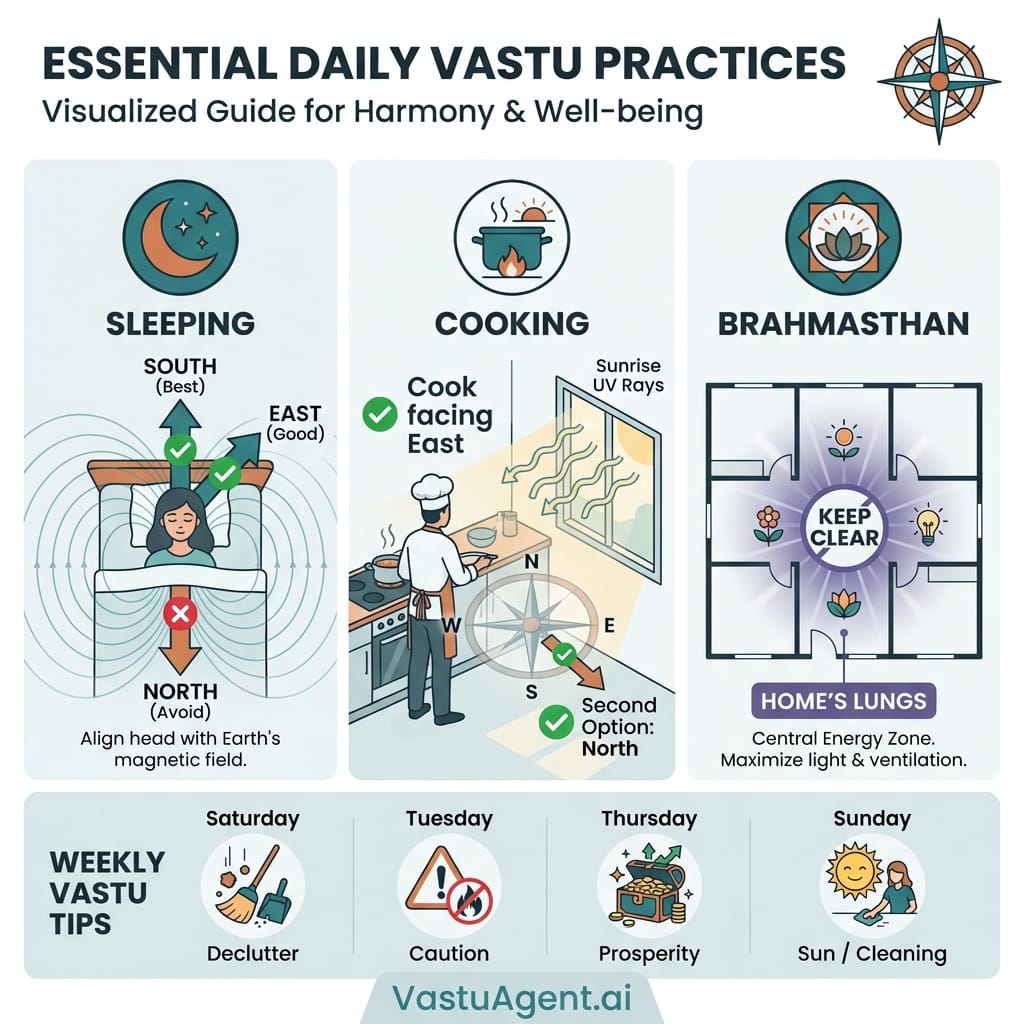
Sleeping Direction: The Magnetic Alignment
Your sleeping direction affects your body's magnetic alignment with Earth. This isn't seasonal—it's a constant that deserves year-round attention.
| Head Direction | Effect | Recommendation |
|---|---|---|
| South | Magnetic attraction with Earth's field | ✅ Ideal for deep sleep and recovery |
| East | Aligned with solar energy | ✅ Good for knowledge and spiritual growth |
| West | Neutral | ⚠️ Acceptable if South/East unavailable |
| North | Magnetic repulsion with Earth's field | ❌ Avoid—causes disturbed sleep, headaches |
During illness recovery, sleeping with head to the South accelerates healing. The Earth's magnetic field flows from North to South; aligning your body's magnetic field (head to foot) in the same direction reduces resistance.
If you're using a guest bedroom in the North-West or North-East during recovery, ensure your head points South even if it means unusual furniture arrangement temporarily.
Cooking Direction: The Solar Vitality
The cook's facing direction while preparing food affects the meal's energy. Year-round, the cook should face East while cooking.
The morning ultraviolet rays carry vitality-enhancing properties. Facing East while cooking allows this solar energy to infuse the food preparation. This is particularly important for the primary morning meal.
If your kitchen's layout makes East-facing impossible, North is the second-best option. Avoid cooking while facing South or West—these directions don't support food's vital energy.
Brahmasthan: The Breathing Center
The Brahmasthan (central zone of your home) serves as the home's "lungs." Year-round, this area should remain:
- Open and uncluttered
- Well-lit during daytime
- Free of heavy furniture
- Without any toilet, kitchen, or staircase
During Shravan and Kartik months, pay special attention to the Brahmasthan. These periods particularly benefit from a clear central zone. Consider adding a small lamp or fresh flowers to the center during auspicious months.
Day-Specific Tips
Each day of the week carries specific energies that can be aligned with Vastu practices:
Saturday (Shani/Saturn):
- Best day for decluttering and removing rubbish
- Avoid buying iron items or salt (increases debt)
- Good for cleaning dark corners and storage spaces
- Donate black items to satisfy Saturn's energy
Tuesday (Mangal/Mars):
- Avoid moving heavy furniture
- Good for protective rituals in the South zone
- Avoid beginning construction
- Focus on kitchen organization (Agni connection)
Thursday (Guru/Jupiter):
- Auspicious for starting new home-related activities
- Good for arranging the North-East zone
- Enhance the pooja room
- Yellow flowers in the North bring prosperity
Sunday (Surya/Sun):
- Open East-facing windows and doors
- Best day for cleaning brass items
- Enhance the East zone with copper elements
- Ideal for planning renovations
Weather-Responsive Adjustments
Seasonal weather patterns create specific Vastu considerations:
During Monsoon:
- Ensure no dampness accumulates in the South-West. This zone absorbs negative energy faster when damp.
- Keep the North-East corner extra clean—water element already governs this zone, and excess moisture can create imbalance.
- Light more diyas than usual to counteract the darkness and dampness.
During Winter:
- The South-East kitchen zone benefits from additional warmth. Cook more often during morning hours.
- Reduce water features in the North-East if your home already feels cold.
- Use warmer colors (terracotta, orange) in the South zone.
During Summer:
- Enhance the North-East water element. Add a small fountain or fresh flowers in water.
- Keep the South-East kitchen well-ventilated to prevent fire element excess.
- Use cooling colors (blue, green) in the North and East zones.
✏️ Ready to design a Vastu-perfect layout from scratch? VastuAgent.ai's Floor Plan Generator creates compliant designs based on your requirements—free.
→ Try Floor Plan Generator: vastuagent.ai/floor-plan-generator
Real-Time Vastu: Dynamic Tips Based on Today's Date
Imagine having a Vastu advisor who knows exactly what adjustments to make based on today's date and your location. Here's what such a system would recommend for different scenarios:

Scenario A: Mid-September Check-In (Bhadrapada Month)
Status: Construction is inauspicious this month.
Vastu Purusha Position: Head in the East, feet in the West.
Alert: Do NOT dig in the East or West sectors of your plot. You risk disturbing the Vastu Purusha's head and feet.
Tip: This month is associated with potential loss. Avoid starting new foundations. Focus on maintenance, planning, and interior organization instead.
Action: Use this month to analyze your home's existing Vastu using VastuAgent.ai's tools. Identify defects now so you can address them when auspicious construction months arrive.
Scenario B: Mid-November Check-In (Margashirsha Month)
Status: Highly auspicious for construction and Griha Pravesh.
Vastu Purusha Position: Head in the South, feet in the North.
Alert: Construction brings wealth now! However, avoid digging in the South (head) or North (feet) sectors.
Tip: This is ideal timing for house-warming. If you've been waiting to move into a new home, Margashirsha is excellent.
Action: Schedule your Griha Pravesh or begin renovations. Focus construction activity on the East-West axis where the Vastu Purusha's stomach region lies.
Scenario C: Health-Related Alert
Condition: You've been feeling fatigued or unwell in a specific room.
Immediate Remedy: Check your sleeping direction. If your head points North, shift to South-facing sleep immediately.
If sleeping in North-West or North-East during recovery: Ensure head is towards South regardless of room orientation.
Seasonal Adjustment: During rainy season, check for dampness in the South-West corner of the affected room. This zone absorbs negative energy faster when damp.
Scenario D: Financial Concern Alert
Condition: You've experienced unexpected expenses or financial leakages.
Immediate Remedy: Check your North zone (Kubera's direction). Is it cluttered? Does it have a toilet or heavy storage?
Day-Specific: On Thursday, place a yellow flower or citrine crystal in the North zone to activate wealth energy.
Seasonal Note: During auspicious months (Kartik, Margashirsha, Vaishakh), the North zone is particularly responsive to enhancement.
Scenario E: Relationship Stress Alert
Condition: Increased conflict or disconnection with family members.
Immediate Remedy: Check your South-West zone (relationships and stability). Is it weak (cut, low, or containing water elements)?
Festival Opportunity: During Pitru Paksha, create an ancestral altar here. Ancestor blessings strengthen family bonds.
Seasonal Note: Avoid disturbing the South-West during months when the Vastu Purusha's head or feet lie in this direction.
These dynamic recommendations reflect the core principle: Vastu is not static. Your home's energy shifts with cosmic cycles, and your adjustments should follow.
🧭 Want personalized recommendations for YOUR home based on its actual layout? VastuAgent.ai's AI-powered analysis considers your specific floor plan, zone configuration, and defects.
→ Get Personalized Analysis: vastuagent.ai/floor-plan-optimizer
Geopathic Stress and Seasonal Sensitivity
Some zones in your home may be more susceptible to seasonal energy shifts due to underlying geopathic stress. These are areas where Earth's natural electromagnetic field is distorted—often due to underground water streams, mineral deposits, or fault lines.
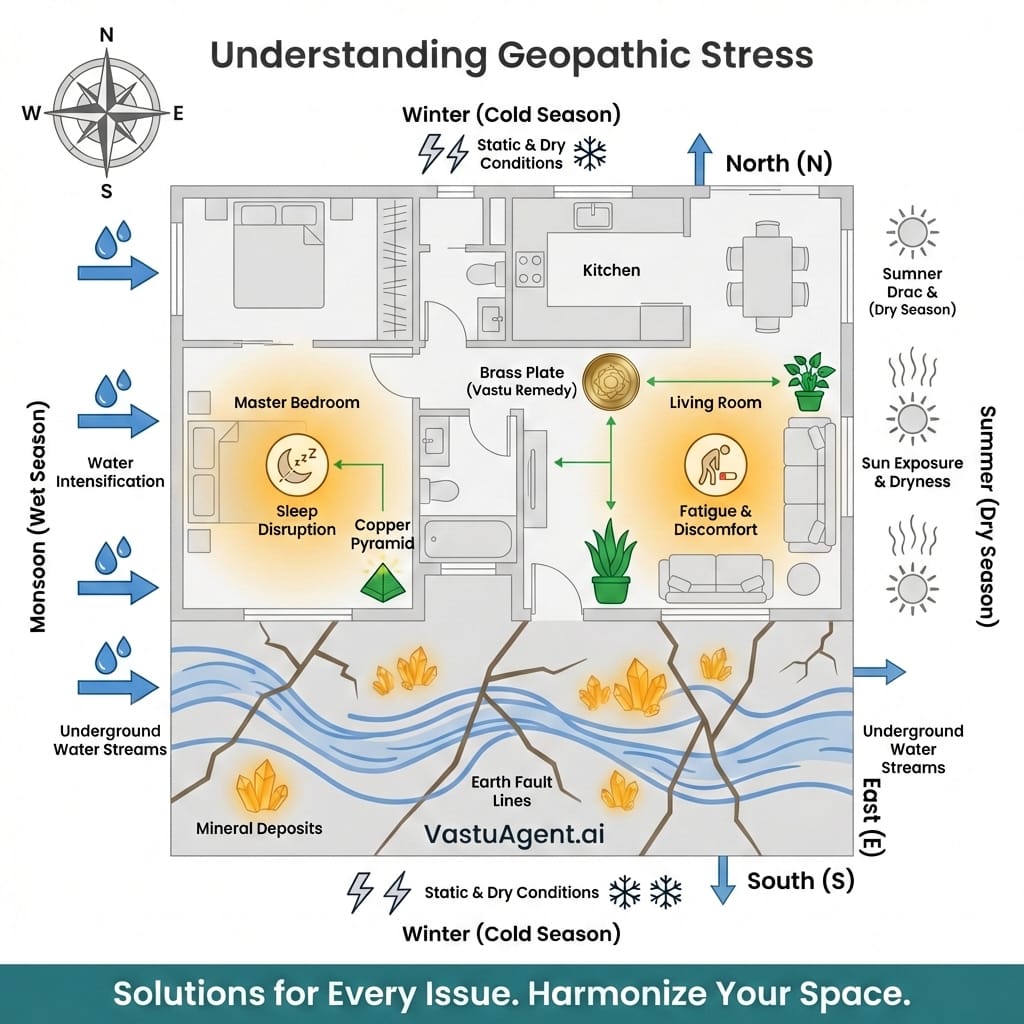
Signs of geopathic stress intensify during certain seasons:
Monsoon Intensification
During July-September, underground water levels rise. If your home has geopathic stress from underground streams, symptoms intensify:
- Disturbed sleep in affected bedrooms
- Increased fatigue in specific rooms
- Plants dying in particular spots
- Pets avoiding certain areas
Remedy: If you've identified geopathic stress zones, place copper pyramids or brass plates in these areas. The metal disrupts the distorted electromagnetic field.
Winter Sensitivity
Dry winter months reduce natural grounding. Geopathic stress symptoms may manifest differently:
- Static electricity buildup
- Increased anxiety in affected zones
- Dry, cracking walls in specific areas
Remedy: Increase indoor plants in affected zones. The plant's roots provide natural grounding energy that counterbalances geopathic distortion.
Summer Activation
The intense solar energy of summer can either heal or aggravate geopathic zones depending on their orientation:
- East-facing zones: Benefit from morning sun's healing energy
- South-facing zones: May overheat and intensify distortion
- North-facing zones: Remain relatively stable
Remedy: During summer, ensure cross-ventilation in geopathically stressed zones. Moving air helps dissipate stagnant energy.
Practical Checklist: Seasonal Vastu Actions
Here's a consolidated checklist for seasonal Vastu adjustments you can implement throughout the year:
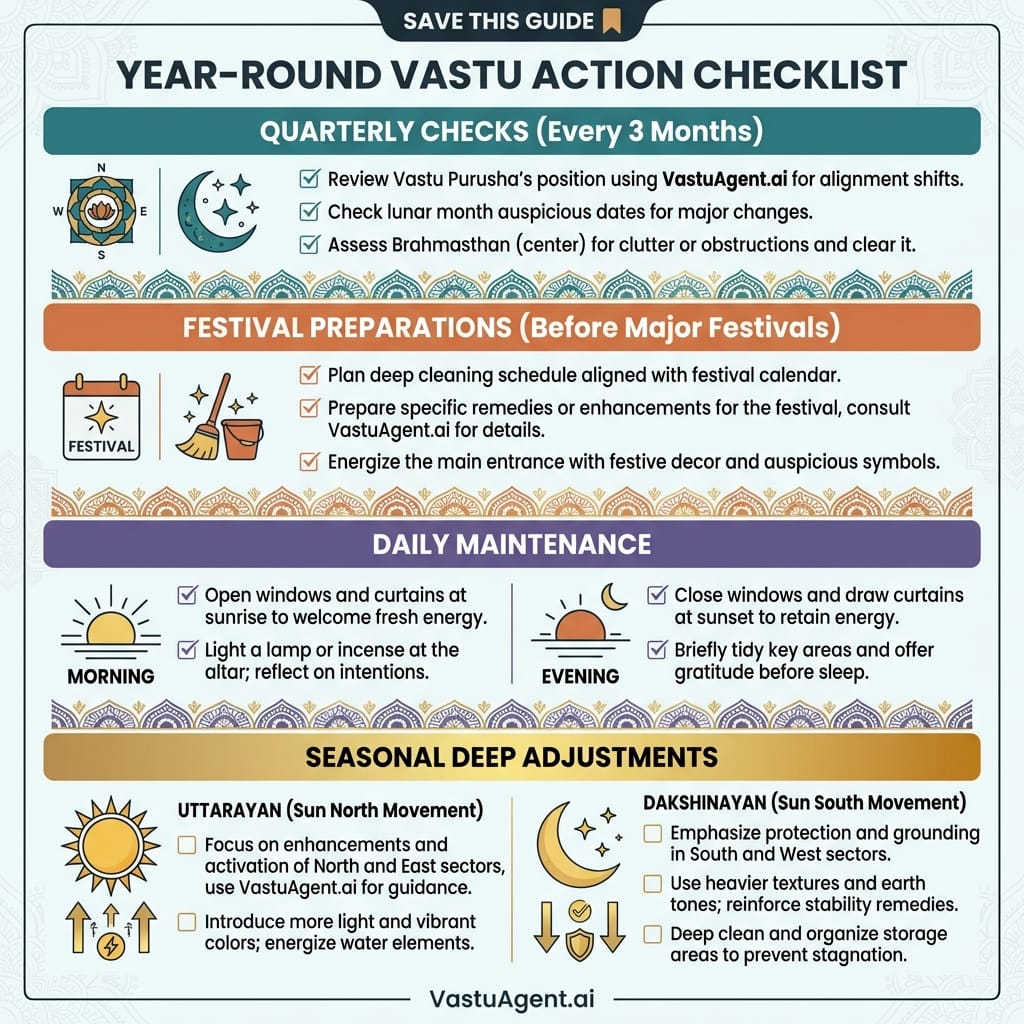
Quarterly Checks (Every 3 Months)
Note the Vastu Purusha's current position:
- Which direction is his head?
- Which direction are his feet?
- Avoid major work in these two zones
Review the current lunar month:
- Is it auspicious for your planned activities?
- If not, what alternative timing works?
Assess the Brahmasthan:
- Is it clear and clutter-free?
- Does it receive adequate light?
Festival Preparations
One week before major festivals:
- Deep clean the relevant zones (South-West for Pitru Paksha, East for Diwali)
- Prepare remedy items (diyas, flowers, offerings)
- Identify any defects in the festival-relevant zone
Day of festival:
- Implement specific placements (see festival section above)
- Light lamps in all corners
- Set intentions for the coming period
Daily Maintenance
Morning routine:
- Open East-facing windows at sunrise
- Check sleeping position alignment
- Brief Brahmasthan attention
Evening routine:
- Light at least one diya in the East or North-East
- Ensure South-West is grounded with heavy objects
- Clear any clutter accumulated during the day
Seasonal Deep Adjustments
Uttarayan (Dec 21 - June 21):
- Best period for major Vastu corrections
- Ideal for Griha Pravesh and new beginnings
- Focus on enhancement and expansion
Dakshinayan (June 21 - Dec 21):
- Focus on completion and maintenance
- Protective remedies and defensive corrections
- Planning for Uttarayan activities

Frequently Asked Questions
Q: Can I start construction during an inauspicious month if I have no other choice?
Yes, but with precautions. Perform a Bhoomi Pooja (ground-blessing ceremony) before any excavation. Avoid digging in the zones where the Vastu Purusha's head and feet rest during that period. Focus initial work on the "stomach" zones (center and diagonals). Consulting a Vastu practitioner for specific rituals can help counterbalance unfavorable timing.
Q: Does the Vastu Purusha rotation apply to apartments as well as houses?
Absolutely. The Vastu Purusha's energetic blueprint overlays any enclosed living space regardless of whether it's a standalone house or an apartment. The rotation cycle affects which zones of your apartment are sensitive during each quarter. VastuAgent.ai's Vastu Chakra tool works equally well for apartments.
Q: How do I determine which lunar month we're currently in?
The Hindu lunar calendar (Panchang) provides this information. You can find Panchang apps or websites that show the current tithi (lunar day) and month. The months roughly correlate with Gregorian dates as mentioned in this article, but for precise timing, a Panchang reference is recommended.
Q: Is it bad to live in a home with South-facing main entrance during Dakshinayan?
Not necessarily. South-facing entrances have specific benefits and challenges regardless of the solar half-year. During Dakshinayan, simply ensure your South entrance is well-lit and adorned with auspicious symbols. The Yama energy (South) can be balanced with proper remedies year-round.
Q: What if my kitchen is in the wrong zone—should I renovate based on seasonal timing?
Kitchen relocation is a major renovation requiring auspicious timing. Wait for favorable months (Phalguna, Vaishakh, Kartik, or Margashirsha) during Uttarayan. Meanwhile, implement remedies: place green plants near the kitchen if it's in the North, add blue elements if it's in the South, etc. Get a detailed analysis through VastuAgent.ai's Floor Plan Optimizer to understand your specific situation.
Q: Do the seasonal adjustments differ for different climatic zones in India?
The cosmic principles (Vastu Purusha rotation, auspicious months) remain consistent across India. However, practical weather-related adjustments vary. In coastal Kerala, monsoon considerations extend longer than in arid Rajasthan. Apply the universal principles while adapting the weather-responsive adjustments to your local climate.
Q: Can I perform Griha Pravesh during Dakshinayan if that's when my home is ready?
It's traditionally avoided, but not impossible. If you must enter during Dakshinayan, choose an auspicious weekday (Thursday is excellent) during a favorable lunar phase (Shukla Paksha—waxing moon). Perform additional protective rituals and ensure the home is thoroughly blessed before entry. Many families wait until after Makar Sankranti if possible.
Q: How do I know if my home is affected by geopathic stress?
Common signs include: persistent illness in specific rooms, pets avoiding certain areas, plants dying in particular spots despite proper care, unusual electrical interference, and feeling drained in certain zones. Professional detection requires dowsing rods or electromagnetic meters. Start by observing patterns—if issues cluster in one zone, geopathic stress may be present.
Q: Should I adjust my home's Vastu every time the season changes?
You don't need major changes every quarter. Awareness is key—know which zones are sensitive and avoid disturbing them. The daily and weekly practices (sleeping direction, cooking orientation, Brahmasthan maintenance) provide year-round stability. Seasonal awareness helps you time major activities correctly and respond to any emerging issues appropriately.
Q: What's the single most important seasonal Vastu practice?
Maintaining an open, clutter-free Brahmasthan throughout the year. The center of your home functions as its energetic heart—when it's clear, energy flows properly regardless of external seasonal shifts. During any auspicious month, add a small lamp or fresh flowers to the center to enhance the home's core energy.
Q: Does VastuAgent.ai account for seasonal factors in its analysis?
VastuAgent.ai's tools focus on your floor plan's static Vastu compliance—zone mapping, defect identification, and remedy recommendations. The seasonal principles discussed in this article add a time-based layer that you can apply to the tool's spatial analysis. Together, they provide comprehensive guidance for year-round Vastu harmony.
Q: Are there any days when I should absolutely avoid any Vastu-related activity?
Amavasya (new moon) is traditionally avoided for new beginnings unless it's a specific festival like Diwali. Rahu Kalam (the inauspicious period ruled by Rahu each day) should be avoided for important activities. Eclipse days are strongly avoided for any Vastu work. Beyond these, follow the monthly and seasonal guidelines for optimal timing.
Your Year-Round Vastu Journey Starts Now

Vastu Shastra's seasonal dimension transforms home harmony from a one-time fix into a living practice. The ancient sages understood that cosmic energies shift—and your home, as a reflection of the cosmos, must breathe with these rhythms.
The Vastu Purusha rotates every quarter. Auspicious months come and go. Festivals open specific energetic windows. Daily practices maintain the baseline. Together, these create a complete system for year-round alignment.
You don't need to become a Vastu scholar to benefit from this wisdom. Start with awareness: know which zones are sensitive right now. Implement the daily basics: sleep with head to South, cook facing East, keep the center clear. Honor the festivals with conscious adjustments. Time your major activities with the cosmic calendar.
Technology makes this easier than ever. VastuAgent.ai's tools give you instant visibility into your home's zones, defects, and opportunities—the spatial foundation upon which seasonal practices build.
The home that felt different last winter? Now you understand why. And now you have the knowledge to work with these shifts rather than against them.
Transform Your Home with VastuAgent.ai
Ready to apply what you've learned? VastuAgent.ai offers free tools that make Vastu analysis instant and accessible:

| Tool | What It Does | Best For |
|---|---|---|
| Vastu Chakra | Interactive compass with 16-zone mapping | Finding directions, understanding seasonal zones |
| Vastu Purusha | 81-cell Mandala explorer with deity positions | Deep Vastu study, understanding the rotating energy body |
| Floor Plan Optimizer | AI-powered defect detection | Existing home analysis before seasonal adjustments |
| Floor Plan Generator | Create Vastu-compliant designs | New construction planning with auspicious timing |
| Free Report | 25+ page comprehensive analysis | Complete home assessment with zone-by-zone guidance |
→ Start Your Free Analysis: vastuagent.ai/free-report
Join 10,000+ homeowners who've already transformed their spaces with VastuAgent.ai