
Toilet Vastu: Best Placement, Directions & Fixes (2026 Guide)
Complete toilet & bathroom Vastu guide: best zones (NW/W), worst placements (NE), practical fixes without demolition, and direction-specific tips for all 16 zones.

That nagging feeling when something feels "off" about your bathroom? You're not alone. After analyzing over 10,000 floor plans at VastuAgent.ai, we've found that toilet placement issues rank among the top three most common Vastu defects in Indian homes.
Here's the uncomfortable truth: a toilet in the wrong zone doesn't just violate ancient principles—it affects your daily experience of the space. The good news? Most toilet Vastu problems have practical fixes that don't require breaking a single wall.
With 93% of homebuyers in Tier-1 and Tier-2 cities now preferring Vastu-compliant homes (according to Magicbricks), understanding bathroom Vastu isn't just spiritual wisdom—it's practical home knowledge. This guide covers everything from ideal toilet directions to zone-specific remedies you can implement today.
Why Toilet Vastu Matters More Than You Think
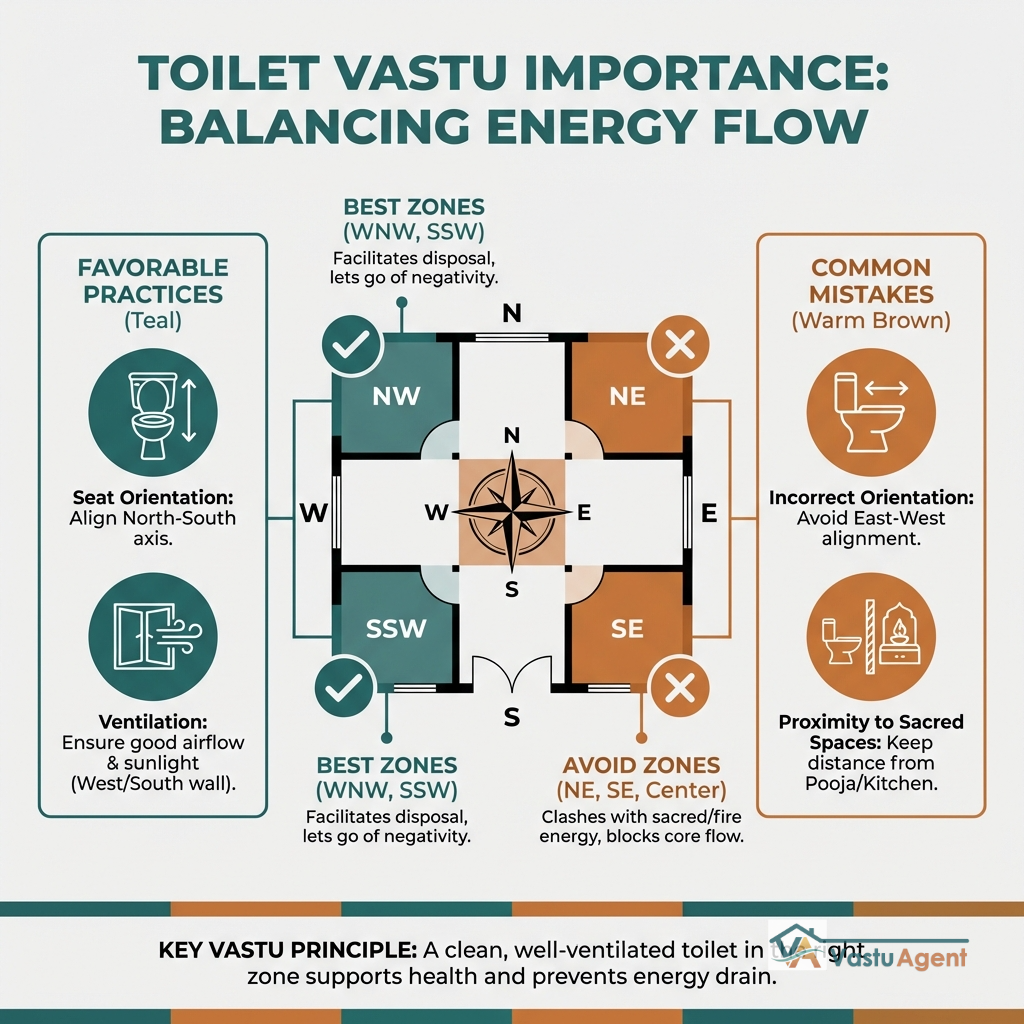
Vastu Shastra classifies toilets as "disposal zones"—spaces that handle elimination and waste. Unlike living rooms or bedrooms that accumulate energy, bathrooms are designed to release it. This classification isn't arbitrary superstition; it's based on 5,000 years of observational wisdom about how spaces affect inhabitants.
The Science Behind Toilet Placement
Classical texts like the Mayamata and Brihat Samhita position toilets in specific zones for practical reasons that remain relevant today. The ancient sages observed patterns over centuries, noting which configurations supported thriving households and which correlated with difficulties. While the language of "energy" and "cosmic forces" may seem mystical, the underlying observations about ventilation, light exposure, and spatial harmony translate into modern architectural wisdom.
Ventilation patterns: Northwest placement aligns with prevailing wind directions in the Indian subcontinent, naturally carrying odors away from living spaces. This isn't coincidence—it's observational science codified into traditional guidelines.
Sunlight exposure: Western zones receive afternoon sun, which has natural antibacterial properties that help sanitize bathroom spaces. Northeast zones receive gentle morning rays best suited for living and meditation areas.
Water flow dynamics: Northern slopes allow for natural drainage toward appropriate discharge points, preventing water accumulation in unsuitable areas.
The Financial Reality
Here's something most Vastu articles won't tell you: toilet placement affects property values. Research from 99acres indicates that Vastu-compliant properties sell 20-30% faster than non-compliant ones. A northeast toilet—one of the most severe defects—can genuinely impact resale negotiations.
According to a recent Anarock survey, nearly 80% of homebuyers in India consider Vastu compliance as a key factor in their purchasing decision. This isn't limited to older generations—young millennial and Gen Z buyers are actively seeking Vastu-friendly homes, viewing them as both spiritually aligned and financially sound investments.
The 62% preference rate for Vastu-compliant properties reported by 99acres translates to real market dynamics. Properties marketed as "Vastu-friendly" consistently attract more inquiries and command better prices. For sellers, this means addressing obvious defects like problematic toilet placements can yield tangible returns.
Understanding the Five Elements Connection
The five elements (Pancha Bhoota) form the foundation of Vastu science. Toilets involve primarily Water (Jal) and disposal energy. Placing this water element in the Fire zone (Southeast) or the spiritual growth zone (Northeast) creates elemental conflict that classical texts describe in vivid terms.
🧭 Curious which zone your bathroom falls in? VastuAgent.ai's Vastu Chakra tool maps all 16 zones onto your floor plan instantly—see exactly where your toilet sits in seconds.
→ Try Vastu Chakra: vastuagent.ai/vastu-chakra
Best Toilet Placements: Where Your Bathroom Should Be according to Vastu
Not all directions are created equal when it comes to toilet Vastu. Let's examine the zones that work best.
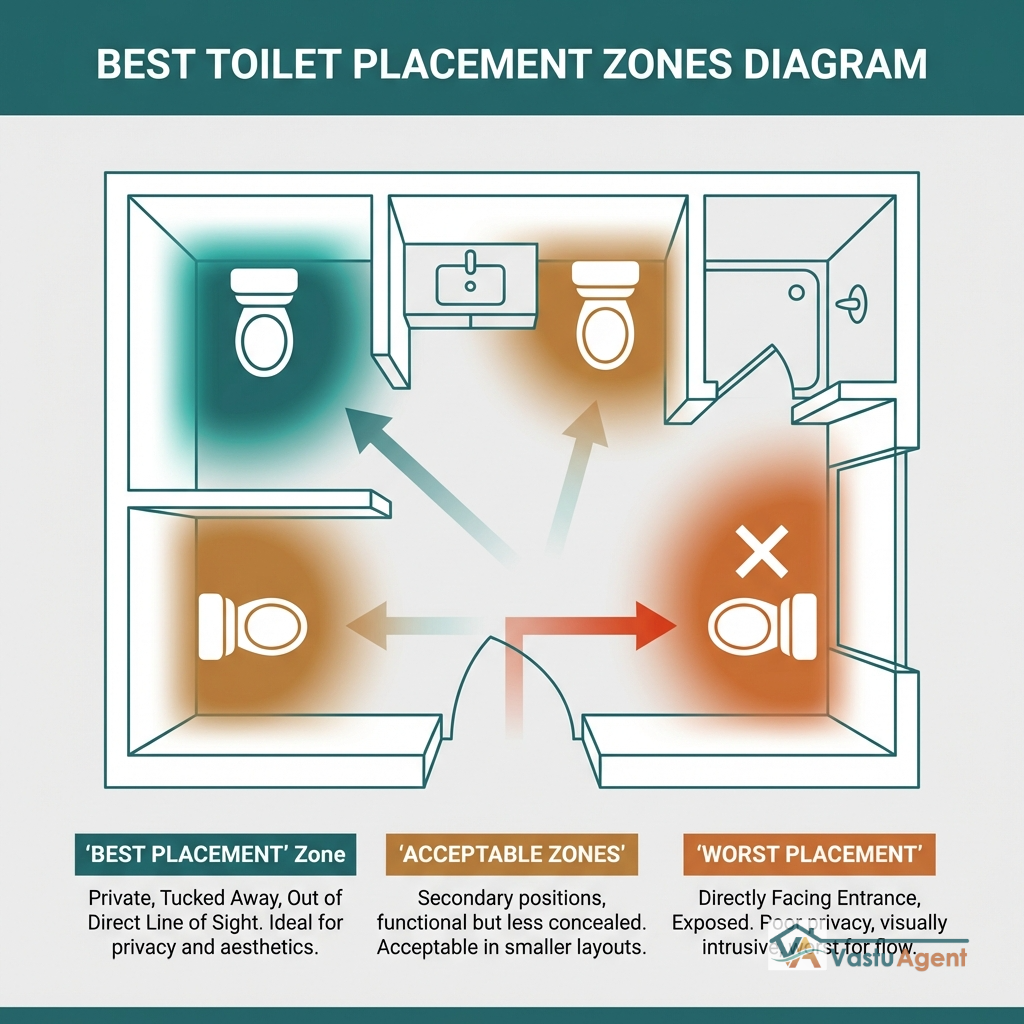
Northwest (Vayavya): The Ideal Zone
The Northwest direction is universally recommended for toilet placement across all major Vastu texts. Governed by Vayu (the Air element) and presided over by the wind deity, this zone naturally supports:
- Movement and elimination
- Air circulation for freshness
- Release of stagnant energies
Practical benefits: Morning breezes in most Indian regions flow from the Northeast, meaning Northwest toilets receive natural ventilation that carries odors away from the main living areas.
The classical reasoning behind this placement connects to the Vastu Purusha Mandala—the cosmic being whose body forms the foundation of all Vastu calculations. The Northwest represents the region associated with movement, transition, and release. Placing disposal zones here aligns with this inherent energy pattern.
Construction tip: When building a Northwest toilet, ensure the door faces North or East, and position the WC so users face North or South while seated. This maximizes the beneficial aspects of this already favorable placement.
West (Paschim): The Strong Alternative
When Northwest isn't available, the West zone provides the next best option. This direction supports:
- Afternoon sunlight with natural sanitizing properties
- Adequate distance from the sacred Northeast quadrant
- Compatible energy for disposal activities
North (Uttara): Acceptable with Conditions
A toilet in the North zone is acceptable when placed correctly—meaning not in the extreme Northeast corner. The key considerations:
- Keep the toilet at least 2 feet from the exact North wall
- Ensure the septic tank doesn't block the North opening
- Maintain proper ventilation toward the West
| Zone | Suitability | Element | Key Consideration |
|---|---|---|---|
| Northwest | ✅ Excellent | Air | Best natural ventilation |
| West | ✅ Good | Water | Afternoon sunlight sanitizes |
| North | ⚠️ Conditional | Water | Avoid extreme NE corner |
| South | ⚠️ Conditional | Fire | Acceptable for water closet |
📐 Not sure where your bathroom falls on the Vastu grid? Upload your floor plan to VastuAgent.ai's Floor Plan Optimizer and get instant zone identification—no guesswork required.
→ Analyze Your Plan: vastuagent.ai/floor-plan-optimizer
Worst Vastu Toilet Placements: Zones to Avoid at All Costs
Some toilet placements create significant Vastu defects. Understanding why helps you prioritize fixes if you're already living with one of these configurations.
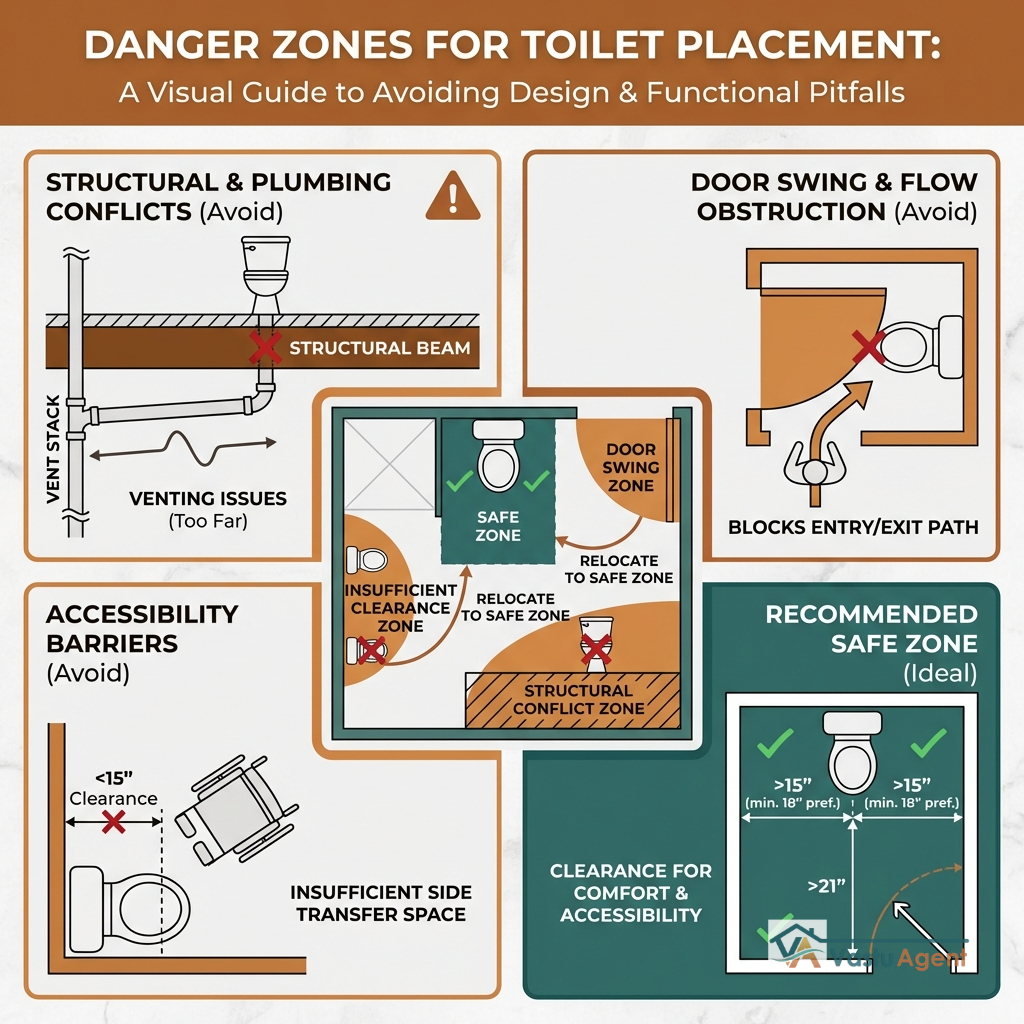
Northeast (Ishana): The Most Critical Defect
A toilet in the Northeast—the zone of Ishana (Lord Shiva) and the Water element's sacred position—represents the most severe bathroom Vastu violation. Classical texts describe this as placing "impurity in the seat of divinity."
Why it's problematic:
The Northeast receives the first morning sunrays and is considered the zone through which positive cosmic energy (prana) enters a home. A toilet here blocks this entry point and mixes sacred and disposal energies.
Traditional consequences cited in texts:
- Financial instability and blocked opportunities
- Health issues, particularly neurological and digestive
- Obstacles in career growth
- Impact on children's education and development
- Mental stress and decision-making difficulties
The Brihat Samhita specifically warns against placing any disposal or "impure" activities in the Ishana corner, stating it affects the household's overall prosperity and the well-being of male members in particular.
The practical reality: Whether or not you believe in energy flow, Northeast toilets often suffer from poor ventilation (morning breezes blow from this direction into the home) and can create dampness issues in adjacent spaces. The morning sun—rich in beneficial ultraviolet light—is blocked from entering what should be the home's most positive zone.
From an architectural standpoint, many modern apartments place bathrooms in the Northeast simply because it's convenient for plumbing stacks. This convenience comes at a cost that many homeowners only recognize after living with the defect.
Southwest (Nairitya): Earth Element Conflict
The Southwest belongs to the Earth element and is designated for the heaviest, most stable portions of a home—like the master bedroom or storage. A toilet here represents "hollowing out" the foundation zone.
This placement can affect:
- Stability of the head of household
- Overall grounding and security
- Relationships within the family
Center (Brahmasthan): The Sacred Heart
The Brahmasthan—the central zone of any structure—should remain open and unobstructed according to Vastu. This nine-cell center (in the 81-cell Mandala) is where Brahma resides and represents the home's spiritual core.
A toilet in the center is considered highly inauspicious because:
- It blocks energy distribution to all zones
- It places disposal energy at the home's heart
- It creates structural and energetic imbalance
| Zone | Severity | Primary Concern | Remedy Difficulty |
|---|---|---|---|
| Northeast | 🔴 Critical | Blocks positive energy entry | Moderate-High |
| Southwest | 🔴 Critical | Destabilizes foundation zone | Moderate |
| Center | 🔴 Critical | Affects entire structure | High |
| Southeast | 🟠 High | Fire-Water element clash | Moderate |
⚠️ Already have a toilet in a danger zone? Don't panic. VastuAgent.ai's Free Report includes personalized remedies based on your exact floor plan—not generic advice.
→ Get Your Free Report: vastuagent.ai/free-report
Toilet Direction as Per Vastu: Internal Layout Rules
Beyond the room's location, the internal arrangement of fixtures matters significantly in bathroom Vastu. Here's what classical texts and modern Vastu consultants agree on.
Toilet Seat Direction: The North-South Axis
The commode or toilet seat should align along the North-South axis. This means while using the toilet, you should face either North or South—never East or West.
Why facing East is prohibited:
The East direction represents Surya (the Sun deity) and is associated with spiritual growth and new beginnings. Facing the rising sun during elimination is considered disrespectful in Vastu tradition.
Recommended facing directions:
- North: Acceptable, promotes financial energy flow
- South: Preferred in many texts, represents release
- West/Southwest: Secondary option when N-S isn't possible
Water Elements Placement
Taps, showers, and water storage should be positioned in specific zones within the bathroom:
| Element | Best Position | Avoid |
|---|---|---|
| Taps/Shower | North, East, Northeast | South, Southwest |
| Geyser/Heater | Southeast | Northeast |
| Bathtub | East, Northeast | Southwest |
| Water Storage | Northeast | Southeast, Southwest |
Floor Slope and Drainage
The bathroom floor should slope toward the North or East for proper drainage. This ensures water flows toward positive directions rather than accumulating in inauspicious zones.
Water outlets and drain holes should be positioned in:
- Northeast corner (best)
- North side
- East side
Mirror and Basin Placement
Bathroom mirrors should be mounted on North or East walls. This placement is believed to attract positive vibrations and reflects beneficial energy into the space.
Avoid placing mirrors:
- Directly opposite the toilet
- On South or West walls
- Facing the bathroom door
🕉️ Want to see how the Vastu Purusha Mandala relates to your bathroom layout? Explore the complete 81-cell grid interactively and understand which deity governs your bathroom zone.
→ Explore Vastu Purusha: vastuagent.ai/vastu-purusha
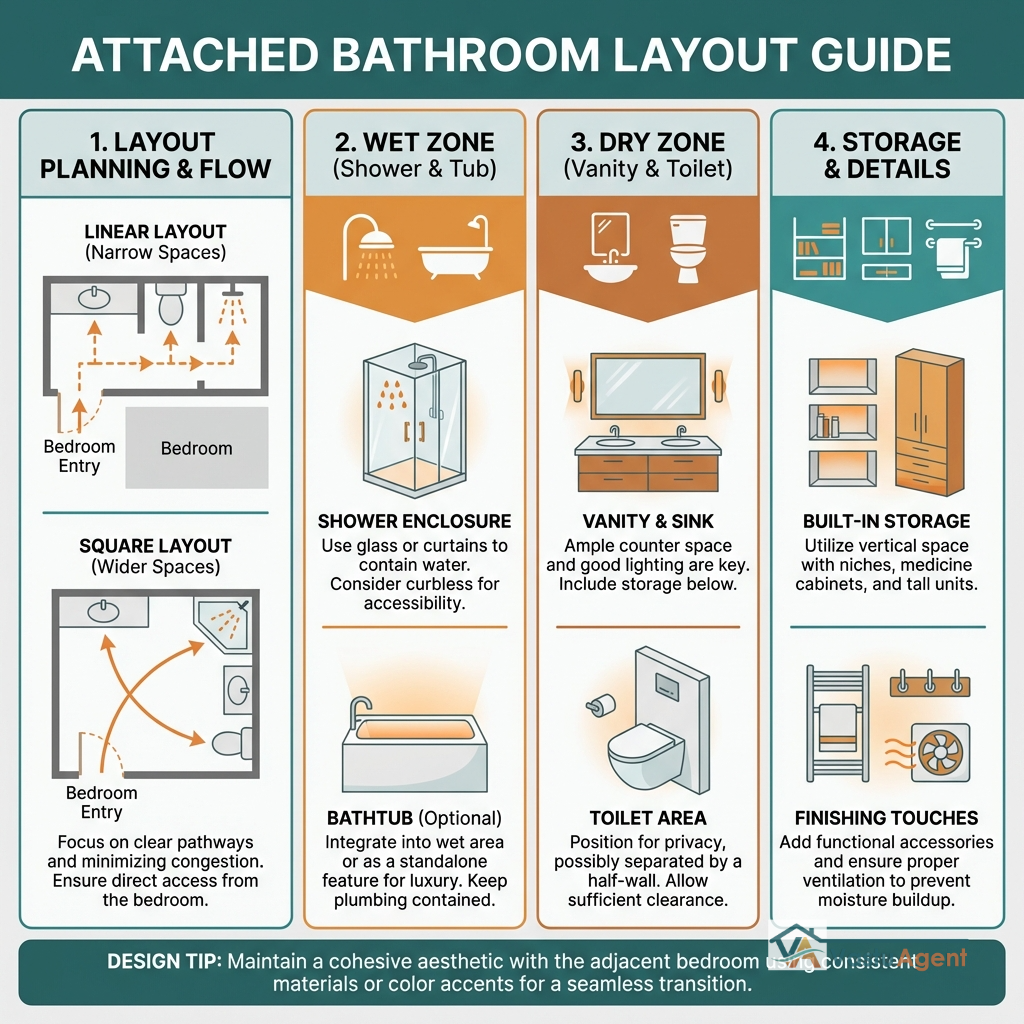
Attached Bathroom Vastu: Bedroom-Toilet Guidelines
Modern homes typically include attached bathrooms with master bedrooms. This creates specific Vastu considerations that blend bedroom and toilet principles.
Ideal Position for Attached Bathrooms
When attaching a bathroom to a bedroom, the toilet should occupy the West or Northwest portion of the bedroom—never the Northeast corner.
Configuration guidelines:
- The bathroom door should open away from the bed
- The toilet shouldn't share a wall with the bed headboard
- Maintain at least 3 feet between bed and bathroom wall
Common Attached Bathroom Problems
Problem 1: Northeast attached bathroom The most common defect in modern apartments. This placement affects both the bedroom's energy and blocks the entire home's Northeast.
Problem 2: Toilet wall behind bed When the bed headboard shares a wall with the toilet on the other side, sleep quality often suffers. The solution is to either move the bed or add insulation.
Problem 3: Bathroom door facing bed Directly visible toilet areas from the bed position create an unfavorable energy exchange. Keep doors closed and consider adding a small partition.
Apartment-Specific Challenges
Flat-dwellers face unique toilet Vastu challenges because structural modifications aren't possible. Focus on:
- Internal arrangement optimization
- Remedy implementation (discussed below)
- Energy balancing through colors and elements
| Attached Bath Position | Bedroom Impact | Recommended Action |
|---|---|---|
| Northwest | ✅ Minimal | Standard Vastu practices |
| West | ✅ Acceptable | Keep door closed |
| North | ⚠️ Moderate | Avoid bed near shared wall |
| Northeast | 🔴 Critical | Implement multiple remedies |
| Southwest | 🔴 Critical | Major remedies required |
📐 Living in an apartment with fixed bathroom positions? Upload your flat's floor plan to get apartment-specific remedies that work within your constraints.
→ Get Flat Analysis: vastuagent.ai/floor-plan-optimizer
Toilet Vastu Remedies: Practical Fixes Without Demolition
Here's where hope meets practicality. Most toilet Vastu defects can be significantly neutralized through remedies that don't require reconstruction.
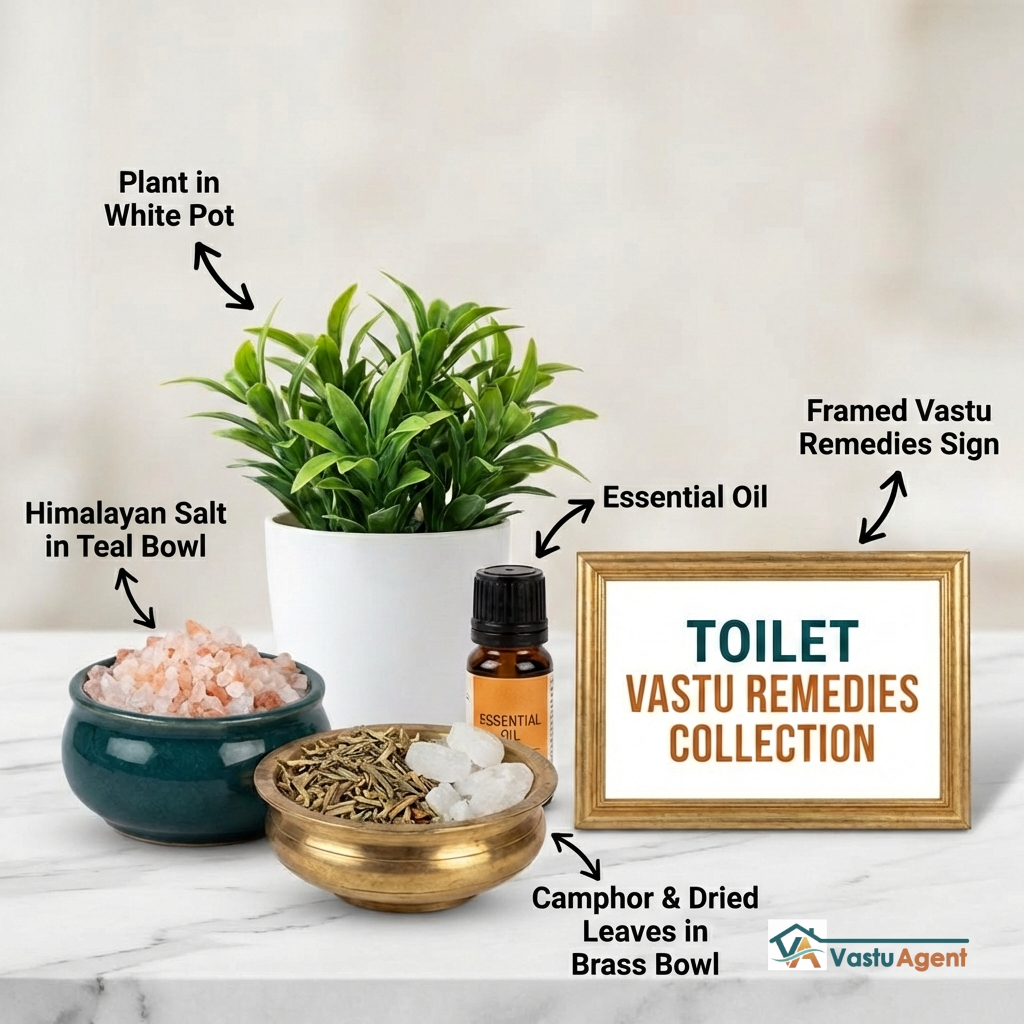
Universal Remedies for All Toilets
These practices benefit every bathroom, regardless of its position:
1. Sea Salt Bowl Place a bowl of sea salt or rock salt inside the bathroom. Salt absorbs negative energy and should be replaced weekly. This simple remedy is recommended across all Vastu schools.
The science involves salt's hygroscopic properties—it naturally absorbs moisture and odors. Many practitioners believe it also absorbs negative vibrations. Use a copper or brass bowl for enhanced effect. Dispose of used salt by flushing it—never reuse it.
2. Keep Doors and Lids Closed Always close the toilet door when not in use. Keep the commode lid down. This contains the disposal energy within the designated space.
This practice has both energetic and hygienic benefits. Studies show flushing with the lid open sprays microscopic particles several feet into the air. Keeping everything closed maintains bathroom energy where it belongs.
3. Proper Ventilation Install an exhaust fan in the East or North wall. Good ventilation prevents stagnation and helps move energy appropriately. Run the fan for 15-20 minutes after each use.
Natural ventilation through windows is even better when possible. East-facing windows bring morning sunlight with natural antibacterial properties.
4. Camphor Usage Burning camphor or keeping camphor blocks in the bathroom purifies the space. Replace weekly for best results. The clean scent of camphor has been used in Indian temples for millennia for purification.
5. Regular Deep Cleaning Cleanliness amplifies all other remedies. A sparkling clean bathroom naturally maintains better energy than one with grime or lingering odors. Weekly deep cleaning—especially of drains—supports all Vastu remedies.
Northeast Toilet Remedies
For toilets in the critical Northeast zone:
Pyramid Yantras: Place three brass or copper pyramid yantras on the outer wall of the toilet (the wall facing the living space).
Color Therapy: Paint the bathroom in white, light blue, or pale green. These colors pacify the Water element conflict.
Mirror Deflection: Mount a mirror on the outside of the bathroom door. This symbolically "hides" the toilet and deflects negative energy.
Vastu Plants: Place air-purifying plants like spider plants or money plants near the bathroom entrance.
Southwest Toilet Remedies
For toilets in the stability-affecting Southwest:
Metal Correction: Install a brass or copper strip around the toilet base or at the door threshold. Metal helps ground the Earth element disruption.
Color Selection: Use yellow, beige, or cream tones. Avoid blue and green which conflict with the Earth element.
Heavy Object Placement: Position heavy decorative items (stone sculptures, brass items) on the Southwest wall outside the bathroom.
Southeast Toilet Remedies
For toilets creating Fire-Water conflict:
Copper Installation: Place a copper pyramid or strip outside the door.
Red Light Therapy: Install a red-tinted bulb in this bathroom to honor the Fire element.
Color Palette: Choose pink, coral, or terracotta tones. Strictly avoid blue.
Center (Brahmasthan) Toilet Remedies
The most difficult defect to remedy:
Pyramid Array: Install four copper pyramids in the four corners of the bathroom.
Minimal Usage: If possible, designate this as the least-used bathroom.
Comprehensive Balancing: This defect typically requires multiple remedies working together.
| Zone | Primary Remedy | Secondary Remedy | Color |
|---|---|---|---|
| Northeast | Pyramid yantras (3) | Mirror on door exterior | White, Light Blue |
| Southwest | Copper/Brass strip | Heavy objects outside | Yellow, Beige |
| Southeast | Copper pyramid | Red light bulb | Pink, Coral |
| Center | 4 corner pyramids | Minimal usage | White |
✨ Want personalized remedies specific to YOUR floor plan? Generic advice only goes so far. Get a comprehensive analysis with remedies tailored to your exact toilet position and surrounding zones.
→ Get Personalized Fixes: vastuagent.ai/free-report
Recommended Colors for Toilet and Bathroom Walls
Color selection in bathrooms isn't just aesthetic—it can enhance or counteract the energies of the zone. The relationship between color and direction is fundamental to Vastu Shastra, rooted in the association between colors, elements, and planetary influences. Here's what Vastu recommends for bathroom walls, tiles, and accessories.
Universally Beneficial Colors
These colors work well in most bathroom positions:
- White: Represents purity and cleanliness. Universally safe.
- Light Blue/Sky Blue: Calming, supports the Water element.
- Light Pink: Soothing, adds warmth without heaviness.
- Cream: Neutral, works with most directions.
- Pale Green: Fresh, connects to nature.
Colors to Strictly Avoid
Regardless of your toilet's position:
- Black: Absorbs negative energy rather than releasing it
- Dark Red: Too intense, creates agitation
- Dark Blue/Navy: Overpowers the space
- Dark Brown: Creates heaviness in disposal zones
Zone-Specific Color Recommendations
| Toilet Zone | Recommended Colors | Avoid |
|---|---|---|
| Northwest | White, Light Grey, Cream | Yellow, Orange |
| West | White, Light Blue, Cream | Red, Orange |
| North | Blue, White, Green | Yellow, Brown |
| Southeast | Pink, Coral, Terracotta | Blue, Black |
| Southwest | Beige, Cream, Light Brown | Blue, Green |
| Northeast | White, Light Blue, Pale Green | Red, Orange |
🎨 Not sure which colors work for your specific bathroom zone? VastuAgent.ai's analysis includes room-specific color recommendations based on your floor plan orientation.
→ Get Color Guidance: vastuagent.ai/floor-plan-optimizer
Septic Tank Vastu: Where to Place Underground Tanks
The septic tank carries even more weight in Vastu analysis than the toilet itself—it's a larger permanent structure that affects the earth element of your entire property.

Ideal Septic Tank Locations
Northwest (Best): The universally recommended position. Place the tank in the West or Northwest portion of the North boundary.
Specific positioning: If dividing the North boundary into nine equal parts, the third section from the Northwest corner is ideal.
Middle North: An acceptable alternative when Northwest isn't feasible.
Critical Rules for Septic Tanks
- Separation: Maintain at least 1-2 feet distance from compound walls and the building plinth.
- Level: The tank must not be higher than the building's plinth level.
- Orientation: The tank's length should run East-West, width North-South.
- Outlet Direction: Drainage outlet should face North or West.
Zones to Absolutely Avoid
| Zone | Consequence |
|---|---|
| Northeast | Business losses, financial ruin |
| Southwest | Severe—potential for accidents, major instability |
| Southeast | Wealth loss, health issues for women |
| Center | Total family disruption |
| South | Health complications |
Construction Guidelines: Building a Vastu-Compliant Toilet
Building a new home or renovating? These construction specifications ensure your toilet starts Vastu-compliant. Following these guidelines during construction is far easier than implementing remedies later—though both paths lead to improved home energy.
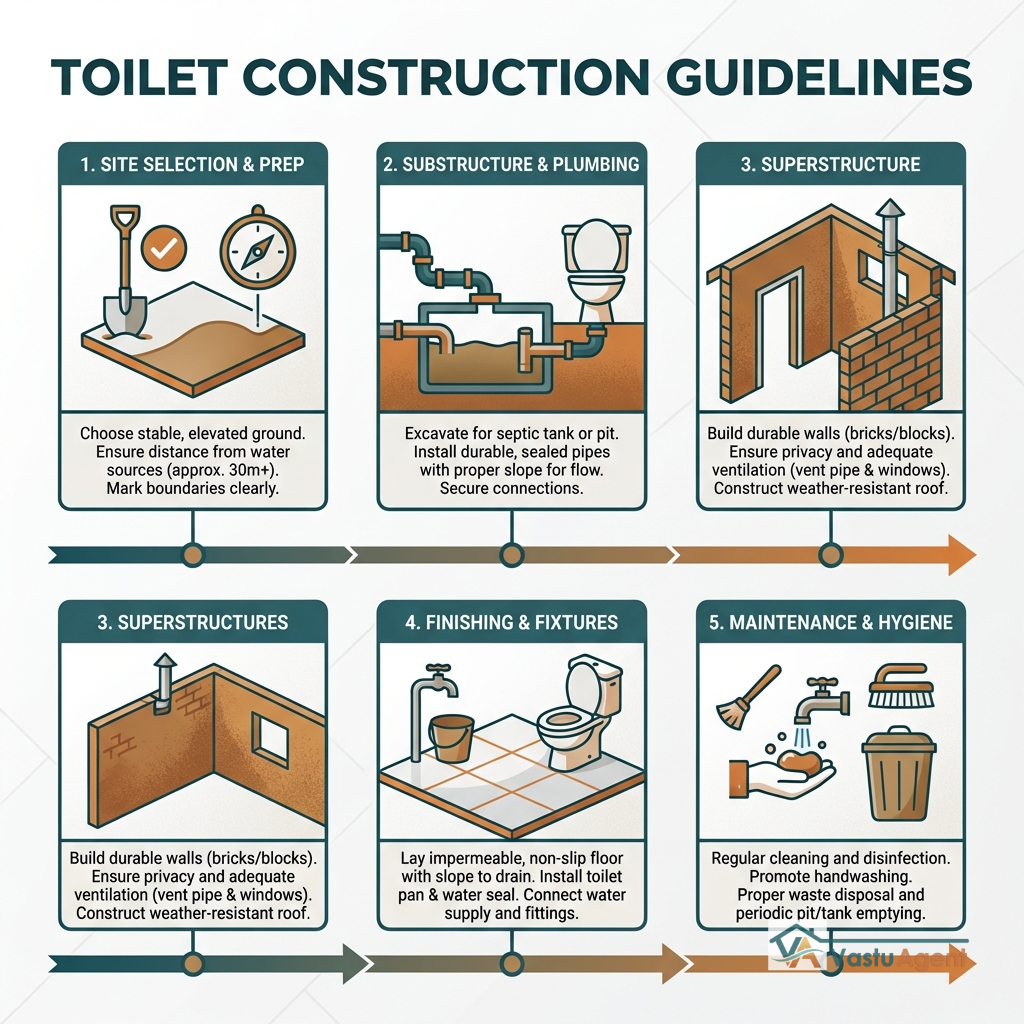
Elevation Requirements
The toilet should be constructed 1-2 feet above ground level. This elevation:
- Separates disposal energy from the foundation
- Provides natural drainage slope
- Creates symbolic distinction from living spaces
Door Specifications
- Direction: Doors should open toward East or North
- Type: Single-shutter doors are preferred
- Opening: Should swing inward, not outward
- Material: Wood is recommended over metal
Window and Ventilation
- Window position: East, West, or North walls
- Exhaust fan: East or North placement
- Ventilator: Should face East for morning light exposure
Internal Measurements
- Minimum ceiling height: 9 feet recommended
- Floor slope: 1-2 inches toward drain
- Wall thickness: Standard construction specs apply
✏️ Planning new construction or major renovation? Generate a Vastu-perfect floor plan from scratch with AI assistance—get your bathroom in the right zone from day one.
→ Design Your Home: vastuagent.ai/floor-plan-generator
Frequently Asked Questions
Q: Which direction is best for toilet according to Vastu?
The Northwest direction is universally considered the best for toilet placement. Governed by the Air element (Vayu), it naturally supports elimination and movement. West is the second-best option. You can instantly check your bathroom's zone using VastuAgent.ai's Vastu Chakra tool.
Q: Is a toilet in Northeast bad for Vastu?
Yes, a Northeast toilet is considered the most severe bathroom Vastu defect. This zone represents spiritual growth and positive energy entry—placing a toilet here blocks these benefits. However, practical remedies like pyramid yantras, specific colors, and mirror placement can significantly reduce the negative effects.
Q: How can I fix Northeast toilet Vastu dosh without demolition?
Key remedies include: placing three pyramid yantras on the exterior wall, using white or light blue paint, installing a mirror on the outside of the bathroom door, keeping sea salt in the bathroom (replaced weekly), and maintaining strict cleanliness. These combined measures help neutralize the defect.
Q: What direction should a toilet seat face as per Vastu?
The toilet seat should align along the North-South axis, meaning you should face either North or South while using it. Facing East is strictly prohibited as it's considered disrespectful to the Sun. Facing West is a secondary option if North-South alignment isn't possible.
Q: Is an attached bathroom in the bedroom bad for Vastu?
Not necessarily—attached bathrooms are acceptable when positioned in the West or Northwest portion of the bedroom. The key concerns are avoiding Northeast placement and ensuring the toilet doesn't share a wall with the bed headboard.
Q: Where should the geyser be placed in a bathroom?
The geyser or water heater should be installed in the Southeast corner of the bathroom. This direction is governed by the Fire element (Agni), making it appropriate for heat-generating appliances.
Q: What colors should I avoid in my bathroom?
Strictly avoid black and dark red in bathroom walls. These heavy colors absorb rather than release energy. Dark blue and dark brown should also be avoided. Opt for light colors like white, sky blue, light pink, or cream.
Q: Can Vastu defects in toilets affect health?
According to Vastu texts, yes—particularly Northeast toilet placement is associated with neurological issues, digestive problems, and general health decline. While individual beliefs vary, proper toilet placement does affect practical factors like ventilation, humidity, and light exposure.
Q: Where should the septic tank be located?
The Northwest zone is ideal for septic tank placement. Avoid the Northeast, Southwest, and center at all costs. The tank should be 1-2 feet from any walls and below plinth level.
Q: Should bathroom doors be kept open or closed?
Always keep bathroom doors closed when not in use. This contains the disposal energy within the designated space and prevents it from affecting adjacent living areas. Also keep the toilet lid down.
Q: Is it bad if my toilet is above the kitchen?
Yes, this creates a significant Vastu defect. Water and disposal energy from above shouldn't flow over the Fire zone (kitchen). If this is your apartment's structure, remedies include copper installations in the kitchen ceiling and maintaining extra cleanliness.
Q: How do I know if my toilet has Vastu dosh?
Upload your floor plan to VastuAgent.ai's Floor Plan Optimizer for instant AI analysis. The tool identifies exactly which zone your toilet occupies and flags any defects with specific remedy recommendations.
Q: Can I use a toilet in a problematic zone as a guest bathroom only?
Yes, minimizing usage is a valid strategy. If you have multiple bathrooms, designate the problematic one for occasional guest use while family members use correctly-placed toilets. This reduces daily exposure to the defect while you implement remedies.
Q: Does toilet Vastu apply to offices and commercial buildings?
Absolutely. Commercial Vastu follows the same principles—toilets should be in Northwest or West zones, never in Northeast or Southwest. Many successful Indian businesses prioritize Vastu compliance in their office layouts, including bathroom placement.
Q: What if my entire bathroom is tiny—does internal layout still matter?
Yes, but focus on what you can control. Even in small bathrooms, ensuring the toilet seat faces North or South (not East) and keeping sea salt present makes a difference. The door direction and exhaust fan position also remain important regardless of bathroom size.
Transform Your Home with VastuAgent.ai
You've now learned the complete framework for toilet Vastu—from ideal placements to practical remedies. But here's what matters: knowing your specific situation.
Every home is unique. Generic advice only takes you so far. What zone does YOUR toilet actually fall in? Which remedies apply to YOUR floor plan? How do other rooms interact with your bathroom placement?
The reality is that 93% of homebuyers in Tier-1 and Tier-2 cities now consider Vastu compliance when making purchase decisions. Whether you're analyzing your current home, evaluating a property for purchase, or planning new construction, understanding exactly where your toilet stands on the Vastu grid transforms vague concerns into actionable insights.
Traditional Vastu consultants have served Indian families for generations—but their services typically cost ₹5,000-50,000+ and require scheduling appointments, waiting for home visits, and interpreting complex reports. VastuAgent.ai brings this ancient wisdom into the modern age with instant, AI-powered analysis that's completely free.
VastuAgent.ai offers free tools that make Vastu analysis instant and accessible:
| Tool | What It Does | Best For |
|---|---|---|
| Vastu Chakra | Interactive compass with 16-zone mapping | Finding directions, understanding zones |
| Vastu Purusha | 81-cell Mandala explorer with deity positions | Deep Vastu study, pada analysis |
| Floor Plan Optimizer | AI-powered defect detection | Existing home analysis |
| Floor Plan Generator | Create Vastu-compliant designs | New construction planning |
| Free Report | 25+ page comprehensive analysis | Complete home assessment |
Traditional Vastu consultants charge ₹5,000-50,000+ for what you can get instantly and free. The 62% of homebuyers who now prioritize Vastu compliance aren't waiting—they're using modern tools to access ancient wisdom.
→ Start Your Free Analysis: vastuagent.ai/free-report
Join 10,000+ homeowners who've already transformed their spaces with VastuAgent.ai
This guide is part of VastuAgent.ai's comprehensive Vastu knowledge library. For more room-specific guidance, explore our guides on Kitchen Vastu, Bedroom Vastu, and Main Entrance Vastu.