Vastu Brahmasthan: The Ultimate A-Z Guide to Your Home's Sacred Centre
Discover the Vastu Brahmasthan, your home's sacred centre. Learn what blocks energy flow, proven remedies, and how to activate this powerful zone. Free analysis.

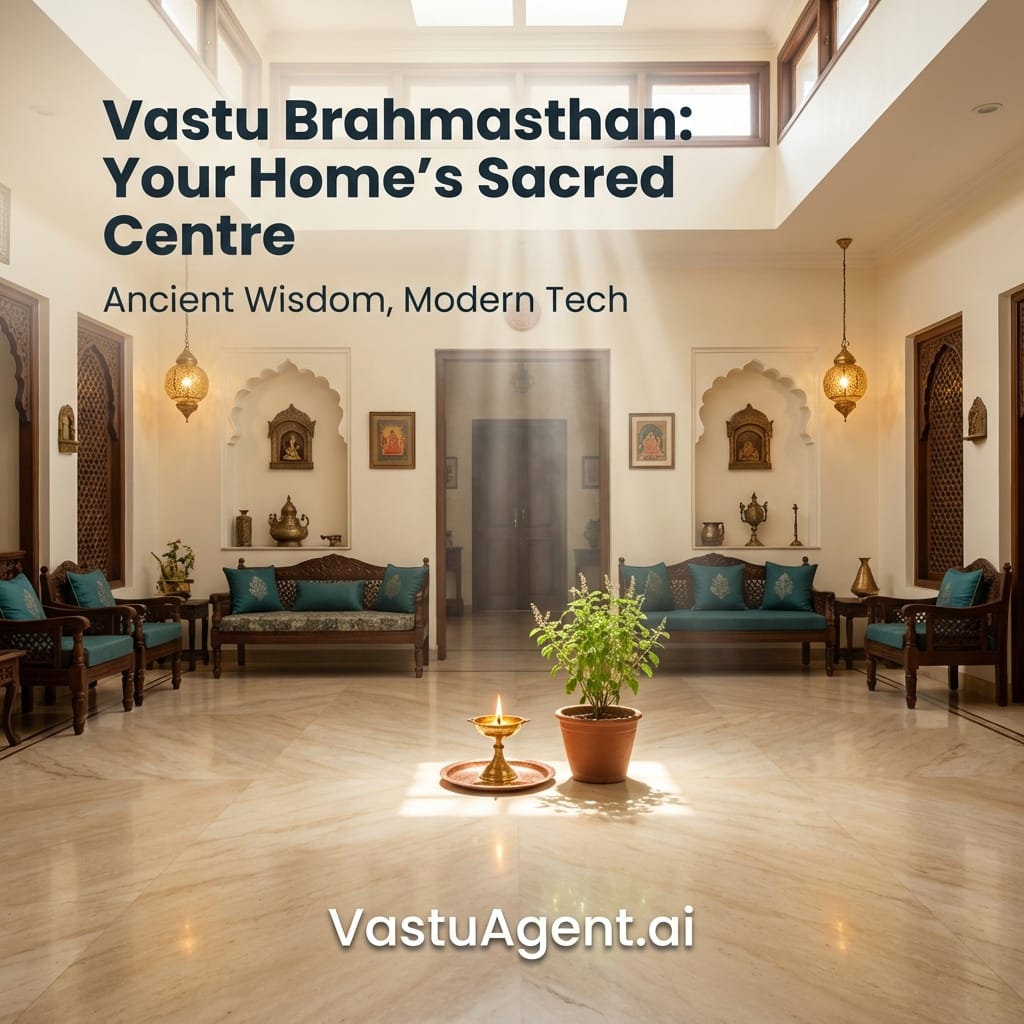
That unexplained heaviness when you walk through your living room. The chronic fatigue that doesn't lift despite eight hours of sleep. The financial stagnation that puzzles you.
What if the answer lies not in your habits, but in the very centre of your home?
In Vastu Shastra, this central zone carries a name that commands reverence: Brahmasthan—literally, "the place of Brahma," the creator of the universe. According to classical texts like the Mayamata and Vishwakarma Prakash, this single area determines whether cosmic energy flows freely through your dwelling or suffocates under the weight of poor design.
The stakes are significant. 73% of Indians believe in Vastu principles, and modern architects increasingly acknowledge that spatial geometry affects psychological well-being. Yet most homeowners unknowingly violate their Brahmasthan with heavy furniture, toilets, or structural columns—creating what Vastu texts call "Brahma Vedh," the piercing of the sacred centre.
This guide walks you through everything: what the Vastu Brahmasthan truly is, why it matters for your health and prosperity, what happens when it's blocked, and exactly how to remedy defects without demolishing walls. Whether you're buying a new flat, renovating your ancestral home, or simply curious about the centre of home in Vastu, you'll find actionable answers here.
What Is the Vastu Brahmasthan? Understanding the Sacred Centre
The Brahmasthan represents far more than a geometric midpoint. In Vastu Shastra, it embodies the energetic nucleus of any structure—the point where cosmic forces concentrate before radiating outward to every corner of your home.
The Geometric Definition
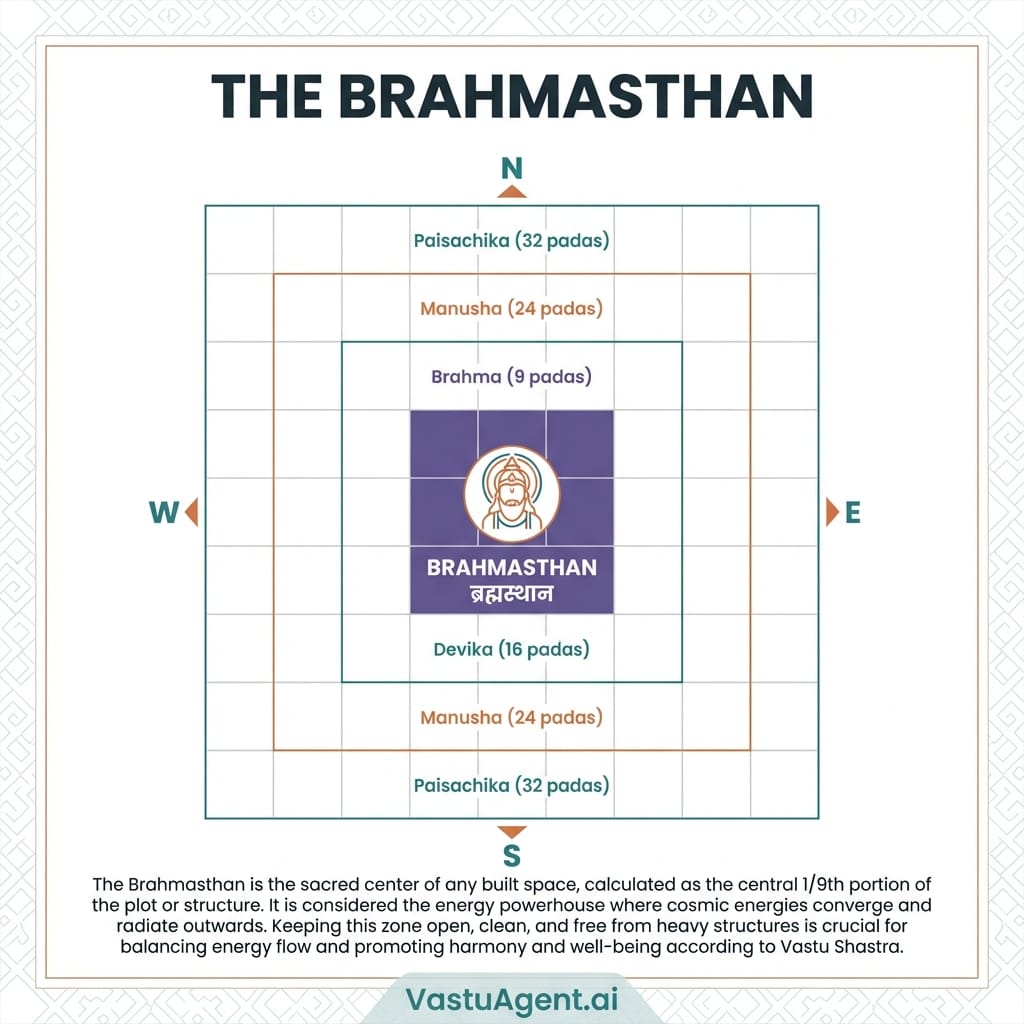
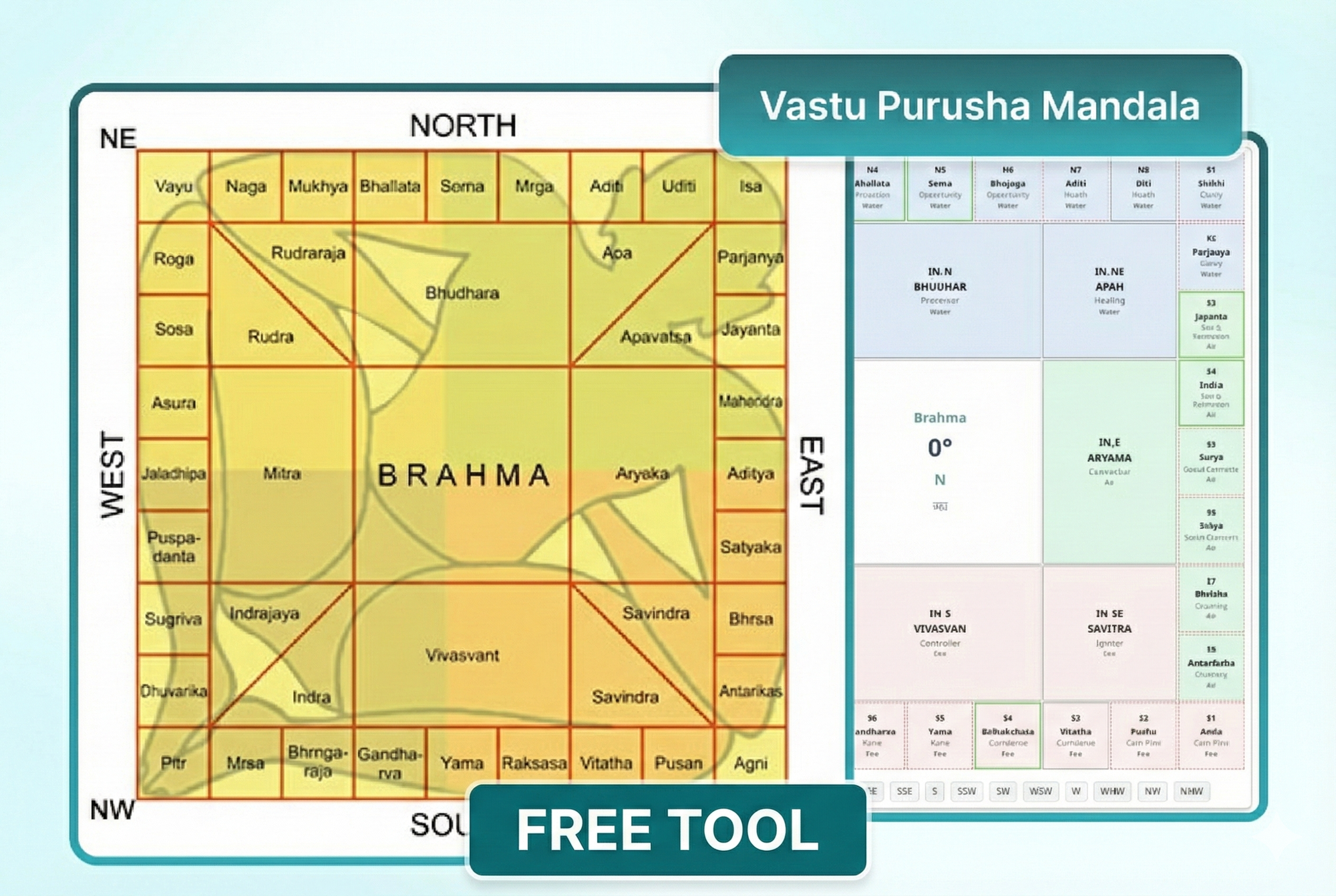
Every Vastu analysis begins with the Vastu Purusha Mandala, a metaphysical grid that maps divine energies onto physical space. In the most commonly used residential grid—the Paramasayika of 81 squares (9 × 9)—the Brahmasthan occupies the central nine cells.
Think of it this way: if you divide your floor plan into a 9 × 9 grid, the absolute middle block of nine squares forms your Brahmasthan. This isn't arbitrary. The nine-cell configuration represents the body of Lord Brahma, the creator deity who governs this zone according to classical Vastu texts.
In larger structures like temples, which use the 64-square Manduka grid, the Brahmasthan covers the central four squares. The principle remains constant: the geometric heart carries the greatest energetic significance.
You can visualize exactly where these zones fall on your floor plan using VastuAgent.ai's Vastu Purusha tool, which maps all 81 cells interactively onto your layout.
The Anatomical Correspondence
Vastu Shastra views every building as a living body—the Vastu Purusha, a cosmic being who lies embedded in the structure. The Brahmasthan corresponds to this being's navel and stomach.
Consider what the navel represents: the connection point through which a fetus receives life from its source. Similarly, the Brahmasthan connects your dwelling to cosmic energy. It's the umbilical cord between your home and the universe.
This anatomical mapping has practical implications. Just as the stomach must remain unburdened to digest food and distribute nutrients, the Brahmasthan must remain unburdened to process Prana (vital energy) and distribute it throughout your home.
The Elemental Association
Among the five elements (Panchabhutas) that govern Vastu, the Brahmasthan represents Space or Ether (Akasha). Space is the subtlest element—invisible yet essential. It fills all voids, allows light and sound to travel, and connects the other four elements.
| Element | Direction | Association |
|---|---|---|
| Fire (Agni) | Southeast | Transformation, cooking |
| Water (Jal) | Northeast | Purification, flow |
| Earth (Prithvi) | Southwest | Stability, grounding |
| Air (Vayu) | Northwest | Movement, ventilation |
| Space (Akasha) | Centre | Connection, transmission |
Because Space fills all voids, the Brahmasthan must remain physically open. Blocking it obstructs the very element it represents.
🕉️ Curious how the 81 cells of the Vastu Purusha Mandala map onto your home? VastuAgent.ai's Vastu Purusha tool lets you explore every deity position and pada interactively—completely free.
→ Explore Vastu Purusha: vastuagent.ai/vastu-purusha
Why the Centre of Home in Vastu Matters: The Science and Spirit
Understanding why the Brahmasthan carries such weight helps you respect its requirements. Classical texts offer spiritual explanations; modern observations add practical ones.
The Energy Core Concept
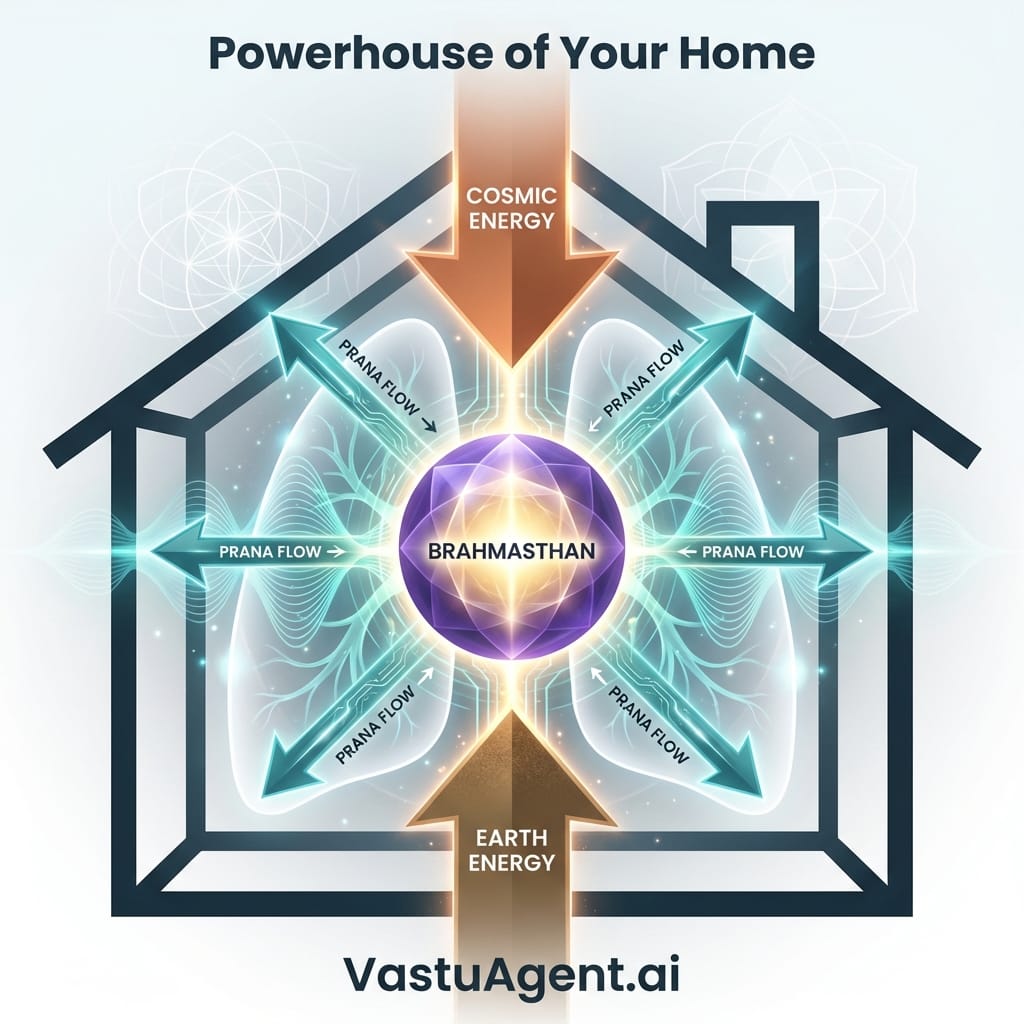
Vastu Shastra describes the Brahmasthan as the powerhouse of your dwelling. Earth energy rises from below; cosmic energy descends from above. These forces converge at the centre before radiating outward through the structure.
The texts use the metaphor of lungs. Just as lungs draw in oxygen and distribute it through the bloodstream, the Brahmasthan draws in Prana and distributes it through your home's energy channels. Block the centre, and you suffocate the dwelling's ability to breathe.
This isn't mere mysticism. Research in building biology increasingly confirms that central circulation spaces affect air quality, natural light distribution, and psychological perception of spaciousness. A cluttered centre creates visual and physical bottlenecks that occupants subconsciously register as oppressive.
The Health Connection
Because the Brahmasthan corresponds to the Vastu Purusha's stomach, classical texts link its condition directly to digestive and metabolic health. Blockages or pollution in this zone correlate with:
- Chronic digestive disorders
- Unexplained fatigue
- General debility and low energy
- Respiratory issues (since it's also the "lungs")
The mechanism proposed by Vastu practitioners: when energy cannot flow freely through the centre, it stagnates. Occupants living in this stagnant field experience physical manifestations of blocked vitality.
Whether you interpret this metaphysically or as a result of poor air circulation and psychological effects, the practical outcome remains: a clean, open Brahmasthan correlates with better-reported health among occupants.
The Stability and Prosperity Factor
Lord Brahma governs creation and continuity. His zone—the Brahmasthan—therefore influences stability in all forms: family harmony, financial consistency, and generational continuity.
Classical texts like the Brihat Samhita warn that severe Brahmasthan defects can lead to "destruction of lineage" and bankruptcy. While such language sounds extreme, practitioners observe subtler patterns: homes with blocked centres often house families reporting persistent financial struggles or interpersonal tension that defies resolution.
The Brahmasthan represents what one text calls "vibrant peace"—not the absence of activity, but the presence of harmonious energy that supports all activities conducted in the surrounding zones.
You can identify whether your floor plan's centre contains any structural issues with VastuAgent.ai's Floor Plan Optimizer, which uses AI to detect defects instantly.
📐 Is your home's centre blocked by walls, columns, or furniture? VastuAgent.ai's Floor Plan Optimizer scans your layout and identifies Brahmasthan defects in seconds—no consultation fees required.
→ Try Floor Plan Optimizer: vastuagent.ai/floor-plan-optimizer
The Physical Characteristics of an Ideal Vastu Brahmasthan
Knowing what constitutes an ideal Brahmasthan helps you assess your current situation and set renovation targets. Classical Vastu describes specific physical requirements.
Structural Openness: The Open-to-Sky Principle
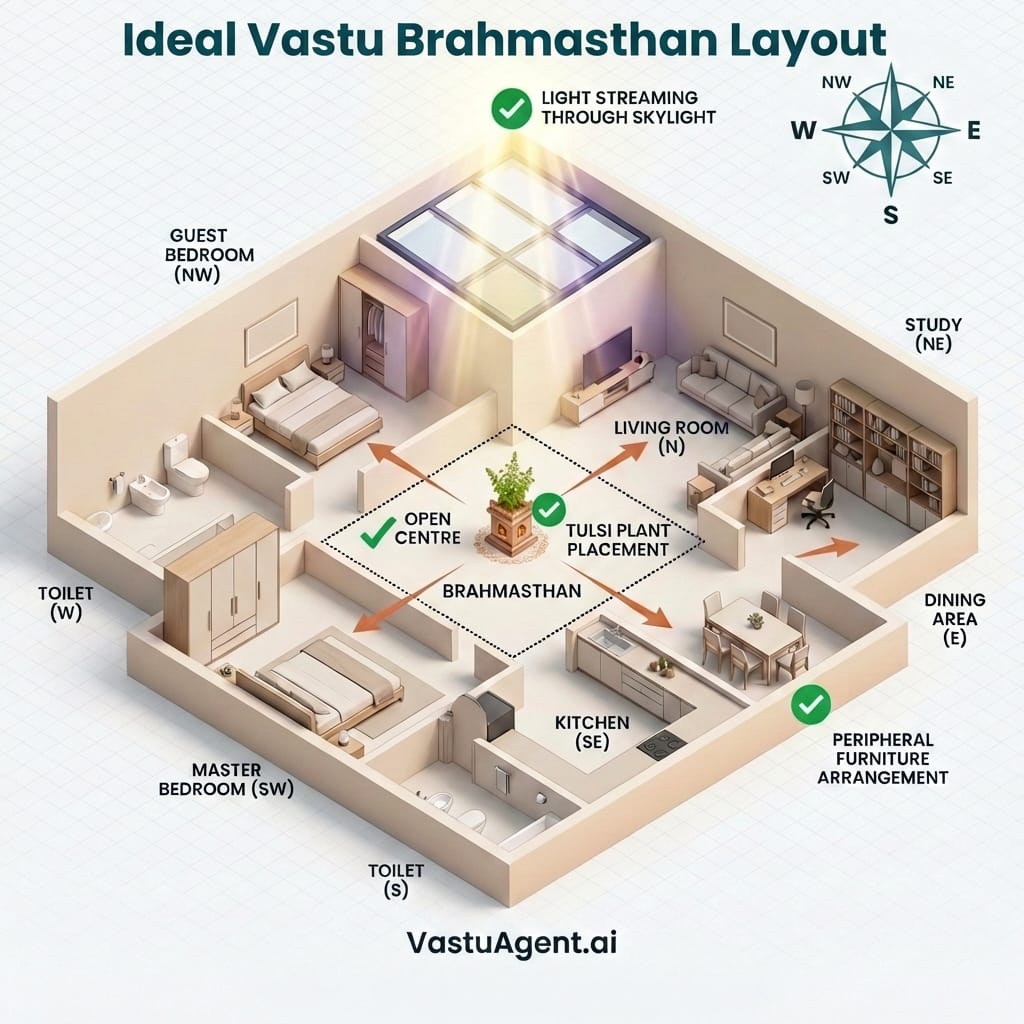
Traditional Indian architecture embraced the courtyard as the physical manifestation of the Brahmasthan. Kerala homes with their central nadumuttam (courtyard) and Rajasthani havelis with sky-open centres exemplify this design.
The logic is straightforward: an open-to-sky centre allows direct contact with sun, rain, and cosmic radiation. Light penetrates to the heart of the home. Rain—considered purifying—falls into the sacred centre. The dwelling breathes.
Modern apartments and enclosed houses cannot always accommodate open courtyards. Vastu texts suggest alternatives:
- Skylights positioned over the centre
- Clerestory windows directing light toward the middle
- Pyramid or slanted roofs over the central zone, preferably slanting toward north or east
The key is ensuring natural light reaches the centre, fulfilling the "influence of light" requirement even when an open courtyard is impossible.
Freedom from Weight and Obstruction
The most critical physical requirement: the Brahmasthan must remain free of heavy loads. This prohibition covers:
| Prohibited | Why |
|---|---|
| Pillars and columns | Structural weight "pierces" the energy centre |
| Heavy furniture | Creates energetic blockage |
| Beams crossing the centre | Divides the unified space |
| Internal walls through the centre | Fragments the Brahma zone |
| Staircases | Vertical circulation disrupts horizontal energy flow |
The exact central point—where the diagonal lines of your floor plan intersect—must remain particularly clear. Even if the broader centre zone serves as a living area, this precise midpoint should hold no fixed objects.
Aesthetic Requirements
Beyond structural concerns, the Brahmasthan has aesthetic requirements that support its energetic function:
Colour: White or very light neutral shades for walls and ceilings. These colours reflect the purity of the Space element and create visual expansion. Dark colours contract the sense of space and accumulate heavy energy.
Lighting: If natural light is insufficient, install artificial lighting to keep the area perpetually bright. A dim or dingy centre fails the luminosity requirement.
Cleanliness: The centre must remain impeccably clean. Dust, debris, or accumulated clutter pollute the energetic nucleus.
Sacred Objects: While heavy items are prohibited, the Brahmasthan is appropriate for a small temple (pooja), a Tulsi plant, or sacred symbols. These enhance spiritual vibration without creating structural blockage.
🧭 Not sure where your home's exact centre falls? VastuAgent.ai's Vastu Chakra tool overlays all 16 energy zones onto your floor plan, showing you precisely where the Brahmasthan lies—instant and free.
→ Try Vastu Chakra: vastuagent.ai/vastu-chakra
What's Strictly Prohibited in the Brahmasthan
Vastu Shastra establishes clear prohibitions for the centre zone. Violating these creates what texts call Brahma Dosha—defects that compromise the entire structure's energy.
Water Elements: Tanks, Borings, and Plumbing
Water in the centre is strictly forbidden. This prohibition covers:
- Underground water tanks
- Overhead tanks
- Boring wells
- Septic tanks
- Swimming pools
- Major plumbing lines running through the centre floor
The reasoning: Water represents the Jal element, which belongs in the Northeast. Placing water in the Space-governed centre creates elemental confusion. Classical texts describe this as "drowning the heart of the home."
Practically, underground tanks in the centre also create structural depressions that violate the principle of keeping the Brahmasthan level and unburdened.
Fire Elements: Kitchen and Heating
Fire (Agni) belongs in the Southeast. Placing fire-related elements in the centre causes equally severe defects:
- Kitchens
- Gas stoves
- Ovens
- Fireplaces
- Major electrical panels (which generate heat)
A kitchen in the Brahmasthan is among the most serious defects. Classical texts associate it with bankruptcy, health deterioration, and family disharmony. The fire element "burns" the Space element, destroying the centre's ability to transmit energy peacefully.
Sanitation: Toilets and Bathrooms
Perhaps the most damaging placement: a toilet in the Brahmasthan. Texts describe this as "destroying the building's vitality."
Toilets generate negative energy (apana vayu) through their function. Placing this in the cosmic centre contaminates the energy that should radiate outward to all zones. The result, according to practitioners: persistent financial difficulties, chronic health problems, and family conflicts that resist resolution.
Structural Elements
Staircases through the centre disrupt both horizontal energy flow and create continuous vertical movement in a zone meant for stillness.
Heavy columns or pillars in the centre create what's called Brahma Vedh—the piercing of Brahma. This defect is considered so severe that texts recommend removing such structures when possible.
Consequences Summary Table
| Defect | Primary Consequence | Secondary Effects |
|---|---|---|
| Water tank in centre | Financial instability | Kidney/urinary issues |
| Kitchen in centre | Bankruptcy | Digestive disorders, conflicts |
| Toilet in centre | Complete energy destruction | Chronic health problems, poverty |
| Heavy pillar in centre | Brahma Vedh (piercing) | Head of family's health compromised |
| Staircase in centre | Energy fragmentation | Instability in all areas |
| Sleeping in centre | Restlessness | Inability to recover energy |
These aren't meant to frighten but to inform. If your home has these defects, remedies exist—covered in the next sections.
⚠️ Worried your floor plan might have Brahmasthan defects? VastuAgent.ai's AI analyzes your layout instantly, identifying not just centre defects but all 16 zones' compliance—completely free.
→ Get Free Analysis: vastuagent.ai/free-report
Common Brahmasthan Defects in Modern Indian Homes
Contemporary construction—especially apartment buildings—often ignores Vastu principles entirely. Architects optimize for maximum carpet area, which frequently places problematic elements in the centre.
The Flat Centre Problem
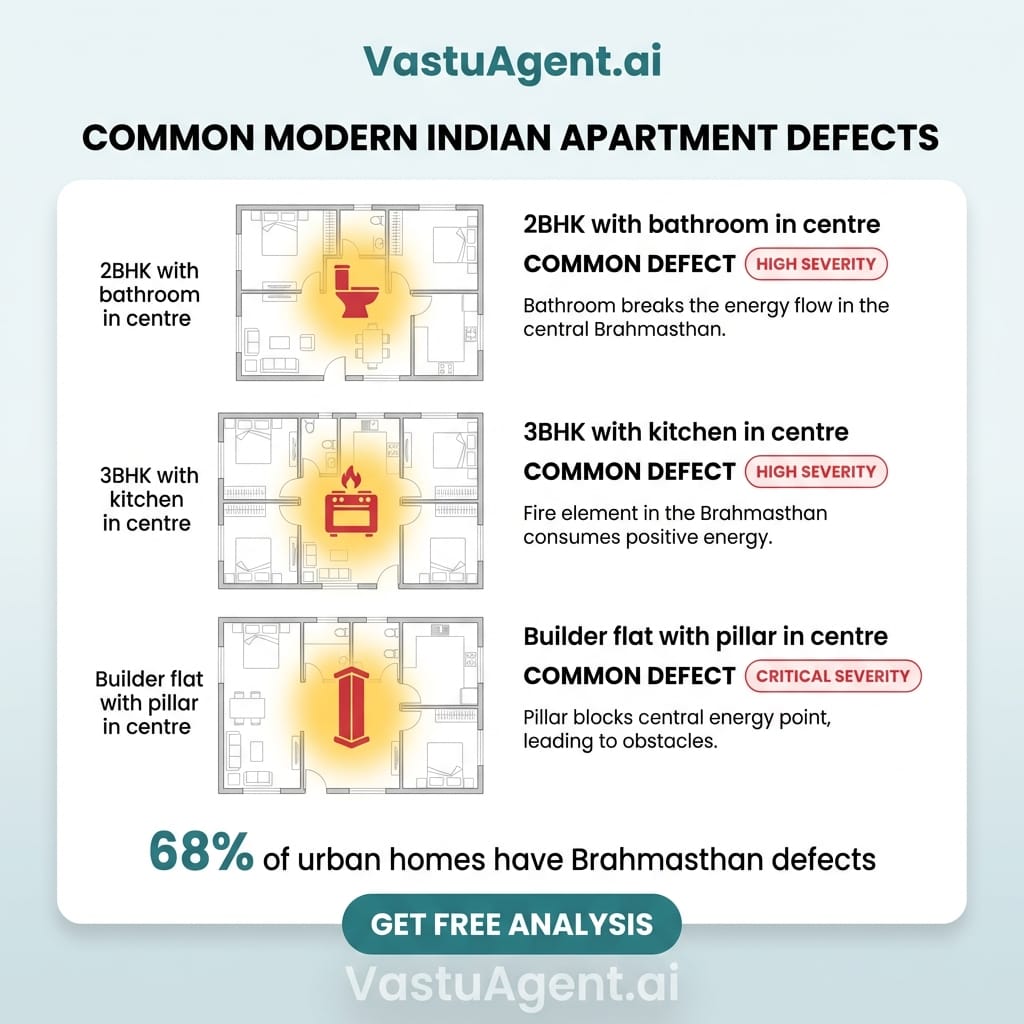
Most 2BHK and 3BHK apartments in Indian cities share a common flaw: the centre of the flat contains either:
- A bathroom (builder's favourite placement)
- The kitchen (optimizing balcony access)
- A structural column (building's core support)
Builders design for efficiency, not energy. The result: millions of Indian families live in homes where the Brahmasthan hosts the most energetically problematic elements.
If you're purchasing a flat, checking the Brahmasthan situation before finalizing can prevent years of remediation efforts.
Independent House Challenges
Independent houses offer more control but present different issues:
- Staircase placement through the centre (common in traditional multi-floor designs)
- Central courtyards converted to rooms (losing the original Vastu-compliant design)
- Heavy furniture accumulation in the living room centre over years
Older ancestral homes often had open courtyards that subsequent generations enclosed for "usable space." This well-intentioned modification frequently destroys the Brahmasthan's function.
Villa and Duplex Issues
Modern villas sometimes place:
- Central atriums with water features (wrong element in centre)
- Indoor swimming pools (severe water violation)
- Home theatres (heavy equipment, dark colours, low energy)
The irony: architects intend these as premium features, but they create energetic liabilities.
After analyzing over 10,000 floor plans at VastuAgent.ai, we've found that approximately 68% of urban Indian homes have at least one Brahmasthan defect. The good news: most can be remedied without structural changes.
📊 Want to know exactly which defects your home has? VastuAgent.ai's Free Report provides a comprehensive 25+ page analysis covering your Brahmasthan and all other zones—insights that traditional consultants charge ₹25,000+ for.
→ Get Your Free Report: vastuagent.ai/free-report
The Vastu Purusha Mandala and Brahma's Position
Understanding the Brahmasthan requires understanding its context within the larger Vastu Purusha Mandala—the complete energy map governing all Vastu principles.
The 81-Cell Grid Explained
The Paramasayika mandala divides any rectangular space into 81 equal squares (9 × 9). Each square (pada) hosts a specific deity with specific characteristics:
- Perimeter padas (32 total): The Paisachika ring—peripheral energies
- Second ring (24 padas): The Manusha ring—human activities
- Third ring (16 padas): The Devika ring—divine energies
- Centre (9 padas): The Brahmasthan—Lord Brahma's seat
Brahma occupies the central nine squares not arbitrarily but because creation emanates from the centre. All other deities—Indra (East), Yama (South), Varuna (West), Kubera (North)—orient around this central creative source.
The Brahma Deity Characteristics
Classical texts describe Lord Brahma in this context with specific attributes:
- Colour: Yellowish-white within the mandala (signifying purity)
- Association: Creation, preservation, protection, restoration
- Mantra: The Abrahagan Mantra used during Vastu Shanti ceremonies
- Gemstone: Ruby (Manik)—the activating stone for the Brahmasthan
Some texts describe Brahma's form as red, signifying Rajoguna (creative active energy). This creative force is why the centre governs not just stability but the generation of prosperity and progeny.
The Body of Vastu Purusha
The cosmic being embedded in every structure lies face-down in a specific position:
- Head: Northeast corner
- Feet: Southwest corner
- Right arm: Northwest
- Left arm: Southeast
- Navel/stomach: Centre (Brahmasthan)
- Heart: Some texts place the heart also in the centre
This positioning explains directional principles throughout Vastu. The head (Northeast) should remain light and open—you don't burden a being's head. The feet (Southwest) can bear weight—hence heavy furniture belongs there.
The stomach/navel at centre explains why this zone affects digestive health and why it must remain unburdened to "process" the home's energy efficiently.
You can explore the complete deity positions and body parts interactively with VastuAgent.ai's Vastu Purusha tool.
🕉️ Want to see every deity position in the 81-cell Mandala? VastuAgent.ai's interactive Vastu Purusha explorer shows you exactly which divine energies govern each zone of your home—completely free.
→ Explore the Mandala: vastuagent.ai/vastu-purusha
Proven Brahmasthan Remedies When Demolition Isn't Possible
Most homeowners cannot demolish walls, remove columns, or relocate bathrooms. Vastu Shastra acknowledges this reality and offers energetic remedies that don't require structural changes.

Pyramid Yantras: The Nine-Pyramid Solution
The most commonly prescribed remedy for Brahmasthan defects involves pyramid yantras. The protocol:
- Obtain nine small pyramid yantras (brass or copper preferred)
- Place them in the centre of your home in a 3 × 3 grid pattern
- Space them approximately one foot apart
- Position the largest pyramid at the exact centre point
- Ensure they remain undisturbed
Pyramids concentrate and transmit energy upward. Nine pyramids—matching the nine central padas—create a corrective energy field that partially compensates for physical obstructions.
Crystal and Gemstone Activation
Ruby (Manik): Placing a natural ruby in the Brahmasthan activates solar energy transmission. The ruby connects the centre to the macrocosm, maintaining the cosmic connection despite physical blocks.
Crystal spheres: Clear quartz spheres placed in the centre amplify positive energy and disperse negativity. A crystal placed under a chandelier in the centre creates continuous light refraction.
Sri Yantra: The sacred geometric pattern of the Sri Yantra, when placed in the centre, establishes powerful corrective vibrations. Brass or copper Sri Yantras are preferred over printed versions.
Metals and Containers
Copper Kalash: A copper pot (kalash) filled with purified water, capped with mango leaves and a coconut, creates a powerful Vastu correction device. Replace the water weekly.
Brass items: Brass bowls, diyas (lamps), or decorative items introduce balancing metal energy to the centre.
Rock salt bowl: A bowl of rock salt in the centre absorbs negative energy. Replace the salt monthly.
Lighting and Colour Remedies
Continuous lighting: If the centre is dark (interior bathroom, for example), install a light that remains on 24/7. Even a small night lamp counts. Light represents the sun's energy—essential for a functional Brahmasthan.
White paint: If walls exist in the centre zone, paint them bright white. This reflects light and energetically "opens" the space visually.
Mirrors: Strategic mirror placement can create the illusion of depth and space, partially compensating for physical enclosure. However, mirrors should never directly face each other in the centre.
Sound and Ritual Remedies
Mantra chanting: Regular chanting of "Om" or the Gayatri Mantra in or near the centre aligns the space with universal vibration. Morning chanting is particularly effective.
Bell ringing: Ringing a brass bell in the centre daily clears stagnant energy through sound vibration.
Havan and Puja: Periodic Vastu Shanti pujas performed by a priest, with offerings to Lord Brahma, provide ceremonial correction.
Remedy Protocol Summary
| Defect Severity | Recommended Remedies |
|---|---|
| Mild (clutter, dark centre) | Declutter, add lighting, white paint |
| Moderate (heavy furniture) | Remove furniture, add pyramids, crystal |
| Significant (kitchen/bathroom) | Full protocol: pyramids + ruby + kalash + continuous light + mantras |
| Severe (toilet/column) | Maximum remedies + professional Vastu consultation + Vastu Shanti puja |
✨ Not sure which remedies apply to your specific defects? VastuAgent.ai's Free Report identifies your Brahmasthan issues and provides personalized remedy recommendations—insights worth ₹25,000+ from traditional consultants.
→ Get Personalized Remedies: vastuagent.ai/free-report
Room-by-Room Brahmasthan Considerations
While the Brahmasthan itself should remain open, understanding how surrounding rooms interact with the centre helps optimize your entire floor plan.
Living Room and the Centre
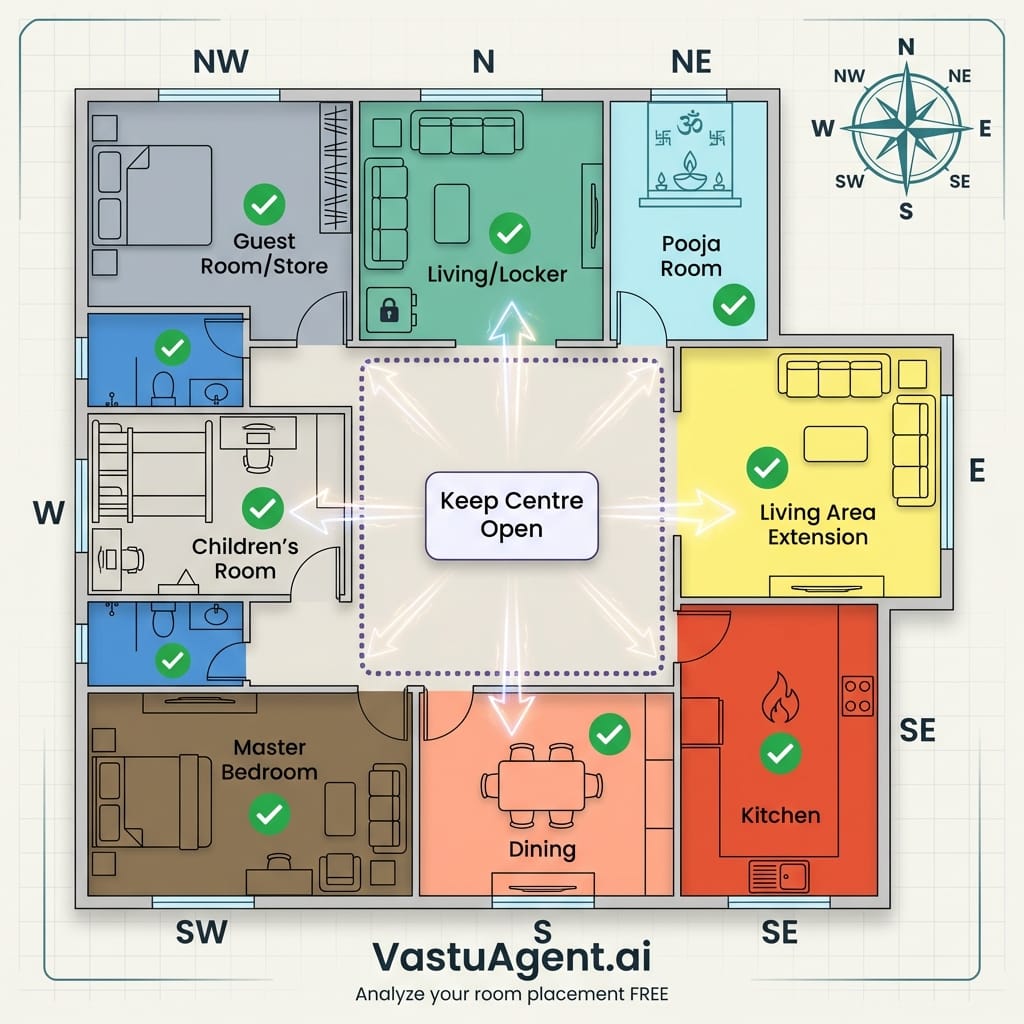
The living room makes an excellent surrounding for the Brahmasthan. Family gathering spaces benefit from central energy radiation. However:
- Keep the exact centre of the living room free of furniture
- Avoid placing heavy sofas directly over the floor plan's geometric centre
- Use light, movable furniture that can be relocated if needed
- Ensure the living room centre receives natural light
Bedroom Placement Relative to Centre
Bedrooms should never be in the Brahmasthan itself. The centre requires activity and light during the day; bedrooms require rest and darkness at night. These functions conflict.
The master bedroom belongs in the Southwest—the direction of stability and the Vastu Purusha's feet. Children's rooms fit the Northwest or West.
If a bedroom unavoidably covers the centre, the remedy involves sleeping with your head toward South or East, keeping the room well-lit during the day, and implementing pyramid remedies beneath the bed.
Kitchen and Fire Placement
Kitchens belong in the Southeast—the fire corner governed by Agni. A kitchen in or near the centre causes:
- Digestive issues for family members
- Financial volatility
- Increased conflicts and temper flare-ups
If your kitchen overlaps the centre, remedies include placing the stove in the kitchen's Southeast corner, installing a copper pyramid above the stove, and keeping the centre portion of the kitchen as a dining or prep area rather than the cooking zone.
Bathroom and Toilet Considerations
Bathrooms have limited appropriate zones in Vastu: Northwest or West sectors primarily. A bathroom in the centre creates the most challenging defect.
If you cannot relocate the bathroom:
- Keep it impeccably clean
- Use air fresheners and ventilation continuously
- Paint walls white or very light
- Install a 24/7 night lamp
- Place rock salt in all corners, replaced monthly
- Conduct weekly cleaning with salt water
Pooja Room and Sacred Spaces
The Brahmasthan is actually ideal for a small temple or pooja space—provided it's a light installation without heavy furniture. This use aligns with the zone's sacred nature.
Requirements for a centre pooja:
- Light structure (wooden shelf, not stone or marble heavy)
- No heavy stone idols (small brass murtis preferred)
- Fresh flowers and diyas (lit daily)
- Regular cleaning and puja
- Tulsi plant if space permits
This transforms a potentially problematic centre into an actively beneficial one.
📐 Wondering if your room placements align with Vastu zones? VastuAgent.ai's Floor Plan Optimizer shows you exactly which rooms are in correct positions and which need attention—instant AI analysis.
→ Analyze Your Floor Plan: vastuagent.ai/floor-plan-optimizer
How to Determine Your Home's Brahmasthan Location
Accurate identification of your Brahmasthan is the first step toward assessment and remedy. Here's how to locate it precisely.
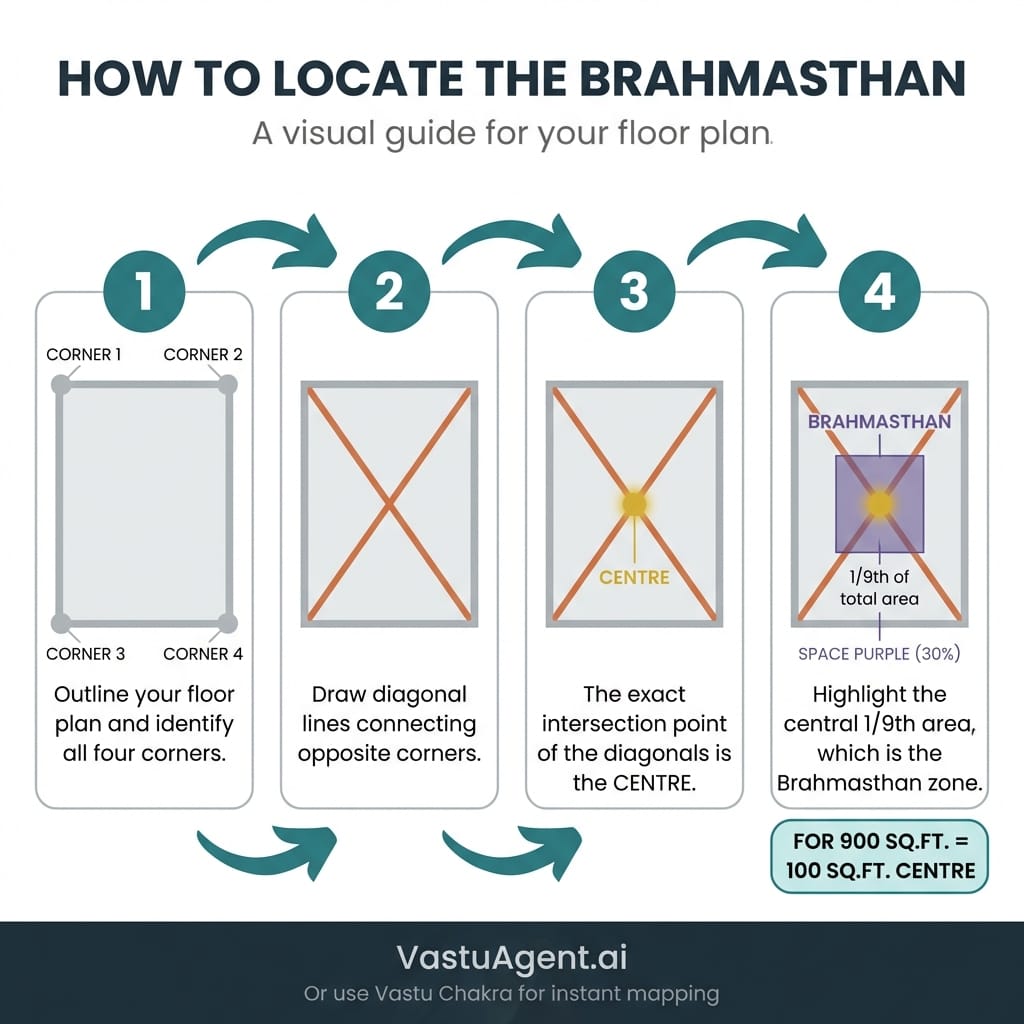
The Geometric Method
For rectangular or square plots and floor plans:
- Draw diagonal lines from corner to corner (all four corners)
- Mark the intersection point—this is your geometric centre
- Extend outward from this point by approximately 1/9th of the total length and width
- The resulting square (about 1/9th of total area) is your Brahmasthan
For a 900 sq.ft. flat (30 × 30 feet), the Brahmasthan would be approximately a 10 × 10 feet central zone.
Irregular Shapes
Modern apartments often have irregular shapes—L-shaped, T-shaped, or with balcony cutouts. For these:
- Imagine the complete rectangle that would contain your floor plan
- Find the centre of this complete rectangle
- Check whether this centre falls within your actual floor plan
- If outside your actual area, your floor plan has a Brahmasthan extension issue—a separate Vastu concern
Missing corners or extended shapes create their own Vastu implications beyond the Brahmasthan.
Multi-Story Considerations
For multi-floor buildings:
- Each floor has its own Brahmasthan
- The building as a whole also has a Brahmasthan (the centre of all floors combined)
- Both floor-level and building-level centres matter
- A problematic element on one floor affects that floor more than others, but severe defects radiate building-wide
Using Technology
Rather than manual calculations, you can upload your floor plan to VastuAgent.ai's Vastu Chakra tool, which automatically:
- Identifies your exact centre
- Maps all 16 Vastu zones onto your plan
- Shows where the Brahmasthan falls relative to your rooms
- Highlights potential overlaps with problematic elements
This eliminates measurement errors and provides instant visualization.
🧭 Skip the manual calculations entirely. VastuAgent.ai's Vastu Chakra tool maps your centre and all 16 zones onto your floor plan in seconds—just upload and see.
→ Try Vastu Chakra: vastuagent.ai/vastu-chakra
Activating Your Brahmasthan for Maximum Benefit
Beyond remedying defects, you can actively enhance your Brahmasthan to amplify positive energy throughout your home.

The Ruby Activation
The gemstone traditionally associated with Brahmasthan activation is the Ruby (Padma-raga or Manik). According to classical texts, a ruby placed in the centre:
- Connects the Brahmasthan to solar cosmic energy
- Ensures continuous energy transmission to the Vastu Purusha Mandala
- Activates the Aryama zone (East), which draws sun energy from the centre
A natural, untreated ruby is preferred. Size matters less than authenticity. Even a small genuine ruby outperforms a large synthetic one.
The Tulsi Plant Method
The sacred basil plant (Tulsi) represents Vishnu and carries purifying properties. A Tulsi plant in or near the centre:
- Purifies the air (scientifically validated)
- Emits positive bioelectrical energy
- Requires daily attention, creating a devotional ritual
- Signals respect for the sacred centre
Place the Tulsi in a light-weight pot that can be moved if needed. Water daily and maintain with care.
Continuous Light Practice
Light represents consciousness and solar energy. A continuously lit lamp in the Brahmasthan:
- Maintains active energy even at night
- Prevents stagnation in enclosed centres
- Fulfills the "open-to-sky" principle symbolically
This can be a small LED lamp—safety matters. Traditional brass diyas with ghee or oil are ideal but require supervision.
Sound Activation
Sound carries vibrational energy that activates dormant spaces:
- Morning chanting: Begin each day with "Om" chanted three times in or facing the centre
- Bell ringing: Ring a brass bell in the centre daily before leaving home
- Music: Play sattvik (pure) instrumental music in the centre periodically
These practices prevent energetic stagnation and keep the centre vibrationally active.
Seasonal Deep Activation
Perform thorough Brahmasthan activation during auspicious occasions:
- Diwali: Deep clean the centre, replace crystals and salt, light multiple diyas
- Ugadi/Gudi Padwa: New Year activation with fresh remedies
- Griha Pravesh anniversary: Annual re-dedication of the home's centre
- Full moon days: Monthly energetic refresh
These practices compound over time, gradually strengthening your home's energetic core.
🕉️ Want a complete Vastu activation roadmap for your specific home? VastuAgent.ai's Free Report includes room-by-room recommendations including Brahmasthan activation protocols personalized to your floor plan.
→ Get Your Personalized Report: vastuagent.ai/free-report
Case Studies: Brahmasthan Transformations
Abstract principles become meaningful through real examples. Here are documented cases from VastuAgent.ai's analysis database.
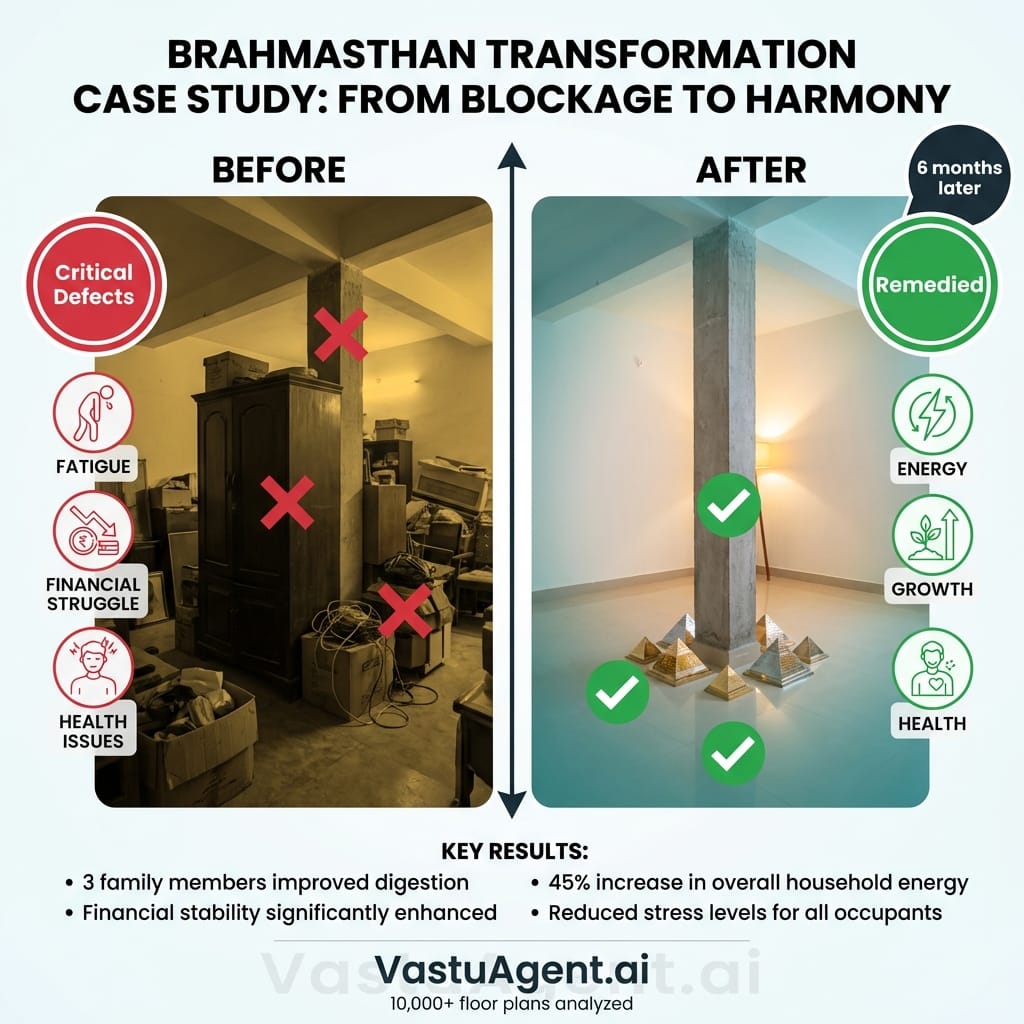
Case 1: The Chronically Blocked 2BHK (Mumbai)
Situation: A 950 sq.ft. Mumbai apartment where the centre contained:
- One bathroom (partial overlap)
- A load-bearing pillar (exactly at centre point)
- Heavy storage cabinet against the pillar
Reported issues: The family of four experienced persistent digestive problems across all members, financial stagnation despite dual income, and a pervasive sense of heaviness in the home.
Remedies implemented:
- Nine copper pyramid yantras around the pillar
- Continuous night lamp in the bathroom
- Heavy cabinet removed, replaced with open shelving
- White paint on bathroom walls
- Daily bell ringing near the centre
Results (reported after 6 months): Digestive issues resolved for three family members. One promotion received. The family reported the home "feeling lighter."
Case 2: The Kitchen-Centre Crisis (Bangalore)
Situation: A newly purchased 3BHK where the modular kitchen occupied the geometric centre—a builder's design optimizing balcony views.
Reported issues: Frequent arguments during cooking, one family member's gastric surgery, unexpected expenses depleting savings.
Remedies implemented:
- Stove relocated to kitchen's Southeast corner (within the existing kitchen)
- Centre portion converted to breakfast counter/dining area
- Copper pyramid above stove
- Fresh Tulsi plant near kitchen window
- Rock salt in all kitchen corners
Results (reported after 8 months): Arguments reduced significantly. Medical follow-ups showed improved digestive markers. Expense patterns stabilized.
Case 3: The Blocked Ancestral Home (Chennai)
Situation: A 60-year-old ancestral home where the original central courtyard had been roofed over 30 years prior for "more room." The covered centre now housed a storage area for decades of accumulated items.
Reported issues: Three generations living together with constant friction. Several family members' careers stalled. The family patriarch experienced chronic fatigue.
Remedies implemented:
- Complete clearance of stored items
- Installation of a large skylight (structural modification approved)
- Creation of a small pooja space in the centre
- Fresh white paint throughout the centre zone
- Vastu Shanti puja performed
Results (reported after 1 year): Family harmony improved noticeably. Two career advancements occurred. The patriarch reported renewed energy levels. The home felt "like it used to" according to elderly family members who remembered the open courtyard.
These cases illustrate patterns rather than guarantees. Individual results vary based on multiple factors, but consistent improvement correlates with consistent Brahmasthan attention.
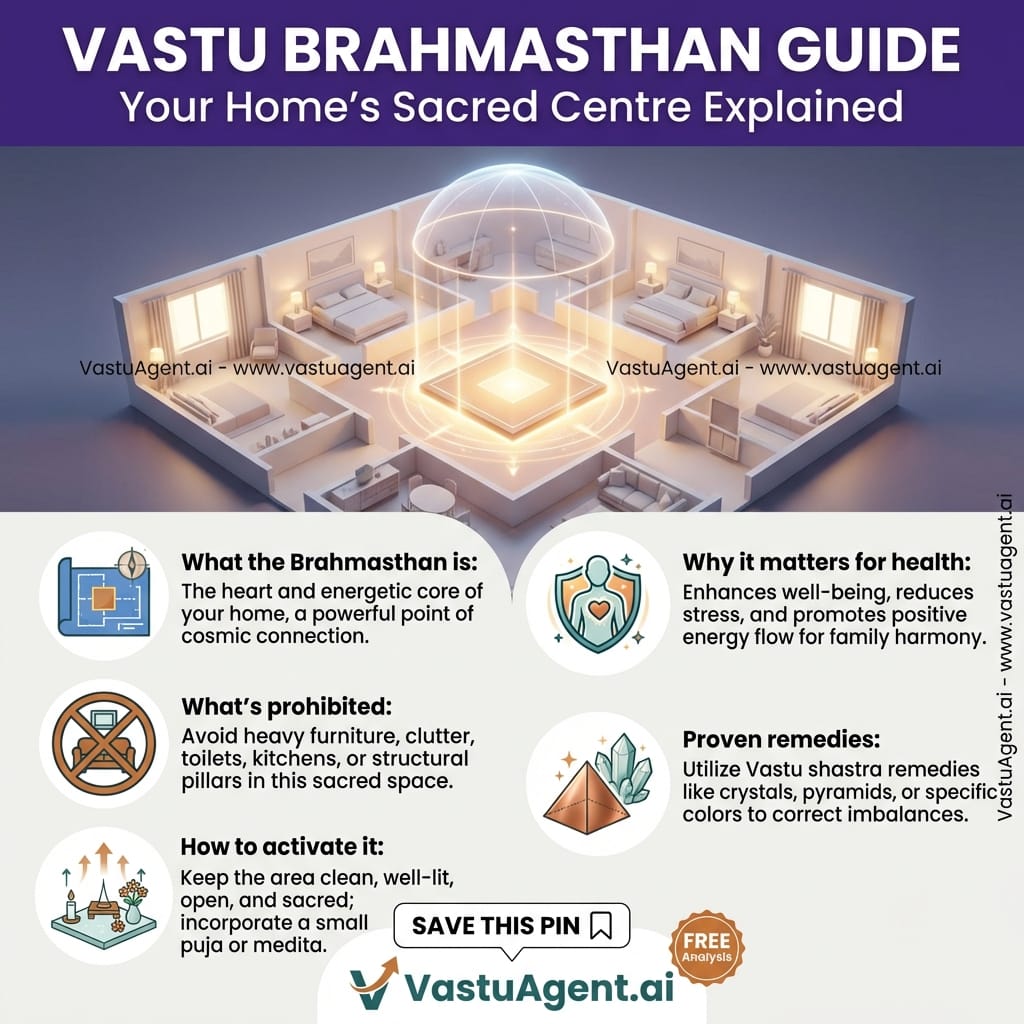
📊 Curious what specific defects your home might have? VastuAgent.ai has analyzed 10,000+ floor plans and can identify your Brahmasthan issues instantly—just upload your floor plan for a free comprehensive report.
→ Get Your Free Analysis: vastuagent.ai/free-report
Frequently Asked Questions
Q: What is the Vastu Brahmasthan and why is it important?
The Vastu Brahmasthan is the central zone of any building according to Vastu Shastra, governed by Lord Brahma and representing the Space (Akasha) element. It acts as the energetic nucleus—the point where cosmic and earth energies converge and radiate outward. Its importance stems from its role as the "lungs" of the home; a blocked Brahmasthan restricts Prana flow throughout the dwelling, affecting occupants' health, finances, and harmony.
Q: How do I find the centre of home in Vastu for my floor plan?
Draw diagonal lines from all four corners of your floor plan. The intersection point is your geometric centre. The Brahmasthan extends approximately 1/9th of your total dimensions around this point. For complex shapes, consider the rectangle that would contain your entire plan. For instant accuracy, upload your floor plan to VastuAgent.ai's Vastu Chakra tool, which automatically maps all zones including the centre.
Q: Can I place a toilet in the Brahmasthan if it's my only option?
A toilet in the Brahmasthan is among the most severe Vastu defects. If relocation is impossible, implement maximum remedies: paint walls white, install 24/7 lighting, place rock salt in all corners (replaced monthly), ensure impeccable cleanliness and ventilation, and install pyramid yantras in surrounding areas. These measures mitigate but don't eliminate the defect.
Q: What happens if there's a pillar in my home's centre?
A pillar in the centre creates "Brahma Vedh" (piercing of Brahma)—a serious defect associated with health problems for the head of family. Remedies include surrounding the pillar with nine pyramid yantras, installing mirror panels to visually dissolve the obstruction, and conducting regular Vastu Shanti pujas.
Q: Is it okay to have a living room in the Brahmasthan zone?
Yes—a living room makes an excellent Brahmasthan surrounding. The key requirements: keep the exact centre point free of heavy furniture, ensure adequate natural light reaches the centre, and maintain cleanliness. A living room allows the centre to remain open and actively used, which is preferable to empty neglected space.
Q: What gemstone activates the Brahmasthan?
The Ruby (Manik or Padma-raga) is the traditional gemstone for Brahmasthan activation. Placing a natural ruby in the centre connects the zone to solar cosmic energy. Clear quartz crystals also work as amplifiers. For severe defects, a Sri Yantra in brass or copper provides powerful corrective energy.
Q: How does the Brahmasthan affect health according to Vastu?
The Brahmasthan corresponds to the stomach and navel of the Vastu Purusha. Blockages here correlate with digestive disorders, chronic fatigue, and general debility. The centre also functions as the home's "lungs"—blocking it restricts energy flow, which practitioners associate with respiratory issues and low vitality.
Q: Can I build a pooja room in the Brahmasthan?
A small pooja room or temple is actually ideal for the Brahmasthan—it aligns with the zone's sacred nature. Requirements: keep structures lightweight (wooden shelves, not heavy stone), avoid heavy idols (small brass murtis preferred), maintain daily puja practice, and include fresh flowers and lit diyas.
Q: What are Brahmasthan remedies if I can't make structural changes?
Non-structural remedies include: nine pyramid yantras in the centre, natural ruby or crystal placement, copper kalash filled with water, rock salt in corners, continuous lighting (even a night lamp), white paint on centre-zone walls, daily mantra chanting or bell ringing, and periodic Vastu Shanti pujas.
Q: How do apartments handle the Brahmasthan when the centre has no windows?
For enclosed centres without natural light: install a skylight if possible, use continuous artificial lighting, paint surfaces white to reflect available light, place mirrors strategically to create depth perception, and implement the standard remedy protocol (pyramids, crystals, salt). The goal is fulfilling the "influence of light" principle through available means.
Q: Does the Brahmasthan affect financial stability?
Yes—Lord Brahma governs creation and continuity, including financial generation. Classical texts associate Brahmasthan defects with financial stagnation or bankruptcy. Practitioners observe that homes with blocked centres often house families reporting persistent financial difficulties that resist conventional solutions.
Q: What's the difference between Brahmasthan in residential and commercial Vastu?
The principles remain identical—the centre must be open, light, and free of obstructions. Commercial spaces should avoid placing cash counters, storage, or heavy equipment in the centre. Reception areas or open circulation spaces work well. The financial implications of commercial Brahmasthan defects may manifest more directly in business revenue patterns.
Transform Your Home with VastuAgent.ai
You've now learned what the Vastu Brahmasthan truly is, why it governs your home's energetic health, what blocks it, and how to remedy defects without demolition. The ancient architects who codified these principles understood something modern science is rediscovering: spatial geometry affects human wellbeing.
Your home's centre isn't just architectural square footage—it's the nucleus from which all domestic energy radiates. A clean, open, luminous Brahmasthan creates the conditions for health, harmony, and prosperity. A blocked, polluted, or burdened centre restricts exactly what you're trying to cultivate.
The path forward is clear. Identify your Brahmasthan. Assess its current condition. Implement appropriate remedies. The ancient wisdom of Vastu Shastra, now accessible through modern technology, makes this process simpler than ever before.
Ready to apply what you've learned? VastuAgent.ai offers free tools that make Vastu analysis instant and accessible:
| Tool | What It Does | Best For |
|---|---|---|
| Vastu Chakra | Interactive compass with 16-zone mapping | Finding directions, understanding zones |
| Vastu Purusha | 81-cell Mandala explorer with deity positions | Deep Vastu study, pada analysis |
| Floor Plan Optimizer | AI-powered defect detection | Existing home analysis |
| Floor Plan Generator | Create Vastu-compliant designs | New construction planning |
| Free Report | 25+ page comprehensive analysis | Complete home assessment |
→ Start Your Free Analysis: vastuagent.ai/free-report
Join 10,000+ homeowners who've already transformed their spaces with VastuAgent.ai
Ancient Wisdom, Modern Tech