Vastu for Pooja Room: The Complete Direction & Setup Guide
Discover the ideal pooja room direction as per Vastu. Northeast placement, deity positions, dos & don'ts—free AI analysis tools

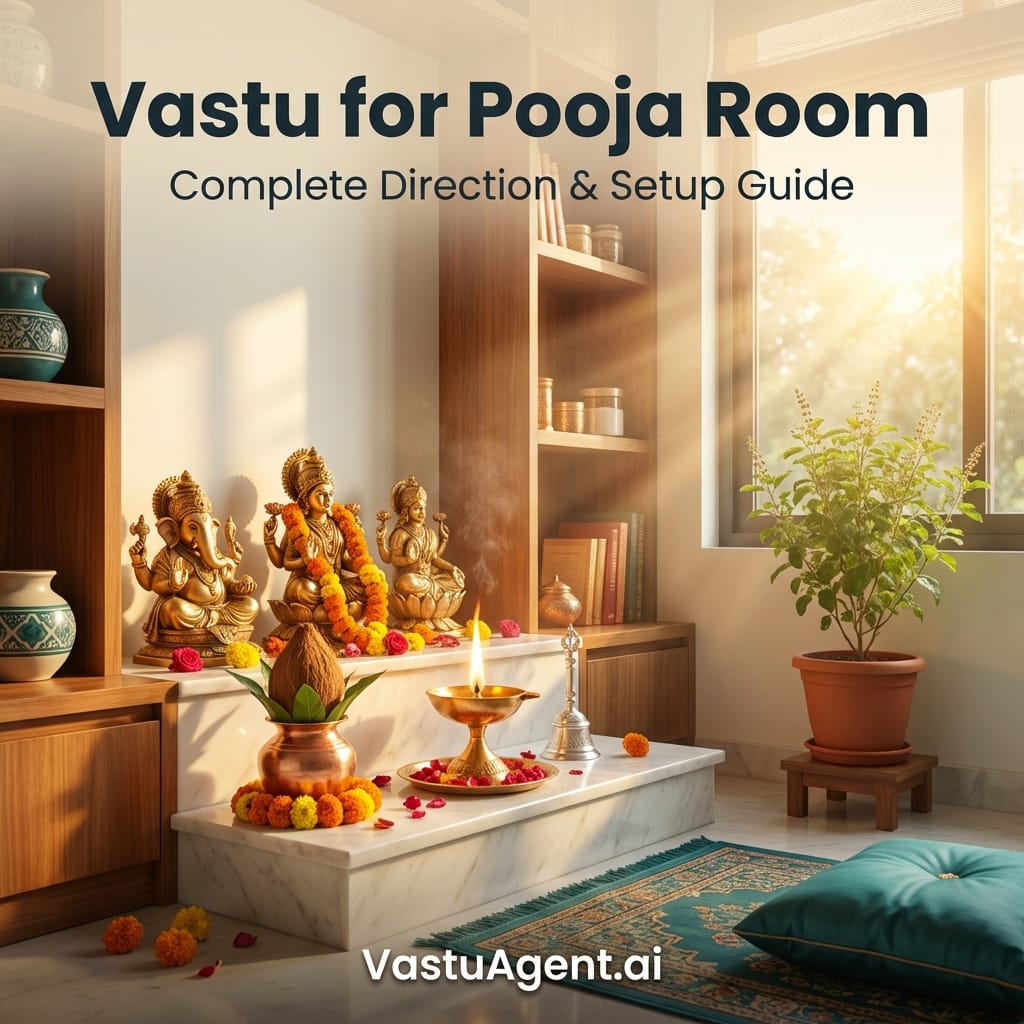
That brass diya your grandmother passed down sits on a shelf facing west. The silver idols crowd together on uneven ground. And despite daily prayers, something feels off—like the sacred space isn't quite reaching its potential.
You're not imagining it. According to Vastu Shastra, the pooja room holds more energetic significance than any other space in your home. The Brihat Samhita, one of the oldest Vastu texts dating back to the 6th century, dedicates entire chapters to the sacred geometry of worship spaces.
The pooja room direction as per Vastu determines not just spiritual outcomes but influences the entire household's prosperity and peace. When positioned correctly, this space becomes a powerful anchor—channeling cosmic energy through your home exactly as intended for millennia.
This guide covers everything: the science behind directional placement, step-by-step setup instructions, deity arrangement rules, and practical remedies if your current space doesn't align with Vastu principles.
Why Pooja Room Direction Matters in Vastu Shastra
The pooja room isn't just another room—it's the spiritual nucleus of your home. In classical Vastu texts like Mayamata and Vishwakarma Prakash, the worship space receives special attention because it directly connects human consciousness with cosmic energy patterns.
The Energy Science Behind Sacred Spaces
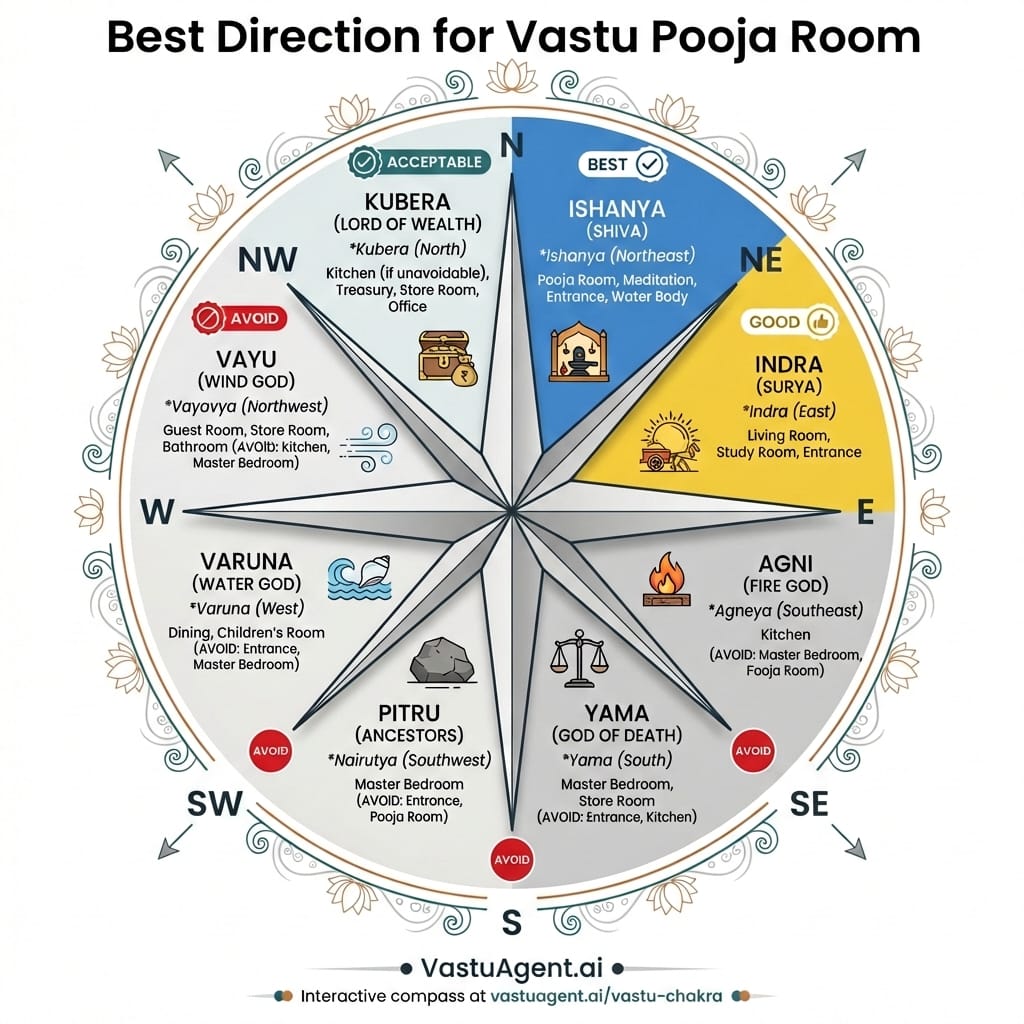
Vastu Shastra maps eight cardinal directions, each governed by specific deities and carrying distinct energy signatures. The northeast direction (Ishanya), ruled by Lord Shiva and associated with the water element, naturally accumulates positive cosmic energy.
Morning sunlight—rich in ultraviolet rays between 6-8 AM—enters from the northeast and east. When your pooja room aligns with this direction, the sacred space receives this purifying light during typical prayer times, amplifying the spiritual environment.
The Mayamata specifically states that the Ishanya corner represents the meeting point of divine consciousness and earthly existence. Placing your worship space here creates what ancient texts call "Brahma Sthana connection"—a direct energetic link to the central life force of the home.
What Happens When Placement Goes Wrong
A pooja room in the wrong zone doesn't just feel uncomfortable—it can create energetic interference patterns throughout your living space. Common issues include:
| Wrong Placement | Typical Effects | Energy Disruption |
|---|---|---|
| South | Restlessness during prayer | Fire element conflict |
| Southwest | Heavy, blocked feeling | Earth element excess |
| Bedroom | Sleep disturbances | Mixed sacred/rest energies |
| Under staircase | Diminished reverence | Compressed energy flow |
| Near toilet | Obvious spiritual conflict | Water/waste energy clash |
The Vishwakarma Prakash warns against placing sacred spaces in zones governed by malefic influences, noting that such placement "scatters the mind and weakens devotion."
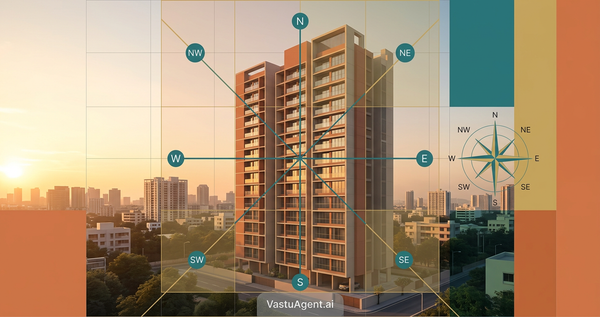
🧭 Not sure which direction your pooja room faces? VastuAgent.ai's Vastu Chakra tool identifies your home's exact orientation and shows all 16 energy zones instantly—completely free.
→ Check Your Direction: vastuagent.ai/vastu-chakra
The Best Direction for Pooja Room as Per Vastu
Classical texts unanimously agree on directional hierarchy for the pooja room. Understanding these rankings helps you make the best choice for your specific floor plan.
Primary Choice: Northeast (Ishanya)
The northeast pooja room direction ranks highest in all major Vastu texts. Here's why this corner dominates recommendations:
Ruling deity: Lord Shiva (Ishana form) Element: Water combined with Space Energy quality: Purifying, elevating, spiritually receptive
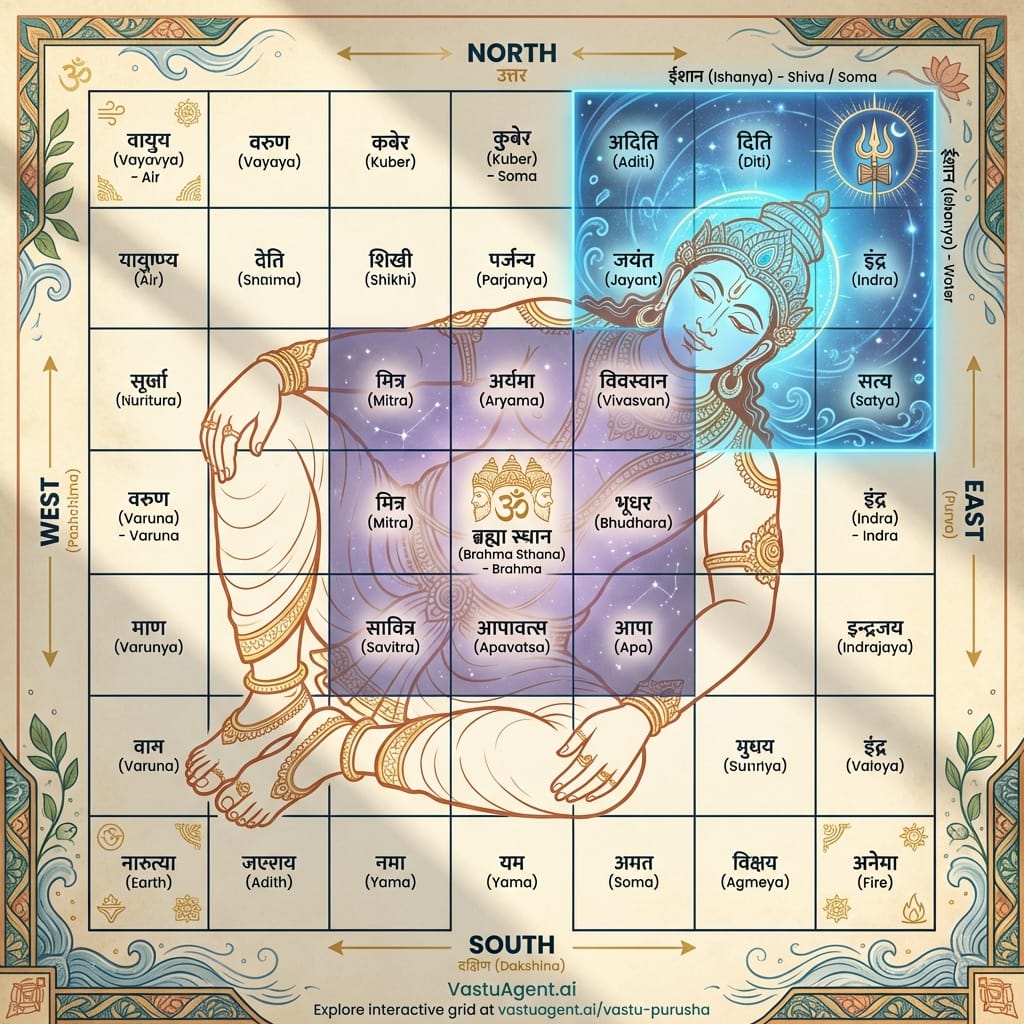
The northeast receives the first rays of morning sun, making it naturally lit during typical pooja times. This direction is considered the "head" of the Vastu Purusha—the cosmic being whose body maps onto every structure according to Vastu principles.
When you pray in the northeast zone, you're metaphorically connecting with the highest consciousness point of your home. The Brihat Samhita calls this the "gateway of divine grace."
Secondary Choice: East (Purva)
If northeast isn't available, the east direction offers excellent results. Ruled by Lord Indra and associated with the sun's daily emergence, this zone carries natural illumination and fresh energy.
Ideal for: Homes where northeast contains a bathroom or has structural limitations.
Acceptable Alternative: North (Uttara)
The north direction, governed by Kubera (the deity of wealth), works well for pooja rooms—especially for those seeking material prosperity alongside spiritual growth. This zone maintains positive energy flow and avoids major Vastu conflicts.
Directions to Avoid
| Direction | Ruling Deity | Why It's Problematic |
|---|---|---|
| South | Yama (death) | Associated with departure, endings |
| Southwest | Nairuthi (demons) | Heavy, earthbound energy |
| Southeast | Agni (fire) | Restless, transformation energy |
| Northwest | Vayu (wind) | Unstable, movement energy |
The south-facing pooja room creates the most significant Vastu defect. Yama's influence in this direction makes sustained devotional practice difficult and may attract obstacles.
You can visualize exactly how the 81-cell Vastu Purusha Mandala maps onto your floor plan using VastuAgent.ai's interactive tool. It shows which deity influences each zone—essential knowledge for optimal placement.
🕉️ Curious which deity governs your pooja room's current location? The Vastu Purusha tool reveals all 45 deities across the 81-pada grid, helping you understand your space's energetic blueprint.
→ Explore Vastu Purusha: vastuagent.ai/compass
Ideal Pooja Room Setup and Layout
Once you've identified the correct direction, internal arrangement becomes crucial. Every element—from deity placement to lamp position—follows specific Vastu guidelines.
Floor Level Requirements
The pooja room floor should ideally sit slightly higher than adjacent rooms, creating subtle elevation for the sacred space. If this isn't structurally possible, use a raised platform (at least 6-9 inches) for the altar area.
Never place deities directly on the ground. The Grihya Sutras specify that idols should rest at a height between your heart and eye level when seated for prayer.
Internal Directional Guidelines
Within the pooja room itself, apply these placement rules:
| Element | Ideal Position | Reasoning |
|---|---|---|
| Main deities | East or west wall | Face east or west when praying |
| Prayer seating | East-facing | Receive morning sun during prayer |
| Diya/lamp | Southeast corner | Fire element alignment |
| Water pot (kalash) | Northeast corner | Water element alignment |
| Heavy items | South/southwest | Grounding energy |
| Entry door | East or north | Positive energy entry |
What to Place in the Pooja Room
Essential items:
- Primary deity idol(s) in metal, stone, or wood
- Brass or copper diya
- Incense holder
- Copper water vessel
- Fresh flowers (daily)
- Sandalwood or kumkum
Beneficial additions:
- Conch shell (shankha) in the northeast
- Bell (ghanta) near the entrance
- Small brass or silver articles
- Tulsi plant nearby (not inside)
Items to avoid:
- Photographs of deceased family members
- Damaged or chipped idols
- Synthetic materials
- Excessive clutter
- Electronic devices
The VastuAgent.ai Floor Plan Optimizer can analyze your current pooja room layout and identify specific placement improvements—showing exactly where each item should move for maximum Vastu compliance.
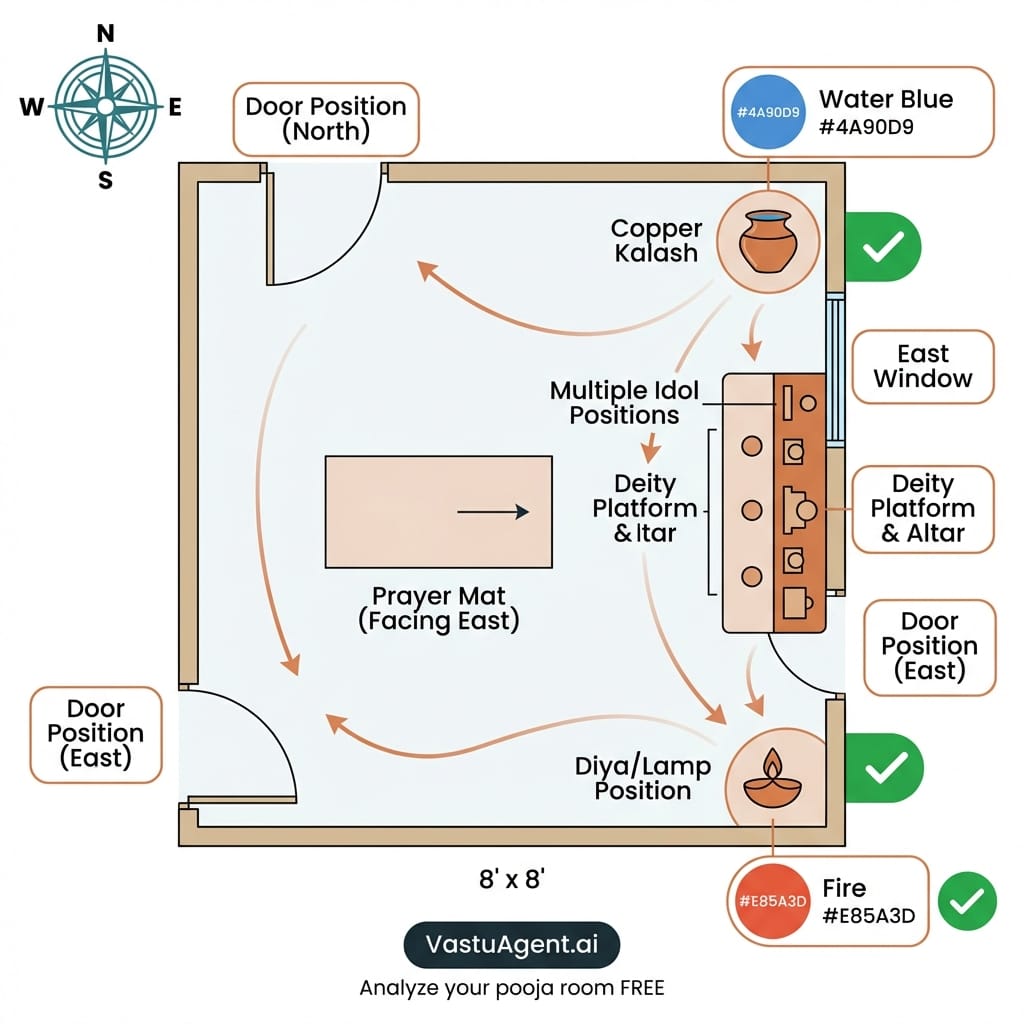
📐 Upload your floor plan for instant analysis. The AI identifies misplacements and suggests room-specific corrections in seconds. Most users find 3-5 adjustments they never considered.
→ Analyze Your Layout: vastuagent.ai/floor-plan-optimizer
Deity Placement Rules in Pooja Room
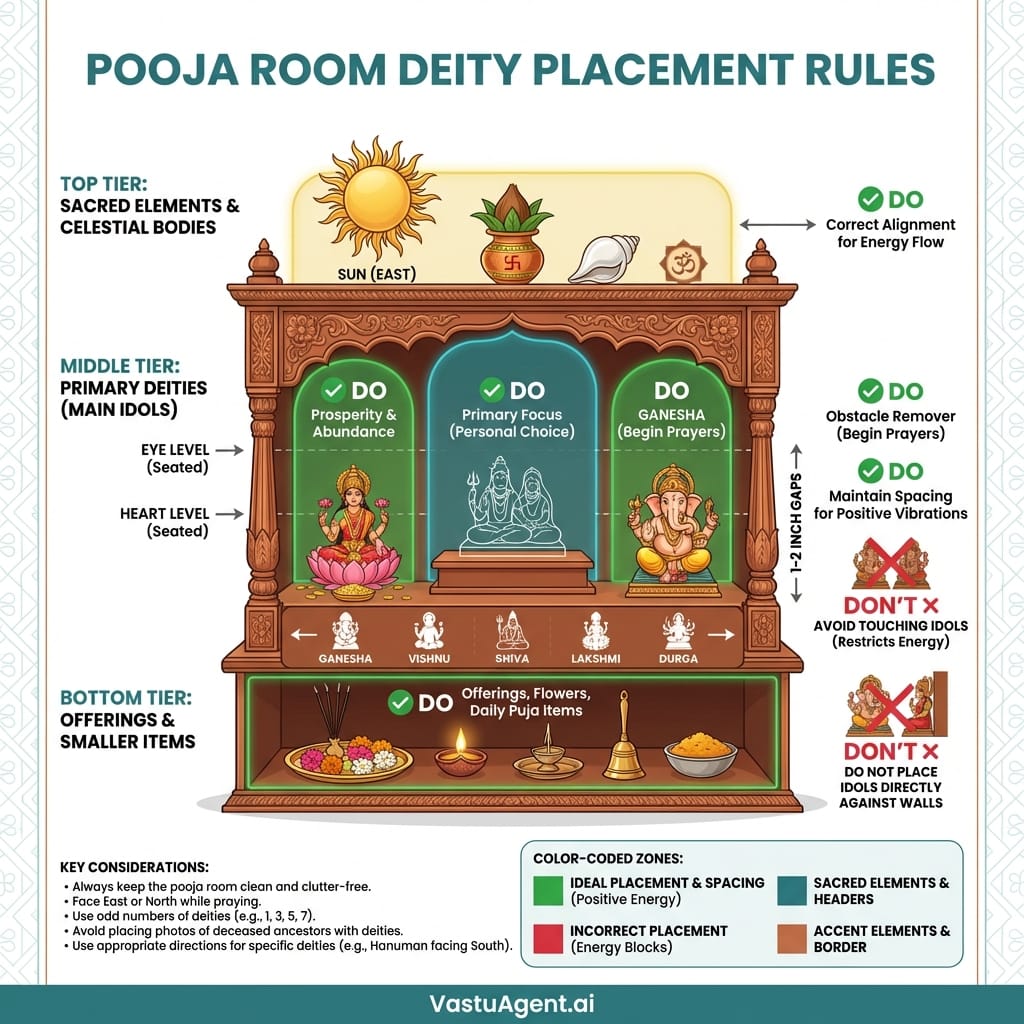
The arrangement of idols follows precise Vastu and Agama Shastra guidelines. Getting this right ensures harmonious energy flow during worship.
Which Wall for Deities?
East wall (idols facing west): You face east while praying, receiving morning light. Considered most auspicious for most households.
West wall (idols facing east): You face west while praying. Acceptable when east wall has structural issues or the room's shape makes east impractical.
Never place idols:
- Facing south (you'd face south while praying)
- Facing each other
- On north or south walls as primary position
Height and Spacing Guidelines
Deity idols should rest at the following heights when you're seated for prayer:
| Prayer Position | Ideal Idol Height | Reasoning |
|---|---|---|
| Seated on floor | 12-18 inches | Eye level alignment |
| Seated on chair | 30-36 inches | Heart to eye level |
| Standing prayer | 48-54 inches | Comfortable gaze |
Spacing rules:
- Minimum 1 inch between idols
- 2-3 inches from wall behind
- No idol should touch another
- Largest/primary deity in center
Specific Deity Placement
Different deities have specific placement preferences within the pooja room:
| Deity | Ideal Position | Facing Direction |
|---|---|---|
| Lord Ganesha | Right side, entrance | West or northwest |
| Lord Shiva | Northeast corner | West |
| Lord Vishnu/Krishna | Center or east | West |
| Goddess Lakshmi | North side | South or east |
| Goddess Durga | South side | North |
| Hanuman | Outside main pooja room | North or northeast |
Important: Hanuman and Saturn (Shani) idols traditionally stay outside the main worship space—either in a separate shrine or the home's entrance area.
Two-Deity Pairing Rules
When placing multiple deities together:
Harmonious pairings:
- Ganesha + Lakshmi
- Vishnu + Lakshmi
- Shiva + Parvati
- Radha + Krishna
Avoid together:
- Shiva lingam + Vishnu
- Two Ganesha idols
- Multiple forms of the same deity
🕉️ See how the sacred grid influences deity placement. The 81-cell Vastu Purusha Mandala shows which zones align with specific deities—helping you place each idol in its energetically optimal position.
→ Learn Deity Zones: vastuagent.ai/vastu-purusha
Pooja Room Vastu Dos and Don'ts
Quick reference guidelines keep your sacred space aligned with classical principles. Print these or save them for easy reference.
Essential Dos
Direction and position:
- ✅ Place in northeast, east, or north zone
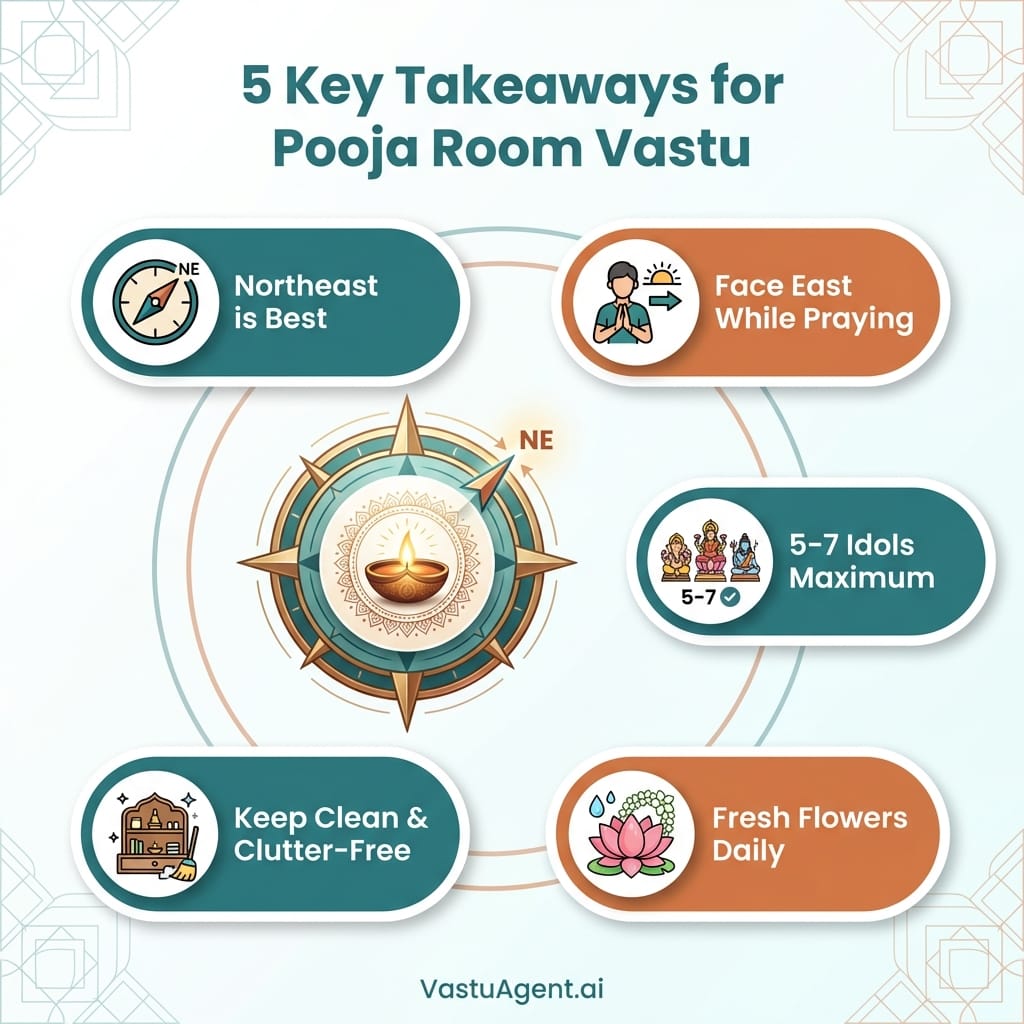
- ✅ Keep the room clean and clutter-free daily
- ✅ Ensure adequate ventilation and natural light
- ✅ Use a raised platform for the altar
- ✅ Face east or north while praying
Maintenance and practice:
- ✅ Light diya with pure ghee or sesame oil
- ✅ Use fresh flowers and remove them before wilting
- ✅ Keep the space well-lit (natural light preferred)
- ✅ Maintain a regular prayer schedule
- ✅ Store puja items in designated containers
Materials and elements:
- ✅ Use marble, wood, or copper for altar surface
- ✅ Include all five elements symbolically
- ✅ Keep a small water vessel in the northeast
- ✅ Use cotton wicks for diyas
- ✅ Include aromatic elements (incense, camphor)
Critical Don'ts
Placement errors:
- ❌ Avoid south-facing pooja rooms
- ❌ Never place under a staircase
- ❌ Don't attach to or share wall with bathroom
- ❌ Avoid bedroom pooja rooms if possible
- ❌ Don't place in kitchen cooking area
Idol and item mistakes:
- ❌ No damaged, broken, or chipped idols
- ❌ Avoid photographs of deceased persons
- ❌ Don't keep excess idols (5-7 maximum recommended)
- ❌ No leather items in the pooja room
- ❌ Avoid synthetic materials for altar covering
Maintenance oversights:
- ❌ Don't let offerings rot or wilt
- ❌ Avoid dusty or unkempt spaces
- ❌ Don't store non-sacred items here
- ❌ Avoid excessive darkness
- ❌ Don't use the space for other purposes
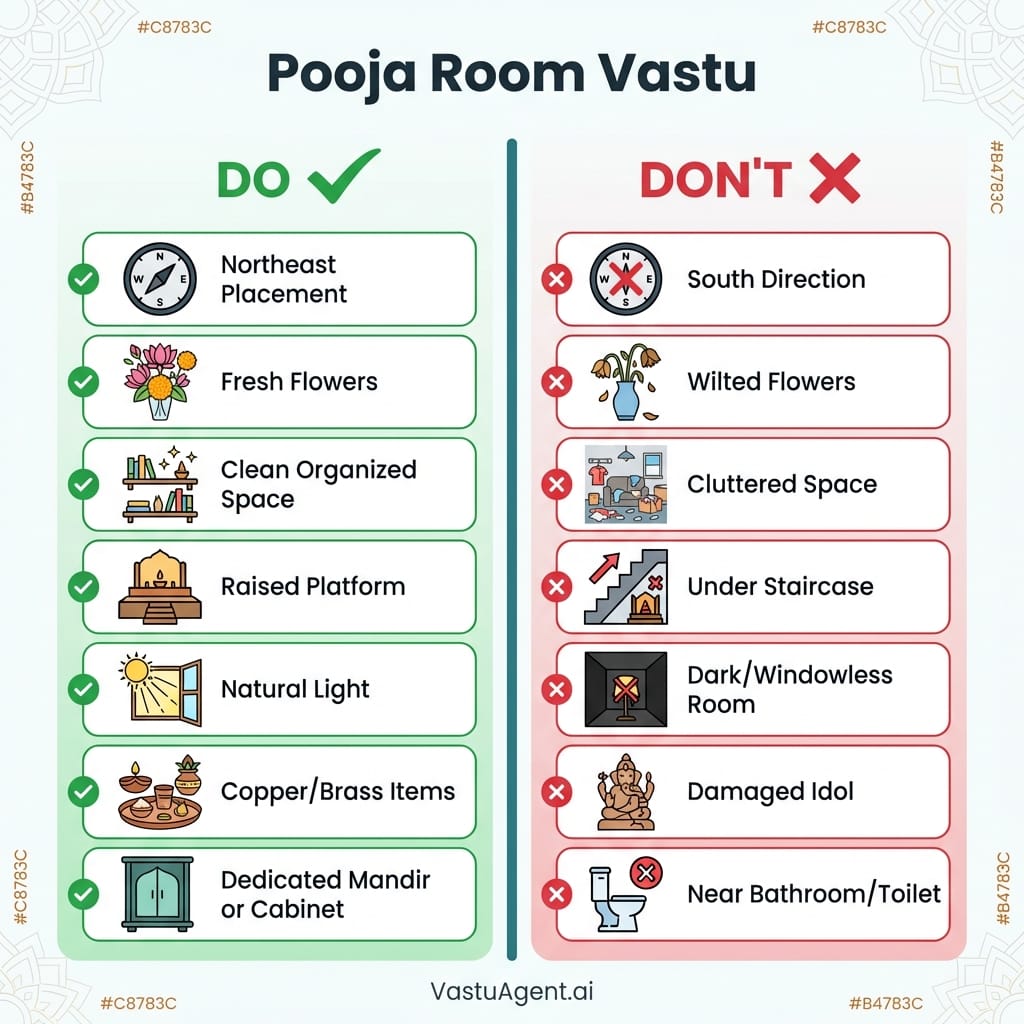
| Do | Don't |
|---|---|
| Northeast placement | South/southwest placement |
| Fresh daily flowers | Wilted or artificial flowers |
| Clean, organized space | Cluttered, dusty area |
| Raised altar platform | Floor-level deity placement |
| Natural materials | Synthetic coverings |
📊 Get a comprehensive 25+ page analysis of your entire home's Vastu—including detailed pooja room recommendations. Traditional consultants charge ₹25,000+. VastuAgent.ai provides the same depth FREE.
→ Get Your Free Report: vastuagent.ai/free-report
Vastu Remedies for Pooja Room in Wrong Direction
Not everyone can relocate their pooja room. If yours sits in a challenging direction, these classical remedies help mitigate negative influences.
For South-Facing Pooja Rooms
The south direction creates the most significant Vastu conflict for worship spaces. Apply these corrections:
Immediate remedies:
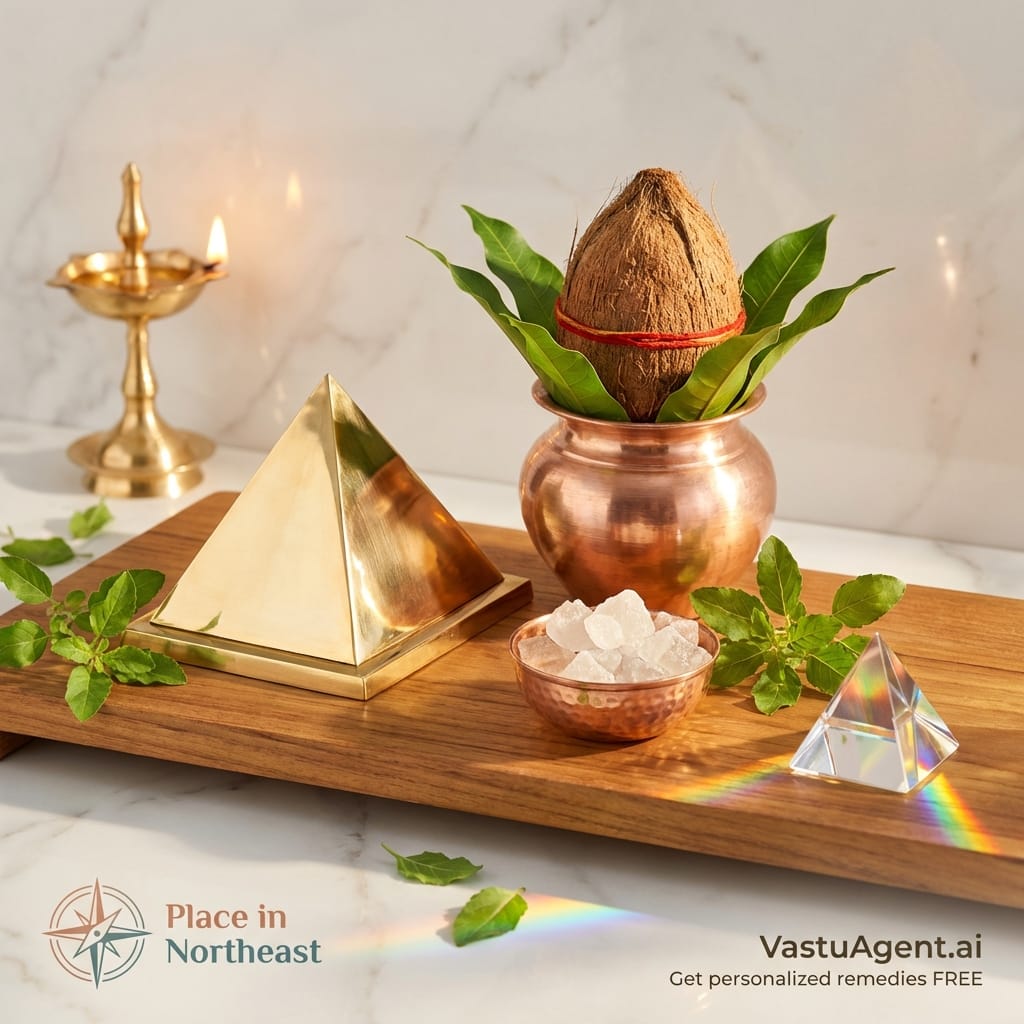
- Place a brass Vastu pyramid in the southwest corner of the room
- Install a small mirror on the north wall (reflects energy northward)
- Keep a copper kalash filled with water in the northeast corner
- Use only white or light yellow curtains/coverings
Deity adjustments:
- Place idols on the east wall instead of south
- Ensure you face east during prayer (perpendicular to room orientation)
- Add a Lord Hanuman image facing south (protects against Yama's influence)
For Southwest Pooja Rooms
The southwest carries heavy, earthbound energy that conflicts with spiritual elevation. Counter with:
- Place rock salt in copper bowls at the room's northeast corner
- Hang a crystal chandelier or prism to lighten the energy
- Use lighter colors throughout (white, cream, pale yellow)
- Keep the space minimalist—avoid heavy furniture or excess items
- Install additional lighting to brighten the area
For Pooja Room Under Staircase
This placement compresses sacred energy. Remedies include:
- Create visual height with light colors and mirrors
- Use a false ceiling panel to create symbolic space
- Place a brass pyramid on the altar
- Consider relocating to another area if feasible
For Pooja Room in Bedroom
When space constraints force this combination:
- Use a curtain or folding screen to separate worship area
- Position the altar so you don't point feet toward deities while sleeping
- Keep the pooja area near the room's northeast corner
- Maintain strict cleanliness in the worship section
Universal Remedy Elements
These items help any pooja room regardless of direction:
| Remedy Item | Placement | Effect |
|---|---|---|
| Copper kalash with water | Northeast corner | Water element balance |
| Rock salt in copper bowl | Any corner | Energy purification |
| Camphor burning | During prayer | Space clearing |
| Vastu pyramid (brass) | Near altar | Energy harmonization |
| Crystal/prism | Window area | Light energy amplification |
The key principle: you're not fighting the direction—you're introducing balancing elements that neutralize challenging influences while amplifying positive ones.
⚠️ Wondering exactly which defects your pooja room has? Upload your floor plan to VastuAgent.ai's analyzer. It identifies specific issues and recommends prioritized remedies—taking the guesswork out of corrections.
→ Identify Defects: vastuagent.ai/floor-plan-optimizer
Pooja Room Design Ideas as Per Vastu
Modern homes require creative solutions that honor Vastu principles while fitting contemporary aesthetics. Here's how to design a compliant space that also looks beautiful.
Small Space Solutions
For apartments or homes with limited space:
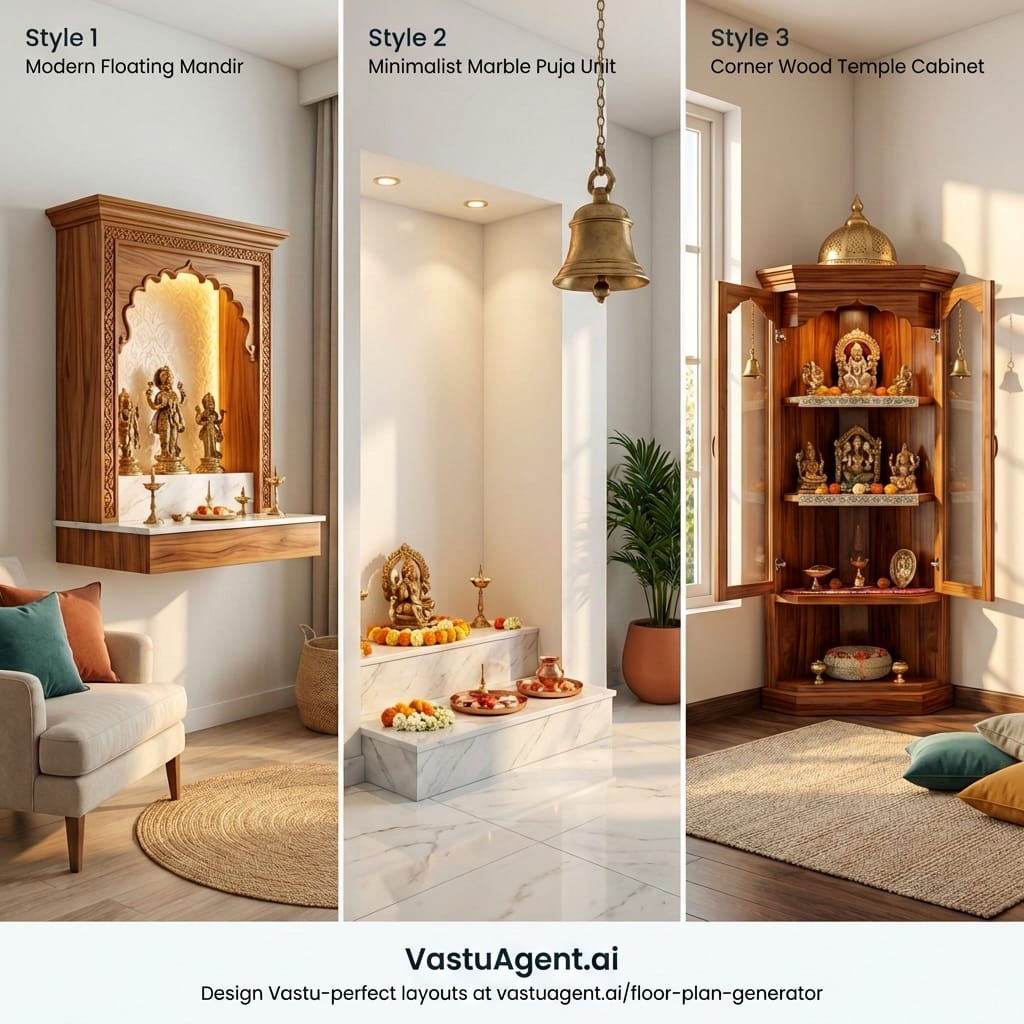
Mandir cabinet design:
- Wall-mounted cabinet in northeast corner
- Doors that close (conceals when not in use)
- Internal lighting (LED strips work well)
- Minimum 2x2 feet internal space
- Marble or wood internal surface
Corner temple approach:
- Free-standing corner unit
- Triangular shape maximizes space
- Multiple tiers for different deities
- Drawer storage for puja items below
Niche/alcove design:
- Built into wall (northeast wall ideal)
- Recessed lighting from above
- Decorative frame or jharokha style opening
- Raised floor platform within niche
Material Selection
Vastu-compliant materials for pooja room construction:
| Material | Best For | Vastu Rating |
|---|---|---|
| White marble | Altar surface, flooring | Excellent |
| Teak wood | Cabinet, frame | Excellent |
| Brass/copper | Decorative elements | Excellent |
| Sandalwood | Small items, frames | Excellent |
| Sheesham wood | Heavy furniture | Good |
| Granite | Flooring (avoid black) | Good |
Avoid: Glass shelves for deity placement, black granite, synthetic materials, particle board for altar.
Color Recommendations
Colors influence energy significantly. For pooja rooms:
Ideal colors:
- White (purity, peace)
- Cream/off-white (warmth, tradition)
- Light yellow (prosperity, wisdom)
- Light orange/saffron (devotion, energy)
- Pale green (growth, harmony)
Accent colors:
- Gold (sacred, prosperity)
- Silver (moon energy, calmness)
- Copper tones (grounding, warmth)
Avoid:
- Black (absorbs positive energy)
- Dark blue (too cooling)
- Dark red (excessive fire energy)
- Gray (dullness, lack of vitality)
Lighting Design
Proper lighting enhances both aesthetics and Vastu compliance:
- Natural light from east/northeast preferred
- Warm white LED strips for internal cabinet lighting (3000K color temperature)
- Avoid harsh overhead fluorescent lights
- Diya and candle light during prayer adds traditional element
- Backlit panels behind deities create divine ambiance
If you're planning a new home or major renovation, VastuAgent.ai's Floor Plan Generator creates Vastu-compliant layouts from scratch—including optimal pooja room placement and design specifications.
✏️ Building or renovating? Generate a complete Vastu-perfect floor plan with ideal pooja room integration. The AI considers all 16 zones, room relationships, and directional requirements automatically.
→ Design Your Layout: vastuagent.ai/floor-plan-generator
[IMAGE: Modern Pooja Room Design Examples - Three Styles]
Pooja Room Vastu for Different Home Types
Different dwelling configurations require adapted approaches. Here's how to apply pooja room Vastu principles across various home types.
Apartments and Flats
High-rise apartments often have fixed layouts with limited flexibility. Strategies include:
When northeast isn't available:
- Convert a portion of northeast living area into pooja corner
- Use modular temple units that fit available space
- Consider balcony pooja area if balcony faces east/northeast
Shared wall considerations:
- Ensure pooja room doesn't share wall with neighbor's bathroom
- Soundproof if shared wall exists (maintains sanctity)
- Avoid common walls with staircases
Floor level considerations:
- Higher floors receive better natural light—use this advantage
- Ground floor apartments should elevate altar area more significantly
Independent Houses
Houses offer more flexibility. Optimal approaches:
Dedicated room:
- Build in northeast corner of home
- Entry door from east or north
- Windows on east/northeast walls
- Ceiling height slightly lower than other rooms (creates intimacy)
Multi-story homes:
- Pooja room ideally on ground floor (grounded energy)
- If on upper floor, ensure nothing "impure" below (bathroom, storage)
- Rooftop temples work if properly weatherproofed
Rented Accommodations
Renters face unique constraints. Practical solutions:
- Portable/modular temple units that don't require installation
- Wall-mounted cabinets using removable fixtures
- Focus on optimizing internal arrangement if direction can't change
- Apply remedies for directional challenges rather than structural changes
| Home Type | Primary Strategy | Secondary Focus |
|---|---|---|
| Apartment | Modular cabinet in best available zone | Internal arrangement optimization |
| House | Dedicated northeast room | Complete structural compliance |
| Rental | Portable setup in northeast corner | Remedy application for limitations |
Frequently Asked Questions
Q: Which direction should God face in a pooja room?
Deity idols should face west or east. When idols face west, you face east during prayer—receiving morning sunlight. When idols face east, you face west. Avoid north-facing or south-facing deity arrangements. The most auspicious setup places idols on the east wall facing west.
Q: Can we keep pooja room in bedroom as per Vastu?
While not ideal, a bedroom pooja area is acceptable when space constraints exist. Position the altar in the bedroom's northeast corner. Use a curtain or screen to separate the worship space. Ensure your feet don't point toward deities while sleeping. Keep the area exceptionally clean and organized.
Q: What is the best color for pooja room walls?
White ranks highest for pooja room walls—symbolizing purity and reflecting light effectively. Cream, light yellow, and soft saffron also work excellently. Avoid dark colors like black, dark blue, or deep red. Light colors maintain positive energy and create appropriate reverence for the space.
Q: Is southeast direction good for pooja room?
No, the southeast direction should be avoided for pooja rooms. Southeast belongs to Agni (fire) and suits kitchens, not worship spaces. The fire element creates restless energy that interferes with meditation and prayer. If your pooja room is in the southeast, apply remedies like copper kalash and Vastu pyramids while keeping the space well-lit.
Q: How many idols should be kept in a pooja room?
Classical texts recommend limiting idols to 5-7 for household pooja rooms. Odd numbers are considered auspicious. Each idol should have adequate space—never touching another. Too many idols create energetic congestion. Focus on your primary deities rather than collecting numerous images.
Q: Can pooja room be in kitchen as per Vastu?
The cooking area of the kitchen should not contain the pooja space. However, a separate pooja niche in the northeast corner of a kitchen room (away from cooking flames and smoke) can work in small homes. The fire element dominance in kitchens conflicts with the meditative energy needed for worship.
Q: What should be placed below pooja room?
Nothing should be placed directly below a pooja room in multi-story homes. Avoid having storage, bathrooms, or bedrooms beneath the worship space. If unavoidable, place Vastu pyramids in the lower space and ensure the pooja room floor is appropriately elevated.
Q: Is glass shelf good for pooja room?
Avoid glass shelves for placing deity idols. Glass is fragile, carries unstable energy, and lacks the grounding qualities needed for worship items. Use marble, wood, or metal surfaces instead. Glass can be used for cabinet doors or decorative elements, but not as the primary deity platform.
Q: Can we keep Shiva and Vishnu together in pooja room?
While some traditions advise against placing Shiva lingam and Vishnu idols together, most modern households can include both deities with proper arrangement. Place them with adequate spacing (2-3 inches minimum). Consider separate elevated platforms for each. Traditional Smartha households worship both without conflict.
Q: What to do if pooja room is in south direction?
Apply these remedies: place idols on the east wall within the room, use a mirror on the north wall, keep copper kalash with water in the northeast corner, add brass Vastu pyramid near the altar, use light colors throughout, and consider Lord Hanuman facing south to protect against Yama's influence. Upload your floor plan to VastuAgent.ai for personalized remedy recommendations.
Q: Should pooja room door be kept open or closed?
Keep the pooja room door open during prayer and worship activities. Close it when not in use if the room faces common areas with heavy foot traffic. Open doors allow positive energy circulation; closed doors maintain sanctity when the space isn't actively used. If using a cabinet-style mandir, opening doors during prayer is essential.
Q: Is north-facing pooja room good?
Yes, a north-facing pooja room is acceptable and considered good in Vastu. North is governed by Kubera, the deity of wealth, making this direction especially suitable for those seeking material prosperity alongside spiritual growth. While northeast ranks highest, north offers solid Vastu compliance for worship spaces.
Transform Your Sacred Space with VastuAgent.ai
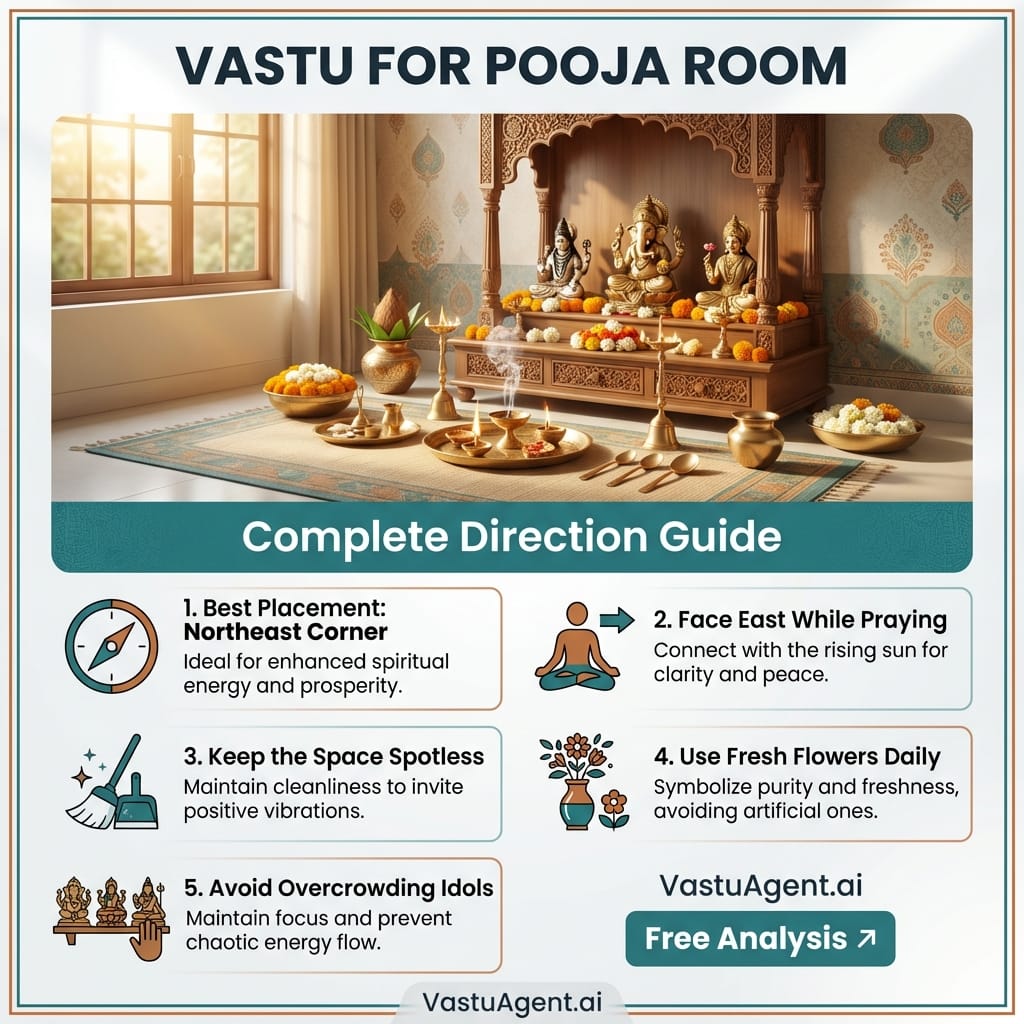
The pooja room represents your home's spiritual heart. When aligned with Vastu principles—northeast placement, proper deity arrangement, correct internal setup—it amplifies every prayer and meditation practice.
You now understand the directional hierarchy, layout rules, and remedy options. The ancient texts encoded these principles through centuries of observation and spiritual practice. Modern technology simply makes applying them faster and more precise.
Whether you're setting up a new pooja room, correcting an existing one, or designing your dream home from scratch, VastuAgent.ai's free tools provide instant, accurate analysis. What once required expensive consultants and complex calculations now takes seconds.
Your sacred space deserves the same attention your ancestors gave their temples. The difference: you have AI-powered precision at your fingertips.
Transform Your Home with VastuAgent.ai
Ready to apply what you've learned? VastuAgent.ai offers free tools that make Vastu analysis instant and accessible:
| Tool | What It Does | Best For |
|---|---|---|
| Vastu Chakra | Interactive compass with 16-zone mapping | Finding directions, understanding zones |
| Vastu Purusha | 81-cell Mandala explorer with deity positions | Deep Vastu study, pada analysis |
| Floor Plan Optimizer | AI-powered defect detection | Existing home analysis |
| Floor Plan Generator | Create Vastu-compliant designs | New construction planning |
| Free Report | 25+ page comprehensive analysis | Complete home assessment |
→ Start Your Free Analysis: vastuagent.ai/free-resources
Join 10,000+ homeowners who've already transformed their spaces with VastuAgent.ai