Vastu Shastra: The Complete Beginner's Guide to Ancient Indian Architecture Science
Everything You Need to Know About the 5,000-Year-Old Science of Harmonious Living

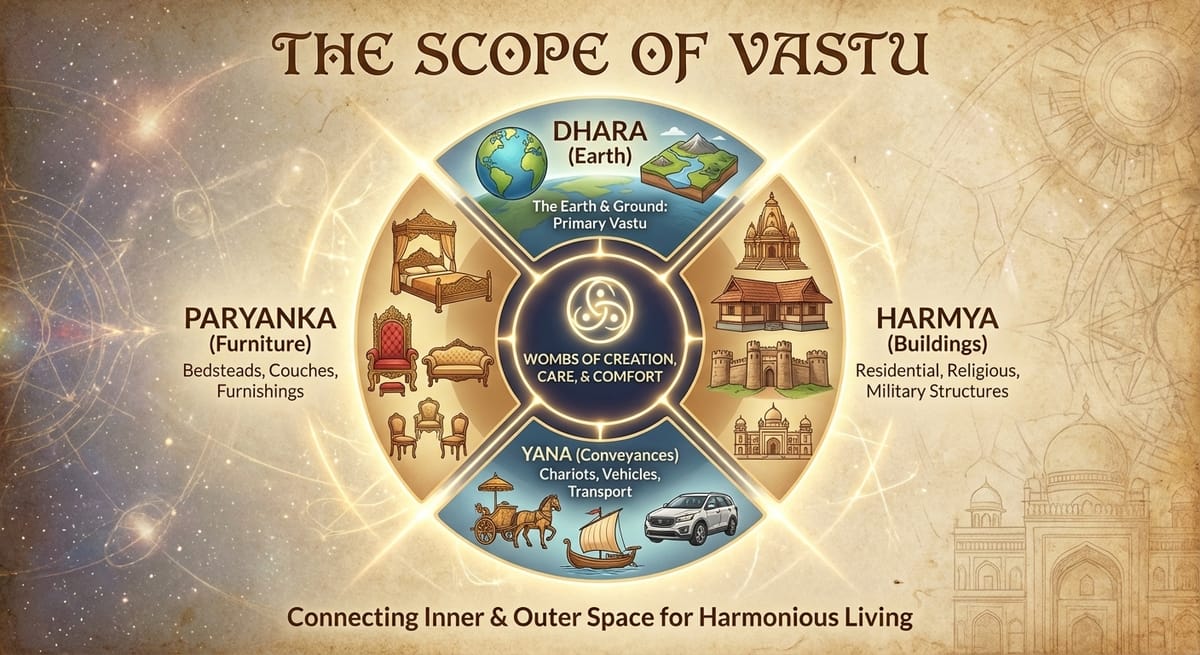
Table of Contents
- What is Vastu Shastra? Definition & Meaning
- History & Origins of Vastu Shastra
- Vastu Shastra vs. Feng Shui: Key Differences
- The Science Behind Vastu: Is It Scientific?
- The 5 Elements (Pancha Bhoota) of Vastu
- The 8 Directions in Vastu & Their Significance
- Vastu Purusha Mandala Explained
- 16 Vastu Zones & Their Meanings
- Vastu for Different Rooms (Overview)
- Common Vastu Dosh (Defects) & Symptoms
- Simple Vastu Remedies Without Demolition
- How to Check Vastu of Your Home
- Vastu Tips for Beginners: Quick Start Guide
- FAQs About Vastu Shastra
Video overview on Vastu Shashtra
Vastu Shastra brief video overview by Vastuagent.ai
1. What is Vastu Shastra? Definition & Meaning
Have you ever walked into a home and immediately felt peaceful, while another house made you uncomfortable without knowing why? This isn't coincidence—it's the energy flow that Vastu Shastra has been optimizing for over 5,000 years.
Vastu Shastra is widely recognized as the ancient Indian science of architecture and building. The term itself is derived from the Sanskrit root Vas, which means "to reside" or "to dwell." Therefore, the word Vastu essentially means a dwelling place, a site, or a habitation where humans and gods reside. The term Shastra loosely translates to "doctrine," "teaching," or "science." Combined, Vastu Shastra is the sacred science related to planning and building houses to achieve a balance between the home and the universe.
While modern architecture focuses primarily on functional and aesthetic design, Vastu extends into the realm of metaphysics and cosmic harmony. It is defined as a system that connects the "inner space" (the human body and mind) with the "outer space" (the building and the cosmos). The ultimate goal of this discipline is to ensure harmony with the universal rhythm of creation, thereby paving the way for health, wealth, happiness, and prosperity for the inhabitants.
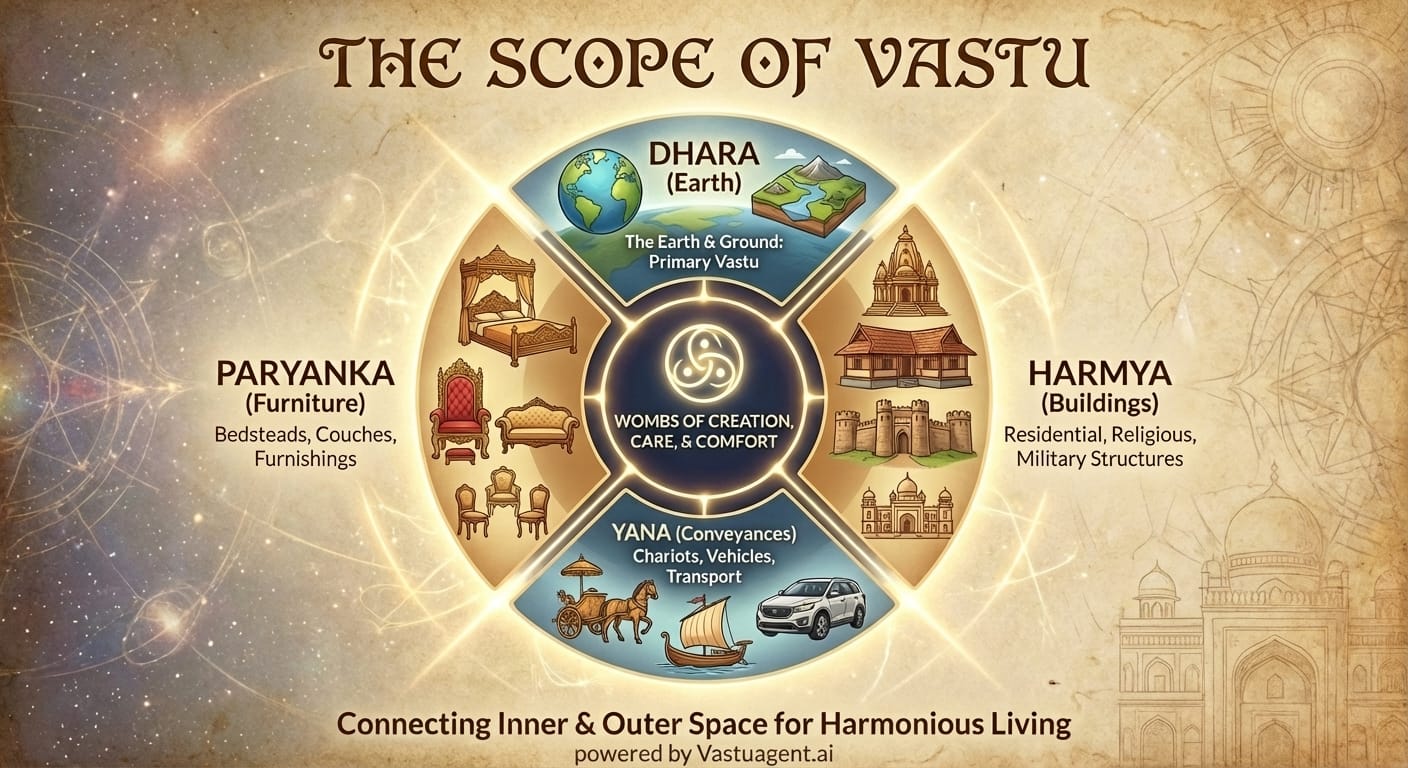
The Scope of Vastu
In the classical texts, the definition of Vastu is extremely broad. It does not just refer to a house. According to the ancient text Manasara, the term Vastu implies four distinct categories:
Dhara: The Earth or the ground (the primary Vastu)
Harmya: Buildings (residential, religious, military)
Yana: Conveyances (chariots, vehicles)
Paryanka: Furniture (bedsteads, couches)
Thus, Vastu meaning encompasses everything from town planning and digging wells to the design of chairs and the layout of gardens. It acts as a bridge, transforming voids into spaces that are "wombs of creation, care, and comfort." By following these principles, the thinking and actions of the people dwelling in these places become harmonious and evolutionary.
🔮 Curious how Vastu principles apply to YOUR home? Try our FREE Vastu Mandal Chakra tool at VastuAgent.ai to instantly visualize your home's energy zones and discover which areas need attention!
2. History & Origins of Vastu Shastra
The origins of Vastu Shastra are deeply rooted in the Vedic tradition of India, dating back thousands of years. It is believed to have originated from the Stapatya Veda, which is a part (Upaveda) of the Atharva Veda. Some sources suggest this science developed between 6000 BC and 3000 BC.
The Mythological Origin: The Vastu Purusha
The creation of Vastu Shastra is often explained through the legend of the Vastu Purusha. According to the Brihat Samhita and other Puranas, there was once a great war between the gods (Devas) and demons (Asuras). During this conflict, a drop of sweat from Lord Shiva fell to the earth, creating a massive, terrifying demon.
This giant being grew rapidly and began to cover the sky and earth, threatening the universe. The gods, led by Indra, captured the demon and pinned him face-down onto the ground. Different gods sat on different parts of his body to hold him down—Lord Brahma occupied the center (the stomach/navel), while the 45 Gods (including Agni, Yama, and Vayu) occupied the limbs and periphery.
Being subdued, the demon asked Brahma for a means of sustenance. Brahma blessed him, naming him Vastu Purusha, and ordained that any structure built on earth must worship him and follow the laws of his body layout (the Mandala). If people followed these rules, the Vastu Purusha would bless them with prosperity; if they ignored them, he was free to cause them trouble.
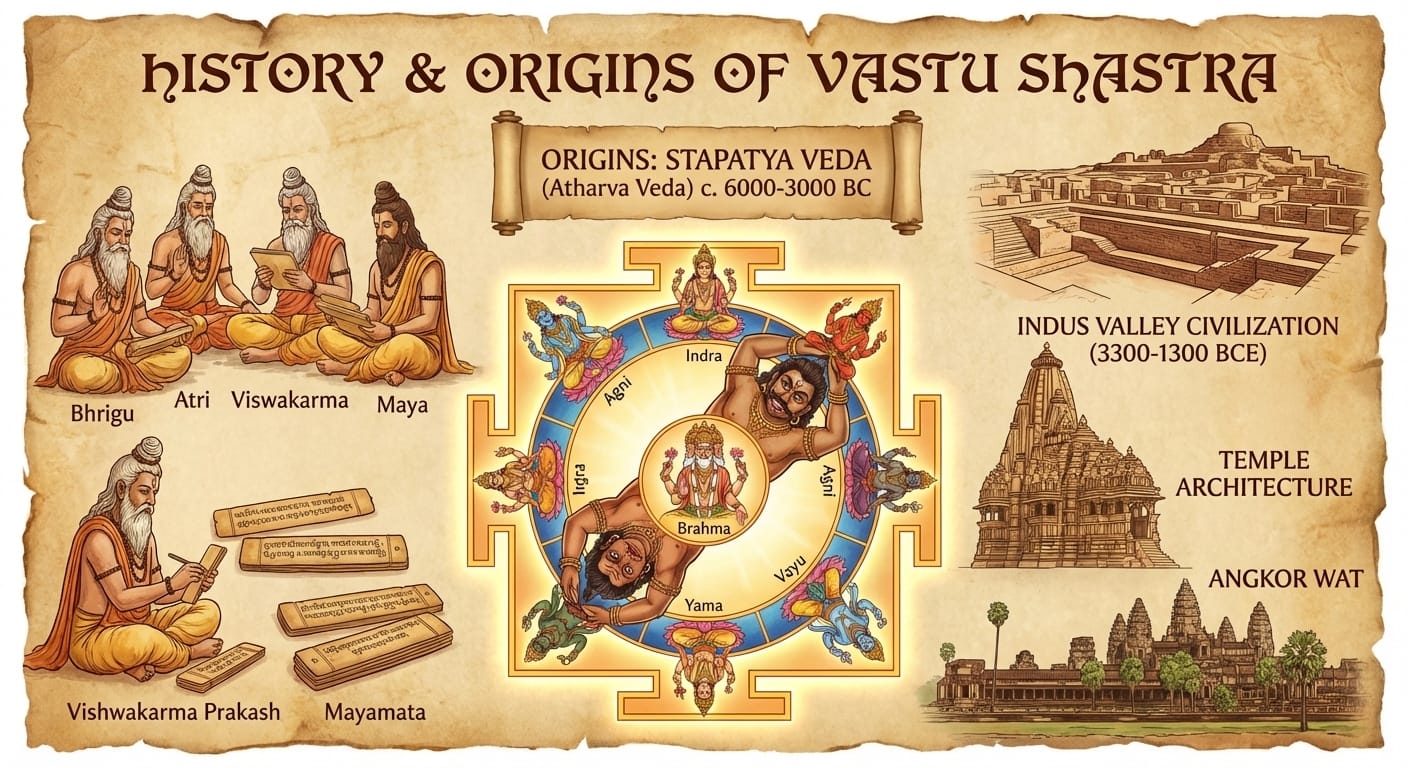
The Great Sages and Texts
The knowledge of Vastu Shastra was not the work of a single person but was cultivated by a lineage of great sages (Rishis). The Matsya Purana lists 18 preceptors of Vastu, including Bhrigu, Atri, Vasistha, Viswakarma, Maya, Narada, and Garg.
Historically, this knowledge was preserved in texts like Vishwakarma Prakash (North Indian tradition), Mayamata and Manasara (South Indian traditions), and Samarangana Sutradhara (written by King Bhoja). Evidence of Vastu application is found in the ancient cities of Mohenjo-Daro and Harappa, as well as in the layout of cities described in the Ramayana and Mahabharata.
The Indus Valley Civilization (3300-1300 BCE) cities like Mohenjo-daro show remarkably planned layouts with proper drainage, orientation, and room placement—suggesting Vastu principles were practiced even before written records existed. All major Indian temples, including Khajuraho, Konark, and Brihadeeswara, were built following strict Vastu principles, and this influence spread to Southeast Asian architecture, including Angkor Wat and Borobudur.
🕉️ Want to see the Vastu Purusha mapped onto YOUR floor plan? Use our FREE Vastu Purusha visualization tool at VastuAgent.ai to understand exactly how this cosmic being's energy flows through your home!
3. Vastu Shastra vs. Feng Shui: Key Differences

While both Vastu Shastra and Feng Shui are ancient geomantic arts aimed at harmonizing human existence with the environment, they stem from different cultural and philosophical roots.
Origin and Philosophy
Vastu Shastra originated in India and is based on the permanent laws of nature, such as magnetic fields (North-South flux) and solar energy (East-West flux). It is deeply tied to the Vedas and the worship of directional deities. Feng Shui, on the other hand, originated in China and literally means "Wind and Water." It focuses heavily on the flow of Chi (energy) and is often more flexible, dealing with the changing fortunes of time cycles.
Directions vs. Form
Vastu gives immense importance to the cardinal directions (North, South, East, West). Directions are considered permanent and absolute—the North is always the source of magnetic energy, and the East is the source of solar energy. Feng Shui, while it uses directions, places significant emphasis on form, shape, and time. Some schools advocate "Directionless Feng Shui," focusing entirely on the shape of the land, flow of wind, and placement of objects.
Comparison Table
| Aspect | Vastu Shastra | Feng Shui |
|---|---|---|
| Origin | India (5,000+ years old) | China (3,000+ years old) |
| Meaning | "Science of Architecture" | "Wind and Water" |
| Foundation | Vedic scriptures | Taoist philosophy |
| Primary Focus | Fixed structure & direction | Movable objects & energy flow |
| Elements | 5 (Earth, Water, Fire, Air, Space) | 5 (Wood, Fire, Earth, Metal, Water) |
| Key Tool | Vastu Purusha Mandala | Bagua Map, Lo Pan compass |
| Changes Required | Often structural | Usually decorative |
While both aim to harmonize living spaces with natural energy, Vastu is more "fixed" (emphasizing permanent structure) while Feng Shui is more "fluid" (focusing on arrangement and objects). Many modern practitioners combine both for optimal results—Vastu as the "hardware" (building structure) and Feng Shui as the "software" (interiors and objects).
4. The Science Behind Vastu: Is It Scientific?
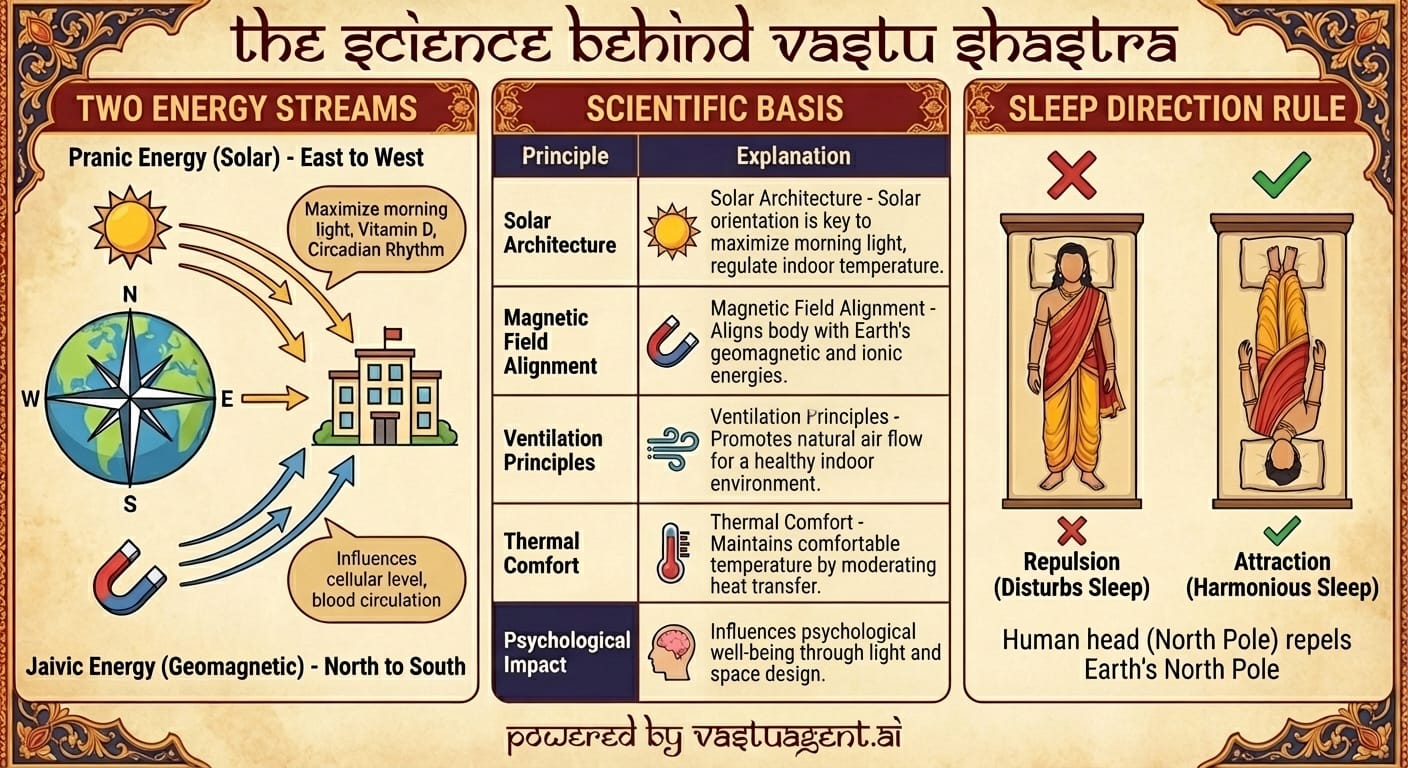
A common question is: Is Vastu scientific? The answer is nuanced. While not all Vastu claims have rigorous scientific validation, many core principles align with modern architecture, environmental psychology, and sustainable design.
The Two Energy Streams
Vastu Shastra postulates that two primary forces interact on any plot of land:
Pranic Energy (Solar Energy): This flows from the East. The sun is the major cosmic entity radiating light and heat. Vastu principles ensure a building captures this life-giving energy by keeping the East and North sectors open and light.
Jaivic Energy (Geomagnetic Flux): This flows from the North to the South. The Earth acts as a giant magnet. This unidirectional organic flow influences the cellular level of living organisms.
Scientific Basis
| Scientific Principle | Explanation |
|---|---|
| Solar Architecture | East-facing entrances maximize morning sunlight (Vitamin D, circadian rhythm regulation) |
| Magnetic Field Alignment | Earth's magnetic field runs north-south; sleeping aligned may affect blood circulation |
| Ventilation Principles | Cross-ventilation from NE to SW follows natural wind patterns in the Indian subcontinent |
| Thermal Comfort | Heavy walls in SW, openings in NE optimize temperature regulation |
| Psychological Impact | Clutter-free spaces, natural light, and organized layouts reduce stress (proven by environmental psychology) |
The Vastu rule of sleeping with the head towards the South is based on magnetic polarity. The human head acts as the North pole. Sleeping with the head to the North causes magnetic repulsion with the Earth's North pole, disturbing blood circulation and sleep. Sleeping head-South creates magnetic attraction and harmony.
Research from institutions like IIT Kharagpur has validated thermal comfort principles in traditional Vastu design. The key is applying Vastu practically while avoiding superstition—many core principles align with modern science even if the metaphysical explanations remain unproven.
📊 Stop guessing about your home's Vastu compliance! Get a Detailed Vastu Report from VastuAgent.ai—our AI analyzes your floor plan against 100+ scientific Vastu parameters and provides personalized recommendations. Try it now for free!
5. The 5 Elements (Pancha Bhoota) of Vastu
At the core of Vastu Shastra basics is the concept of the Pancha Maha Bhutas or the five great elements. The entire universe, including the human body and any building, is composed of these five elements. Balancing them is the key to a Vastu-compliant home.
1. Earth (Prithvi) — Southwest
Attributes: Stability, heaviness, solidity, smell
Vastu Application: The South-West corner should be the heaviest and highest part of the house to provide stability. It is the ideal place for the Master Bedroom. Use earthy colors like brown, yellow, and ochre in this zone.
2. Water (Jal) — Northeast
Attributes: Flow, liquidity, taste, clarity
Vastu Application: Water sources like underground tanks, borings, or wells must be in the North-East to absorb positive cosmic energy. This area must be kept light and low. Aquariums and water fountains are excellent additions here.
3. Fire (Agni) — Southeast
Attributes: Heat, light, vision, transformation
Vastu Application: The kitchen, boilers, meters, and furnaces should be placed here. Fire represents energy and money flow. The cook should face East while preparing meals.
4. Air (Vayu) — Northwest
Attributes: Movement, touch, sound
Vastu Application: This zone governs movement and change. It is suitable for guest rooms, stores for finished goods, or unmarried daughters (to ensure their marriage/movement out of the house). Good cross-ventilation is essential here.
5. Space (Akash) — Center (Brahmasthan)
Attributes: Sound, expansion, openness
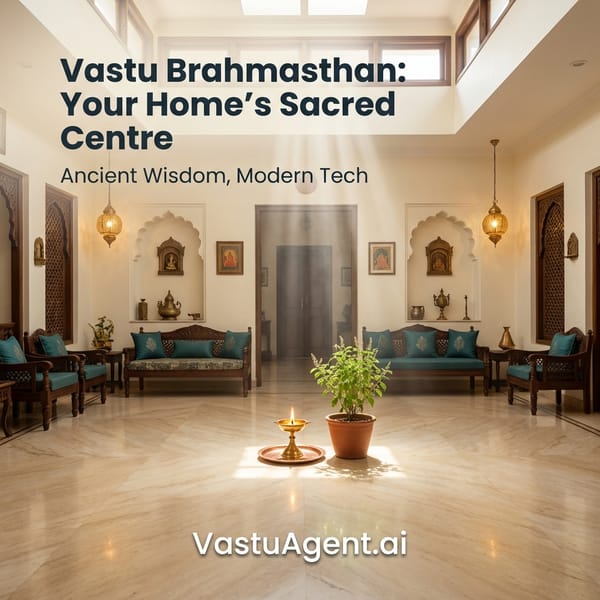
Vastu Application: The center of the house should be open to the sky or kept empty to allow energy to circulate freely. Heavy pillars, walls, or toilets in this area are strictly prohibited. This is considered the "heart" of the building.
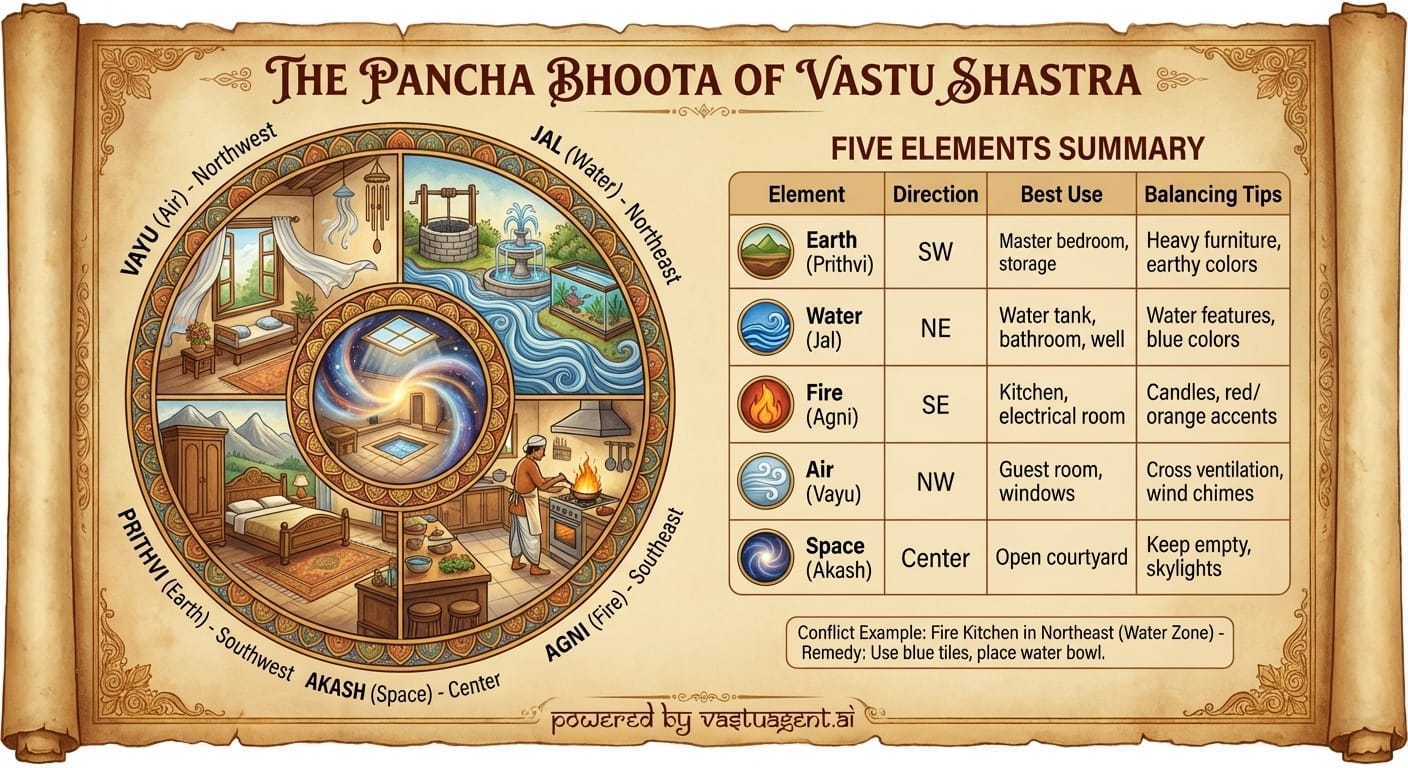
Five Elements Summary Table
| Element | Direction | Best Use | Balancing Tips |
|---|---|---|---|
| Earth | Southwest | Master bedroom, storage | Heavy furniture, earthy colors (brown, yellow) |
| Water | Northeast | Water tank, bathroom, well | Water features, aquarium, blue colors |
| Fire | Southeast | Kitchen, electrical room | Candles, red/orange accents |
| Air | Northwest | Guest room, windows | Cross ventilation, wind chimes |
| Space | Center | Open courtyard | Keep empty, skylights, minimal clutter |
If your kitchen (Fire) is in the Northeast (Water zone), these opposing elements create conflict. Remedies include using blue tiles, placing a bowl of water, or adding water element symbols to balance the energy.
🌊 Is your home's elemental balance off? Our FREE Vastu Mandal Chakra tool at VastuAgent.ai shows you exactly how the 5 elements are distributed in your space—and what's causing imbalance. Check it now!
6. The 8 Directions in Vastu & Their Significance
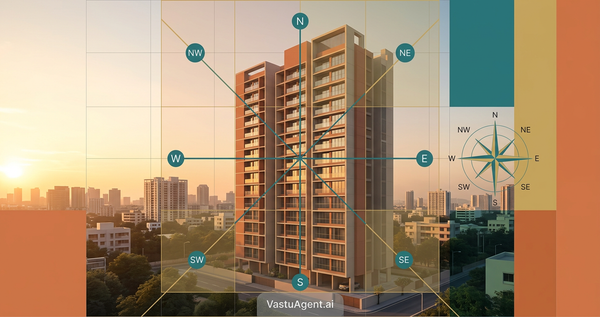
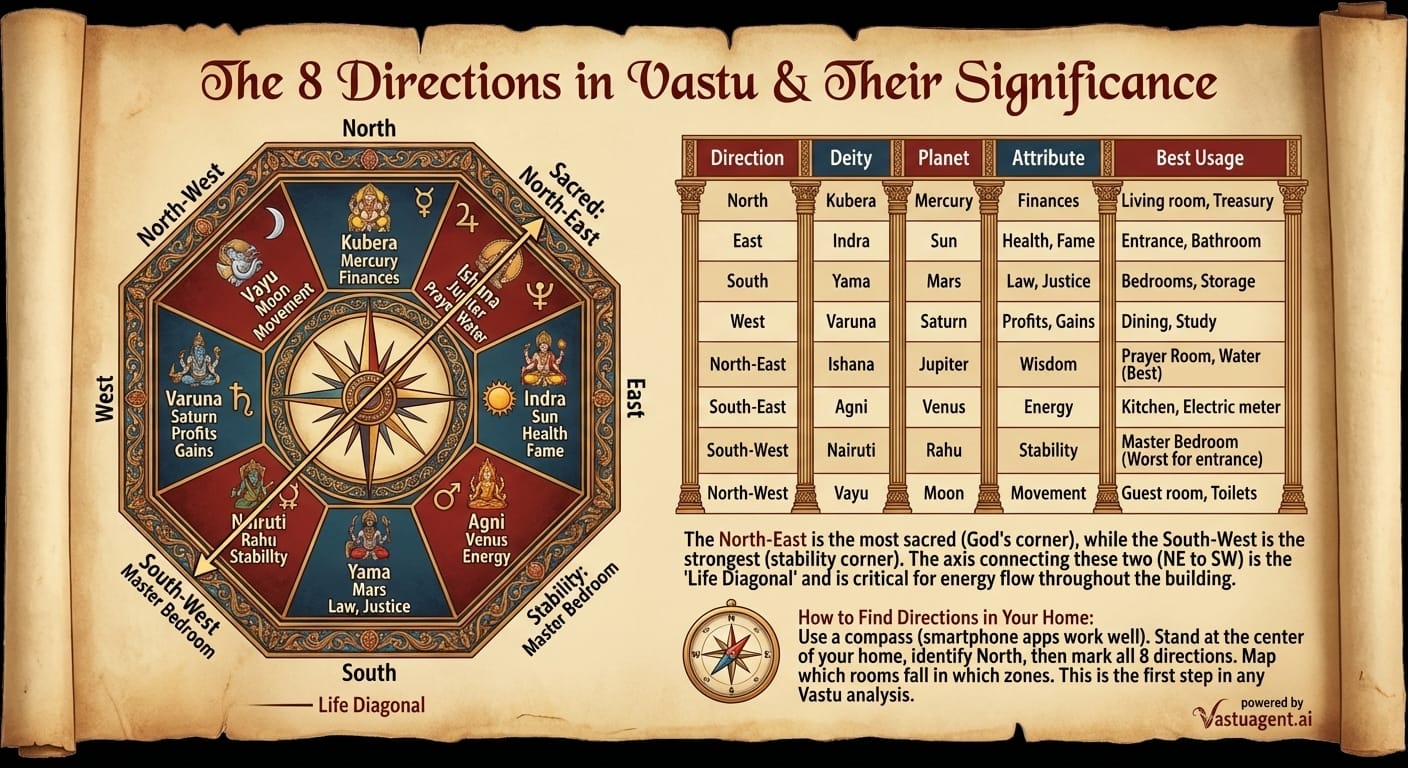
Vastu Shastra analyzes 8 primary directions (4 cardinal and 4 inter-cardinal). Each direction is governed by a specific deity and planet, influencing specific aspects of life. Understanding these directions is fundamental to proper Vastu application.
| Direction | Deity | Planet | Attribute | Best Usage |
|---|---|---|---|---|
| North | Kubera (Wealth) | Mercury | Finances | Living room, Treasury |
| East | Indra (King) | Sun | Health, Fame | Entrance, Bathroom |
| South | Yama (Death) | Mars | Law, Justice | Bedrooms, Storage |
| West | Varuna (Rain) | Saturn | Profits, Gains | Dining, Study |
| North-East | Ishana (Shiva) | Jupiter | Wisdom | Prayer Room, Water (Best) |
| South-East | Agni (Fire) | Venus | Energy | Kitchen, Electric meter |
| South-West | Nairuti | Rahu | Stability | Master Bedroom (Worst for entrance) |
| North-West | Vayu (Wind) | Moon | Movement | Guest room, Toilets |
The North-East is the most sacred (God's corner), while the South-West is the strongest (stability corner). The axis connecting these two (NE to SW) is the "Life Diagonal" and is critical for energy flow throughout the building.
How to Find Directions in Your Home
Use a compass (smartphone apps work well). Stand at the center of your home, identify North, then mark all 8 directions. Map which rooms fall in which zones. This is the first step in any Vastu analysis.
7. Vastu Purusha Mandala Explained
The Vastu Purusha Mandala is the metaphysical diagram or grid of a building. It represents the Vastu Purusha (the cosmic man) pressed face-down onto the site—the foundational concept upon which all Vastu planning is based.
Orientation of the Vastu Purusha
The Vastu Purusha lies with his head in the North-East and his feet in the South-West. His hands and knees extend to the North-West and South-East respectively. This orientation explains many Vastu rules:
Head (North-East): Must be kept light and open to avoid "headaches" or mental tension for the building's spirit and residents
Heart/Center (Brahmasthan): The central 9 squares belong to Brahma and must remain open and unobstructed
Feet (South-West): Can bear weight, hence heavy structures like master bedrooms are built here
Grid Systems
The Mandala divides the plot into smaller squares called "padas." Different grid sizes are used for different purposes:
| Grid Type | Squares | Usage |
|---|---|---|
| Sakala (1×1) | 1 | Basic concept |
| Pitha (3×3) | 9 | Altars, small structures |
| Upapitha (4×4) | 16 | Small homes |
| Manduka (8×8) | 64 | Residential buildings |
| Paramasayika (9×9) | 81 | Temples, large buildings (most common) |
The Mandala is inhabited by 45 deities—32 on the periphery and 13 inside. Understanding which deity governs which section helps practitioners make precise placement decisions for different activities and rooms.
🏠 See the Vastu Purusha come alive on YOUR floor plan! Our FREE Vastu Purusha tool at VastuAgent.ai overlays this sacred diagram onto your home layout, showing you exactly where the cosmic energy centers lie. Try it free today!
8. 16 Vastu Zones & Their Meanings
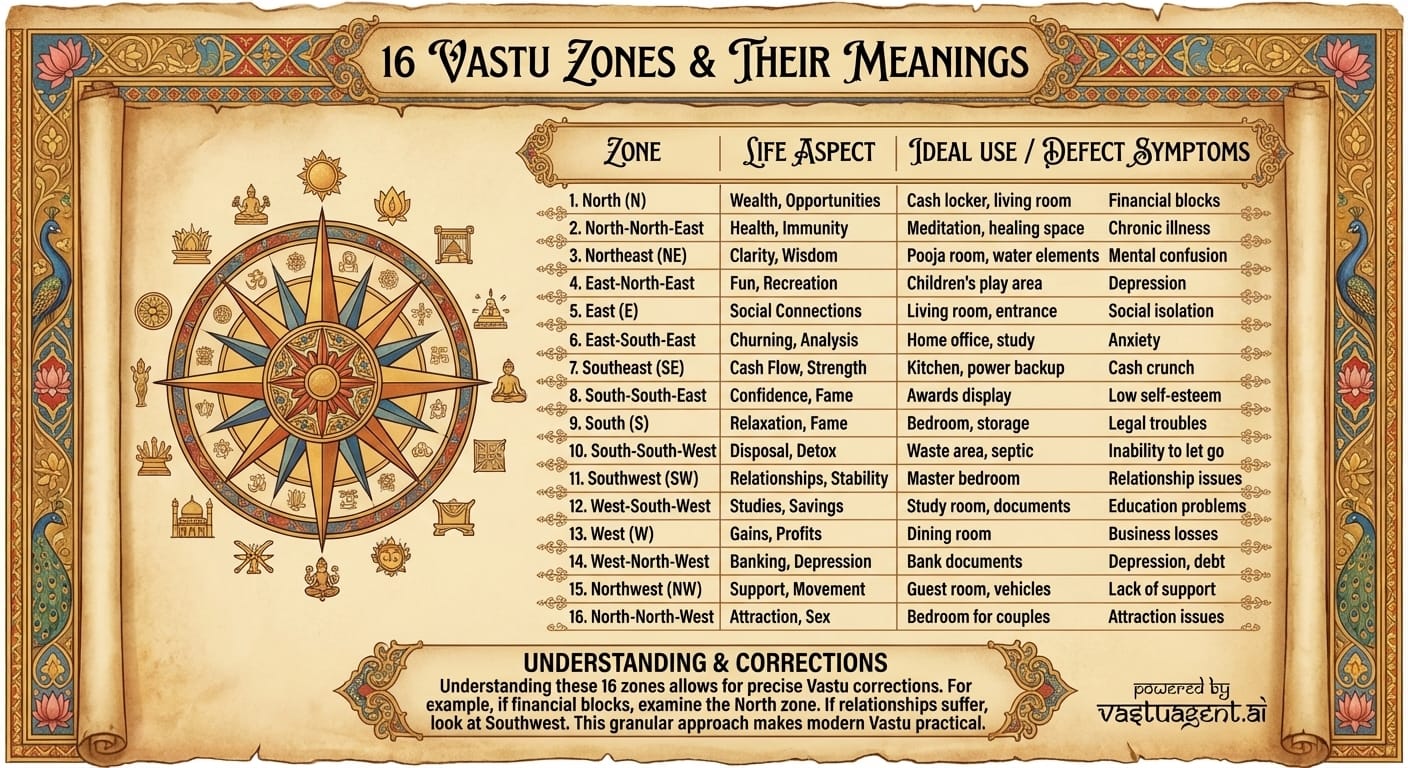
Advanced Vastu (specifically the MahaVastu system) subdivides the 8 directions further into 16 zones, offering precise control over specific life aspects. Each zone governs particular areas of life and has ideal uses.
| Zone | Life Aspect | Ideal Use / Defect Symptoms |
|---|---|---|
| 1. North (N) | Wealth, Opportunities | Cash locker, living room / Financial blocks if defective |
| 2. North-North-East | Health, Immunity | Meditation, healing space / Chronic illness |
| 3. Northeast (NE) | Clarity, Wisdom | Pooja room, water elements / Mental confusion |
| 4. East-North-East | Fun, Recreation | Children's play area / Depression |
| 5. East (E) | Social Connections | Living room, entrance / Social isolation |
| 6. East-South-East | Churning, Analysis | Home office, study / Anxiety |
| 7. Southeast (SE) | Cash Flow, Strength | Kitchen, power backup / Cash crunch |
| 8. South-South-East | Confidence, Fame | Awards display / Low self-esteem |
| 9. South (S) | Relaxation, Fame | Bedroom, storage / Legal troubles |
| 10. South-South-West | Disposal, Detox | Waste area, septic / Inability to let go |
| 11. Southwest (SW) | Relationships, Stability | Master bedroom / Relationship issues |
| 12. West-South-West | Studies, Savings | Study room, documents / Education problems |
| 13. West (W) | Gains, Profits | Dining room / Business losses |
| 14. West-North-West | Banking, Depression | Bank documents / Depression, debt |
| 15. Northwest (NW) | Support, Movement | Guest room, vehicles / Lack of support |
| 16. North-North-West | Attraction, Sex | Bedroom for couples / Attraction issues |
Understanding these 16 zones allows for precise Vastu corrections. For example, if you're experiencing financial blocks, examine the North zone. If relationships are suffering, look at the Southwest. This granular approach makes modern Vastu more practical and actionable.
🎯 Want to know which of the 16 zones are causing problems in YOUR life? Get a Detailed Vastu Report from VastuAgent.ai—we analyze all 16 zones and tell you exactly what's affecting your wealth, health, and relationships. Free for a complete analysis!
9. Vastu for Different Rooms
To ensure a home is Vastu-compliant, specific rooms must align with the elements of their respective directions. Here is a comprehensive room-by-room guide:
| Room | Ideal Direction | Key Tips | Common Mistakes |
|---|---|---|---|
| Main Entrance | N, E, NE | Well-lit, clean, opens inward clockwise | S/SW entrance, cluttered, dark |
| Living Room | N, E, NE | Furniture in S/W, TV in SE | Heavy furniture in NE |
| Master Bedroom | SW | Bed in SW corner, head towards S/E | Bedroom in NE, mirror facing bed |
| Kitchen | SE | Stove in SE, cook facing E | Kitchen in NE, stove facing S |
| Bathroom/Toilet | NW, W | Keep door closed, exhaust fan | Toilet in NE, attached to pooja room |
| Pooja Room | NE | Face E/N while praying, keep clean | Pooja in bedroom, under staircase |
| Study Room | W, NE | Desk facing E/N, light on left | Facing wall, window behind |
| Children's Room | W, NW | Bed in SW, study in NE corner | Room in SW (makes them dominating) |
| Guest Room | NW | Light colors, minimal furniture | In SW (guests overstay) |
| Staircase | S, W, SW | Clockwise ascent, odd number steps | In NE, center of house |
Kitchen Specific Guidelines
The kitchen is best placed in the South-East (Fire zone). If that's not possible, North-West is an alternative. The cook should face East while cooking. The sink (water) should be in the Northeast of the kitchen, and stove (fire) in the Southeast, maintaining elemental balance within the room itself.
Bedroom Specific Guidelines
The master bedroom must be in the South-West (Earth zone) to provide stability for the head of the family. Sleeping with the head towards the South ensures deep rest. Never sleep with the head to the North—this causes magnetic repulsion and disturbs sleep quality.
🛏️ Not sure if your rooms are in the right zones? Upload your floor plan to VastuAgent.ai and get instant room-by-room analysis with our Detailed Vastu Report. See exactly what's right, what's wrong, and how to fix it!
10. Common Vastu Dosh (Defects) & Symptoms
A Vastu Dosh occurs when a structure violates the laws of nature and proper directional alignment. These defects can manifest as various problems in the lives of the inhabitants. Here are the most critical defects to be aware of:
| Vastu Dosh | Description | Symptoms | Severity |
|---|---|---|---|
| Toilet in Northeast | Worst defect; head of Vastu Purusha | Severe health issues, financial ruin, blocked growth | 🔴 Critical |
| Kitchen in Northeast | Fire in water zone | Accidents, health problems, family conflicts | 🔴 Critical |
| Cut/Extended Corners | Missing or protruding corners | Depends on corner—NE cut is worst | 🔴 Critical |
| Staircase in Center | Brahmasthan obstruction | Heart problems, family instability | 🔴 Critical |
| South/SW Entrance | Inauspicious entry point | Financial losses, obstacles | 🟡 High |
| Bedroom in Northeast | Sleeping in sacred zone | Sleep issues, spiritual blocks | 🟡 High |
| Water Tank in SE | Water in fire zone | Fire accidents, conflicts | 🟡 High |
| Mirror Facing Bed | Energy disturbance | Relationship issues, nightmares | 🟢 Medium |
| Clutter in Northeast | Blocked positive energy | Opportunities missed, mental fog | 🟢 Medium |
| Beam Over Bed | Pressure on sleepers | Headaches, stress, pressure feeling | 🟢 Medium |
Self-Assessment Questions
Ask yourself these questions to identify potential Vastu defects in your home: Is my toilet in the Northeast? Is my kitchen in the Northeast? Does my home have missing corners? Is there a staircase in the center? Is my main entrance facing South/Southwest? If you answered yes to any of these, consider applying appropriate remedies.
🔮 Think you might have a critical Vastu defect? Don't guess—KNOW for sure! Our FREE Vastu Mandal Chakra tool at VastuAgent.ai instantly identifies defects in your floor plan. Or get a comprehensive Detailed Vastu Report (For Free) with severity ratings and personalized remedies for every issue found!
11. Simple Vastu Remedies Without Demolition
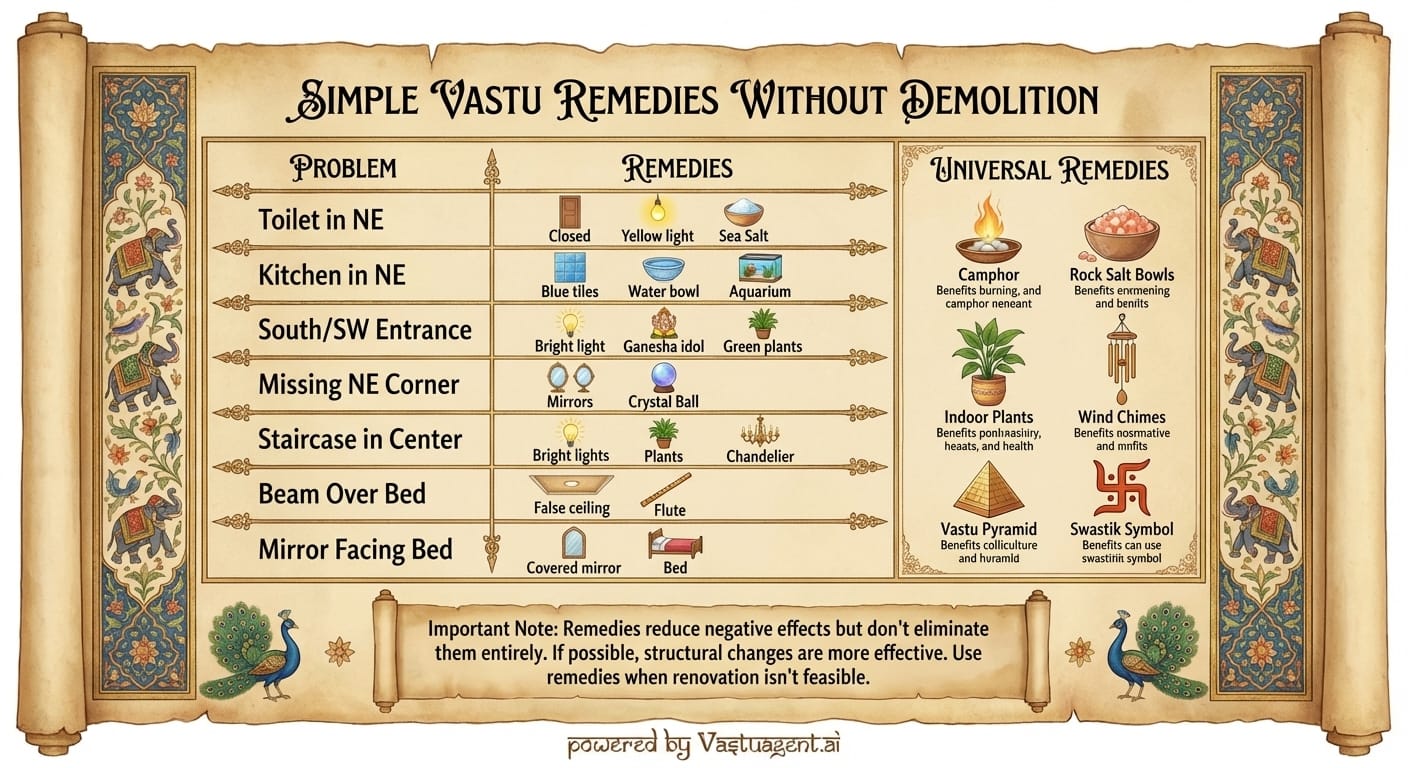
Modern Vastu emphasizes correcting defects without tearing down the building. Here are practical, non-structural remedies that can significantly improve your home's energy:
| Problem | Remedy | How It Works |
|---|---|---|
| Toilet in NE | Keep door closed, yellow light inside, sea salt bowl | Salt absorbs negative energy, yellow counters water excess |
| Kitchen in NE | Blue tiles/paint, bowl of water near stove, aquarium nearby | Adds water element to balance fire |
| South/SW Entrance | Bright lighting, Ganesha idol, green plants on either side | Light and deity energy counter negative entry |
| Missing NE Corner | Mirror on adjacent walls to "extend" space, crystal ball | Creates illusion of space, amplifies energy |
| Staircase in Center | Bright lights, plants underneath, crystal chandelier | Activates dormant energy |
| Beam Over Bed | False ceiling to cover, shift bed, or hang bamboo flutes | Deflects downward pressure |
| Mirror Facing Bed | Cover at night, or relocate to another wall | Prevents energy disturbance during sleep |
Universal Remedies
Camphor Burning: Daily in the evening—purifies air and energy throughout the home
Rock Salt Bowls: Place in corners of rooms—absorbs negativity and purifies the space
Indoor Plants: Especially in NE, E, N—adds life energy and improves air quality
Wind Chimes: In NW or W entrance—activates air element and attracts positive energy
Vastu Pyramid: In the center of home/room—balances all energies
Swastik Symbol: At main entrance—ancient protective symbol that wards off negative forces
Important Note: Remedies reduce negative effects but don't eliminate them entirely. If possible, structural changes aligned with Vastu are always more effective. Use remedies as a practical solution when renovation isn't feasible.
💡 Get PERSONALIZED remedies for YOUR specific Vastu defects! Our Detailed Vastu Report from VastuAgent.ai doesn't just identify problems—it provides room-by-room, defect-specific remedies you can apply TODAY. No demolition required! Get your report for free
12. How to Check Vastu of Your Home
To check the Vastu of your home, follow these systematic steps derived from classical texts:
Step-by-Step Vastu Assessment
Step 1 - Find True North: Use a magnetic compass (phone apps work well). Do not rely on the rising sun alone, as it shifts seasonally.
Step 2 - Stand at Center: Position yourself at the approximate center of your home with the compass.
Step 3 - Mark All 8 Directions: Draw or mentally note all cardinal and inter-cardinal directions on your floor plan.
Step 4 - Identify Room Zones: Map which rooms fall in which directional zones.
Step 5 - Check Entrance: Stand inside looking out. The main door should ideally be in the North, North-East, or East.
Step 6 - List Room Placements: Create a checklist comparing your room placements against ideal Vastu guidelines.
Step 7 - Identify Defects: Note any misalignments between actual and ideal placements.
Step 8 - Prioritize Corrections: Address Critical issues first, then High, then Medium severity defects.
DIY Vastu Scoring System
| Criteria | Points |
|---|---|
| Entrance in N/E/NE | +20 |
| Kitchen in SE | +15 |
| Master bedroom in SW | +15 |
| Toilet NOT in NE | +15 |
| Center is open (no pillars/toilets) | +10 |
| Pooja room in NE | +10 |
| No missing corners | +10 |
| Study in W/NE | +5 |
| Total | /100 |
Score Interpretation
80-100: Excellent Vastu compliance
60-79: Good, minor corrections needed
40-59: Average, significant remedies required
Below 40: Poor, consider major corrections or remedies
📱 Skip the manual work—let AI do it for you! Upload your floor plan to VastuAgent.ai and get an INSTANT Vastu score with our FREE tools. Or upgrade to a Detailed Vastu Report for a comprehensive 100-point analysis with room-by-room scores, defect identification, and personalized remedies!
13. Vastu Tips for Beginners: Quick Start Guide
Here are 20 practical Vastu tips that anyone can apply today, regardless of their home's current layout:
| # | Tip | Difficulty | Impact |
|---|---|---|---|
| 1 | Keep Northeast corner clean and clutter-free | Easy | High |
| 2 | Ensure main entrance is well-lit | Easy | High |
| 3 | Sleep with head towards South or East | Easy | High |
| 4 | Keep center of home (Brahmasthan) empty | Easy | High |
| 5 | Place water element (fountain/aquarium) in North | Medium | High |
| 6 | Cook facing East | Easy | Medium |
| 7 | Keep toilet lids closed | Easy | Medium |
| 8 | Remove dried/dead plants immediately | Easy | Medium |
| 9 | Fix leaky taps (water = money draining) | Medium | High |
| 10 | Place cash locker in North, opening to North | Easy | High |
| 11 | Avoid mirror opposite main entrance | Easy | Medium |
| 12 | Keep brooms hidden, not near entrance | Easy | Low |
| 13 | Display family photos on SW or W walls | Easy | Medium |
| 14 | Place Ganesha idol at entrance | Easy | Medium |
| 15 | Use light colors in NE rooms | Easy | Medium |
| 16 | Avoid storing items under bed | Easy | Medium |
| 17 | Keep dustbins covered and in W/NW | Easy | Low |
| 18 | Open NE windows first thing in morning | Easy | Medium |
| 19 | Avoid TV/electronics in bedroom | Easy | High |
| 20 | Burn camphor weekly to cleanse energy | Easy | Medium |
Beginner's 4-Week Priority Plan
Week 1: Declutter Northeast, fix any leaking taps or pipes
Week 2: Adjust bed direction (head South/East), organize and brighten entrance
Week 3: Arrange kitchen items properly, add indoor plants to appropriate zones
Week 4: Fine-tune other rooms, add remedies like salt bowls and wind chimes
🚀 Ready to go beyond tips and get a COMPLETE Vastu transformation plan? VastuAgent.ai offers THREE powerful tools:
✅ FREE Vastu Mandal Chakra — Visualize your home's energy zones instantly
✅ FREE Vastu Purusha Tool — See how cosmic energy flows through your floor plan
✅ Detailed Vastu Report — Comprehensive 100+ point analysis with personalized remedies
Start your Vastu journey at VastuAgent.ai today!
14. FAQs About Vastu Shastra
Q1: Is Vastu only for Hindus?
A: No. Vastu is a secular, universal science based on the sun, earth, and elements. It applies to all human beings regardless of caste, religion, or creed—just as gravity applies to everyone. The principles work based on natural laws, not religious beliefs.
Q2: Can I apply Vastu to a rented house?
A: Absolutely! The principles apply to the occupant, not just the owner. Simple remedies like furniture placement, sleeping direction, colors, plants, and removable items can be used effectively in rented spaces. You can achieve 60-70% compliance without any structural changes.
Q3: Can Vastu change my destiny?
A: Vastu deals with "human effort" (Purushartha) and environment. While it cannot fully override destiny (Karma), it can make "sweet things sweeter and bitter things less bitter." It removes environmental obstacles, allowing you to achieve your full potential by creating a supportive living environment.
Q4: Is a South-facing house always bad?
A: No, this is a common myth. South-facing houses can be excellent and prosperous if the main entrance is placed in the correct "Pada" (grid section) such as the 4th pad (Grihakshat) or Gandharva position. Many successful people live in well-designed South-facing homes. It depends on the specific door location, not just the overall orientation.
Q5: What is the most important Vastu rule?
A: The North-East must be kept light, open, and clean (ideal for water and prayer), and the South-West must be heavy, closed, and high (for stability and Earth element). This fundamental balance—maintaining the "Life Diagonal" from NE to SW—is the cornerstone of all Vastu principles.
Q6: Does Vastu really work?
A: Millions of practitioners report positive effects. While difficult to prove scientifically in a controlled setting, Vastu's focus on light, ventilation, organization, and spatial harmony has documented psychological and physiological benefits. Many principles align with modern architecture and environmental psychology.
Q7: Which direction should we sleep?
A: South or East. Sleeping with your head towards South aligns with Earth's magnetic field for better rest. East promotes spiritual growth and clarity. Avoid sleeping with head towards North (causes magnetic repulsion) and West (may cause disturbed sleep and restlessness).
Q8: Can Vastu defects be corrected without breaking walls?
A: Yes, many defects can be effectively mitigated using remedies like mirrors, colors, plants, symbols, crystals, metals, and rearranging furniture. However, structural alignment is always more powerful. Remedies provide practical solutions when renovation isn't possible.
Q9: What is Brahmasthan?
A: Brahmasthan is the central zone of any building, representing the heart of Vastu Purusha and the dwelling of Lord Brahma. It should be kept open, clean, and free of pillars, toilets, staircases, or heavy objects. This area allows energy to circulate freely throughout the structure.
Q10: Vastu vs Feng Shui—which is better?
A: Neither is objectively "better"—they're different complementary systems from different cultures. Vastu is structure-focused (Indian origin, emphasizes permanent construction), while Feng Shui is arrangement-focused (Chinese origin, emphasizes movable objects and energy flow). Many modern practitioners successfully combine both approaches for optimal results.
Conclusion: Beginning Your Vastu Journey
Vastu Shastra offers a time-tested framework for creating living spaces that support health, wealth, happiness, and spiritual growth. While the ancient texts may seem complex, the core principles are surprisingly practical: maximize natural light and ventilation, organize spaces thoughtfully, align with natural forces, and create environments that feel balanced and harmonious.
Whether you're building a new home or seeking to improve your current space, even small Vastu adjustments can create noticeable positive shifts in your life. Start with the basics—declutter the Northeast, ensure proper sleeping direction, and brighten your entrance. From there, gradually address more significant alignments as your understanding deepens.
Remember that Vastu is not about superstition or fear—it's about understanding and working with the natural forces that surround us. Approach it with an open mind, apply the principles practically, and observe the results in your own life. The 5,000-year track record of this ancient science suggests there's profound wisdom waiting to be discovered.
May your home become a sanctuary of peace, prosperity, and positive energy. Welcome to the transformative world of Vastu Shastra.
🏡 Ready to Transform Your Home's Energy?
You've learned the ancient wisdom—now apply it to YOUR space with VastuAgent.ai!
🔮 FREE Vastu Mandal Chakra Tool — Instantly visualize your home's 16 energy zones
🕉️ FREE Vastu Purusha Visualization — See how cosmic energy flows through your floor plan
📊 Detailed Vastu Report (Free for now) — Complete 100+ point analysis with:
- Room-by-room Vastu scores
- All defects identified with severity ratings
- Personalized remedies (no demolition needed!)
- Priority action plan for maximum results
Traditional Vastu consultations cost $500-$10,000. Get the same insights for free, limited time only.
👉 Visit VastuAgent.ai and start your Vastu transformation today!
About VastuAgent.ai: We're democratizing ancient architectural wisdom through artificial intelligence. Our platform provides comprehensive Vastu analysis at a fraction of traditional consultation costs—making the 5,000-year-old science of harmonious living accessible to everyone. Try our FREE tools today at vastuagent.ai.